|
Every author deserves to work with an editor who’s a great fit for their book.
Commissioning editorial help means investing your money and your trust in someone you might never have met. It’s therefore critical that you choose the right editor. Below are 7 reasons why I won’t be a good fit for you. 1. You’ve written an academic or non-fiction book
Fiction and non-fiction are different. Yes, there are conventions when it comes to spelling choice and grammar, but fiction often requires a nuanced approach that respects not just authorial style but character voice and environment too.
Specialist fiction editors deal with issues that a specialist academic editor won’t. For example:
And academic editors regularly tackle issues that fiction editors don’t. For example:
But there’s something else. Fiction editors need not only to allow non-standard variants in grammar, punctuation and syntax, but embrace them. Why? Because that’s where the magic can happen. I’m a specialist fiction editor. You don’t want me in charge of ensuring the references in your article on cross-generational sexualities, life course and ageing are formatted according to Harvard. Hire an academic editor instead. However, if you struggle with point of view, or worry your chapters lack suspense, I can help.
Need help understanding grammar and punctuation in fiction?
I have a library of resources dedicated to helping fiction writers get to grips with different aspects of sentence mastery. Find out more about the following: 2. I don’t work on your novel’s genre
Some fiction editors work across genres, which is absolutely fine. I choose to specialise in crime fiction, mysteries, thrillers and suspense.
Despite genre tropes – recurring themes that readers enjoy and expect – there’s no formula to writing great fiction, which means there’s no formula when it comes to editing these books either. For example, character voice, story arc, plot, and authorial style are just four reasons why Ian Rankin offers a different reading experience to Harlan Coben, and why both those writers’ novels have a different feel to them from Margaret Atwood’s books. So why am I picky about genre? It’s simple. I have a fixed number of hours every weekday to devote to my job. I want to love every minute of working with an author. And so just as I choose to drink black tea because that’s how I like it, so I choose to specialize in crime, mysteries, thrillers and suspense. If you’ve written literary fiction, romance, young adult, erotica or historical fiction, I recommend you work with an editor who loves to edit those genres. That way, you can be sure they’re invested in your book in the same way I’m invested in everything from the cosy whodunit, to the hardboiled police prodedural, to the high-octane thriller. Of course, many novels are hybrids, for example:
I welcome the opportunity to work on hybrids because they still tick my suspense and thrill boxes!
Need help deciding whether to work with a subject/genre specialist?
For an overview of just some of the subgenres in the crime and thriller field, read: Crime fiction subgenres: Where does your novel fit? And if you need more guidance on working with a specialist, try a few episodes from The Editing Podcast’s Genre and Subject Editing Collection below. 3. You need help with plot and story structure
If you’re committed to getting your novel’s structure right before you do anything else, I commend you.
You clearly understand that there are different levels of editing, all of which serve a different purpose, and that big-picture work around plot and structure comes first. I’m a specialist sentence-level editor, which means I come in after that big-picture work’s complete. Line work focuses on the mood, rhythm and readability of your narrative and dialogue. It ensures your readers are captivated and love every minute they spend on the page with you rather than flicking to the end to find out whodunit. Editors like me focus on the following:
Need more help understanding the different levels of editing?
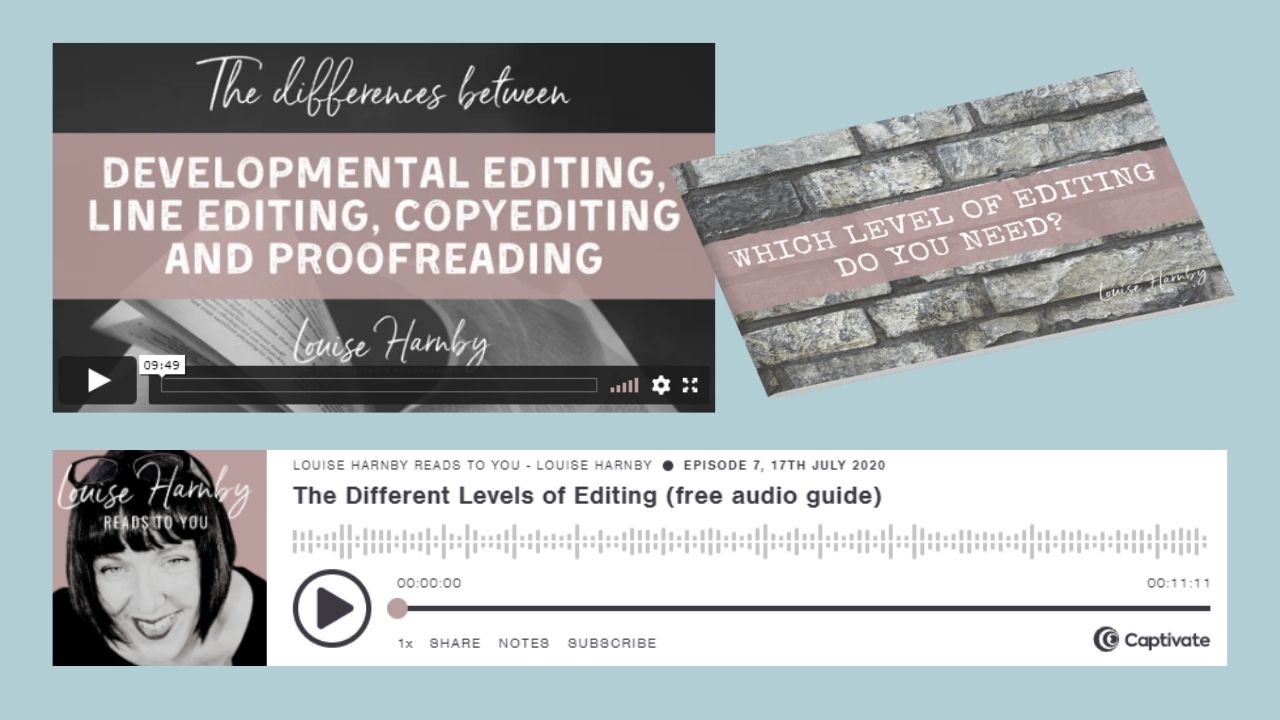
If you’re unfamiliar with the different levels of editing, watch this video, listen to the audio, and download the accompanying free booklet. 4. You need the work done next week
Many professional editors get booked up fast and months in advance.
I recommend you start researching who you want to work with before you’ve finished writing so you know what their availability is. That way you won’t be disappointed. I'm usually booked nine to twelve months ahead, so unless a client cancels I won’t be available to help you next week. Bear in mind, too, how much time the novel edit will take. Two factors are length and complexity. These are ballpark figures, but I set aside the following for the types of editing I offer:
Developmental work might take an editor even longer depending on how much help a writer needs. If you’re working with several editors at different stages, you’ll need to build time into the overall schedule to review their work and implement their suggestions.
Want to understand more about how fast editors work?
For an overview of the factors that influence how fast an editor can work on a manuscript, listen to this episode of The Editing Podcast: How long does editing take? 5. You need a cheap editor
Every author has a budget based on what they’re prepared to pay and able to pay. Every editor has a budget based on what they want to earn and need to earn to make a living.
Sometimes there’s a good fit; sometimes there isn’t. Many editors (me included) don’t publish prices on their websites because each project needs to be assessed on its own merits. And so while I can’t tell you what it will cost to have your novel edited without seeing a sample, I can tell you that if it’s 80K words long, it’ll cost you way more than a couple of hundred quid. My line-editing speed is around 1,000 words per hour depending on the complexity of the work. That's why I said above that line editing a novel can take between 2 and 5 weeks. Now stack that up against what any working person needs to earn to feed themselves, pay their rent/mortgage, and meet their taxation and insurance responsibilities every month. The question is this: will someone who's willing to edit 80K words for £250 invest 80 hours on the project? If their average speed is similar to mine, they'll earn £3.13 an hour. That's not sustainable, which means corners have to be cut somewhere along the line. Unless editing is just a hobby and someone else is paying the bills. This isn't a hobby for me and I pay my share of family expenses, so if you're looking for a bargain, I'm not the right editor for you. Instead, try one of the marketplaces that specialize in freelance services at every price point.
Need more guidance on how to save money on editing?
If budget’s an issue, read about money-saving tips and tools in these two blog posts: 6. You want absolute perfection
I’d love to tell you I’m perfect but, alas, I’m only human.
Most professional editors take pride in ensuring that they’re highly qualified. And even when we’ve completed our foundational training, we continue developing our skills throughout our careers. Some of us are members of industry recognized bodies with professional codes of practice. For example, I’m an Advanced Professional Member of the Chartered Institute of Editing and Proofreading. That means I’m professionally bound to do my very best for you. What it doesn’t mean is that I can make your book 'perfect'. That's because there's no such thing. Stylistic editing is subjective, and when it comes to fiction, there’s always room to bend the standard so-called rules of grammar and punctuation because it’s in the prose’s best interest. A pro fiction editor can work with you to make your narrative and dialogue pop. Will a pedantic Amazon reviewer who knows nothing about literary devices agree with the decision to omit a comma in favour of polysyndentic rhythm? Possibly not. That doesn’t mean your editor made a mistake. It means fiction editors seek to balance sense and sensibility. If you're looking for an editor who's practically perfect in every way, ask Mary Poppins if she's available!
Still not sure about how ‘perfect’ a qualified editor should be?
Most editors include their professional credentials on their website so you can review and verify their professional training, affiliations and teaching materials. Take a look at my Qualifications page as an example. 7. Your best friend read your book so it just needs a quick proofread
If you best friend (or your mum or granny) has read your novel and thinks it’s ready for a final once-over, they might well be right … if your best friend (or your mum or granny) is a pro editor.
Your book will also be ready for a proofreader if it’s been through previous multiple rounds of editing – structural, line- and copyediting. And if you’re very lucky, or very experienced, or very brilliant, you might have nailed everything yourself and be on track for a final round of prepublication quality control. What you still won’t be ready for is a quick proofread. There’s no such thing as a quick proofread. Proofreading is meticulous work that focuses on every word, every sentence, every paragraph. It incorporates layout and consistency checks too. It’s the last stage of editing but not a fast stage of editing. Most editors can proofread faster than they can line- or copyedit, but I don’t know any who can whizz through a whole book in a couple of hours and be confident that they’ve caught most of what needs catching to a professional standard. And so if you’re looking for fast, I recommend you consider the following:
Both types of review will also give you a sense of how the editor works.
Want to know more about proofreading and sample edits?
To find out more about sample edits, and why they’re useful, read this blog post: What's a sample edit? Who does it help? And is it free? To find out more about what proofreading entails, and get your hands on a free checklist for use with print books, check out the following:
Wrapping up
There's a teacup for every saucer according to my podcasting pal Denise Cowle's auntie! She's right.
Sometimes a writer and an editor are a great fit; sometimes we're not. That's not a problem because there are thousands of writers and thousands of editors. Make sure you're working with one who's a great match for you. About Louise Harnby
Louise Harnby is a line editor, copyeditor and proofreader who specializes in working with crime, mystery, suspense and thriller writers.
She is an Advanced Professional Member of the Chartered Institute of Editing and Proofreading (CIEP) and co-hosts The Editing Podcast.
7 Comments
In this episode of The Editing Podcast, Louise Harnby and Denise Cowle talk to Rich Leder about writing screenplays and novels. Rich has worked with some of the biggest names in the movie industry. He shares what he's learned about Hollywood, TV and novel craft.
Listen to Episode 65Listen to find out more about
About Rich Leder
Rich has been a working writer for more than three decades. His credits include 19 produced movies—television films for CBS, Lifetime, and Hallmark and feature films for Lionsgate, Paramount Pictures, Tri-Star Pictures, Longridge Productions, and Left Bank Films—and six novels for Laugh Riot Press.
He’s been the lead singer in a Detroit rock band, a restaurateur, a Little League coach, an indie film director, a literacy tutor, a magazine editor, a screenwriting coach, a wedding guru, a PTA board member, a commercial real estate agent, and a visiting artist for the UNCW Film Studies Department, among other things, all of which, it turns out, was grist for the mill. He resides on the North Carolina coast with his awesome wife, Lulu, and is sustained by the visits home of their three fabulous children. Music credit
'Vivacity’ by Kevin MacLeod
|
BLOG ALERTS
Sign up for blog alerts!
NEWSLETTER
Sign up for The Editorial Letter.
EDITOR RESOURCES
BOOKS FOR EDITORS AND WRITERS
TRAINING COURSES FOR EDITORS
TESTIMONIALS
'I love the clean impact you've brought to my writing'
Thomas R Weaver 'The voyage through your edits is an intellectual and craft adventure' Dan Flanigan 'I'm a better writer because you edited my book' Rich Leder 'You are by far the best literary editor I've had' Nina Fitzpatrick 'I wholeheartedly recommend her services ... Just don’t hire her when I need her' Jeff Carson 'Sincere thanks for a beautiful and elegant piece of work. First class' JB Turner CATEGORIES
All
ARCHIVES
April 2026
|
|
|