
|
If you’re struggling to decide what to call your new editing or proofreading business, here’s a 6-step framework to set you on the right path.
Deciding what to call your editing or proofreading business is part of the BRANDING process and needs careful consideration. Follow these steps to work out what’s right for you.
Step 1: Brainstorm a list of possible business names Let your imagination fly. Put your silly hat on. Then your serious one. Then your smarty-pants one. Anything goes at this point. This is all about you and what floats your boat. There’s no wrong or right – just ideas. For demonstration, let’s imagine a new proofreader called Basil Rhoueny. Basil is trying to decide on a business name and comes up with the following ideas: 1. Basil Rhoueny | Academic Proofreading Services 2. Basil Rhoueny Editorial 3. Bulletproof Editorial 4. Comma Sutra 5. Full-proof Editorial Services 6. Norfolk Editorial 7. Perfect Prose 8. Responsible Editing 
Step 2: Identify target clients
The next step is for Basil to identify his target clients. If he doesn’t know who he wants to work for, he can’t create a message that compels them – via his business name, his mission statement, his elevator pitch, his web copy, or any other marketing materials. And if he doesn’t have a compelling message, why would anyone choose him over any one of the tens of thousands of colleagues who are also offer editing services? ‘I’ll edit and proofread anything for anyone’ isn’t a standout proposition. Basil needs to do better. Even if an editor is prepared to be something of a generalist, I recommend talking like a specialist when communicating with different client groups. On our websites, that means giving visitors signals so that they can navigate to specialist messaging on different pages that focus on solving group-specific problems. Some people know who they want to work for right from the get-go. Some have no clue. Some think they do, but seven years ahead find that they’ve completely shifted their client base. We’ll deal with that issue in Step 6. For now, let’s imagine that Basil thinks his editorial training, educational background and former career make him best suited to the following client groups:
Identifying these groups will help him with Steps 3 and 4. 
Step 3: Identify core brand values
A brand can be loosely defined as what others think about us – external perceptions. A brand identity is the distinctive business persona we present that nudges target clients to notice the things that we want them to notice. It’s what allows us to influence those external perceptions. Brand values are the essence of our brand identity. They represent the kind of editorial pro we want to be seen as – the things we stand for, what we’re passionate about, what makes us tick, why we’re different. Our business name, photographs, colour palette, web copy and marketing materials should reflect our brand values so that the clients we’d most love to work with will most love to work with us. It’s no small thing to develop a brand identity. If you need help, I have an online course called Branding for Business Growth that can help you develop an emotion-based business brand identity. Let’s imagine that Basil has identified the following brand values that he wishes to convey at every touchpoint of his business:
Identifying these brand values will help him with Step 5. 
Step 4: Serving the client
In this step, Basil revisits his list of business-name ideas and considers whether they’re appropriate for his target client groups: academic publishers, students and independent academics. 1. Basil Rhoueny | Academic Proofreading Services 2. Basil Rhoueny Editorial 3. Bulletproof Editorial 4. Comma Sutra 5. Full-proof Editorial Services 6. Norfolk Editorial 7. Perfect Prose 8. Responsible Editing He asks himself the following questions:
Names (1) , (2) and (8) best reflect exactly what he’s offering. Names (3), (5) and (6) are next in line, though they’re less specific. Name (4) alludes to sentence-level editing work, and some will think it amusing. However, Basil wonders whether some of his non-fluent English-speaking clients will get the joke and bypass him. Name (5) is a problem – there’s an existing established business called Full Proof | Professional Proofreading Solutions. Names (4) and (7) give him cause for concern regarding their searchability. It’s likely that the words ‘proofreading’ or ‘editing’ or ‘editorial’ will be searched for by potential clients. It’s far less likely that someone will search for ‘comma sutra’ or ‘perfect prose’ if they need proofreading assistance, though they are distinctive. Name (6), however, might be great for being found in the search engines by local clients. Basil decides to remove Comma Sutra, Full-proof Editorial Services, and Perfect Prose from the list of contenders. Now he turns to the branding issue. 
Step 5: Serving the brand
In this step, Basil revisits his list of business-name ideas and considers whether they’re good brand practice. His remaining names are: 1. Basil Rhoueny | Academic Proofreading Services 2. Basil Rhoueny Editorial 3. Bulletproof Editorial 6. Norfolk Editorial 8. Responsible Editing He asks himself the following questions:
Basil has an unusual name. If he’d been called John Smith, he might have been easy to confuse with other editors called John Smith, at least in the West. However, either of his remaining business names would work. There is, however, a good chance that his name might be misspelled. Is this something he needs to worry about if people are searching for him by name? This could be an issue if he’s referring someone to his website by phone, or if a word-of-mouth lead is trying to find him. Here’s a test. Type ‘louise harby editor’ or ‘louis hornby proofreader’ into the search engines. Can you find me? I can find me! I’m not convinced that tricky-to-spell names are as problematic as we might think. Back to Basil. Name (3) is at odds with the sentiment of BV-Green Editor. This brand value seeks to nudge potential clients towards thinking of Basil as compassionate, respectful, broad-minded, ethical, warm … someone who can see the bigger picture. The word ‘bullet’ might bring to mind thoughts of violence, death, harm and brutality. It’s potentially a negative nudge rather than one that evokes positivity. Name (6), while potentially clickbaity for local searches, doesn’t sit so well with BV-Globalist. Basil would be happy to work with local clients, but he’s not sure he can build a sustainable business on this alone. Name (8) has a definite though subtle nod to BV-Green Editor. He elects to remove Bulletproof Editorial and Norfolk Editorial from the list of contenders.
Step 6: Think ahead but don’t get bogged down
Can any of us be absolutely sure that what we want to do now is what we will want to do in the years ahead? Choosing a business name requires us to think ahead, but also to be true to who we are and what we’re offering in the present time. In case you didn’t spot it, Basil’s name is an anagram of mine. When I set up my business in 2005, I was a dedicated proofreader who specialized in working for social-science publishers. If you’d told me back then that by 2016 I’d be specializing in line- and copyediting for indie fiction authors, I’d have been a tad surprised. But that’s exactly what happened. My original business name was Louise Harnby | Proofreader. My URL was and still is: www.louiseharnbyproofreader.com. My business name now is Louise Harnby | Proofreader & Copyeditor. It wasn’t actually a big deal to add an ampersand and the word ‘copyeditor’ into my business name and didn’t affect my findability in the search engines. Would it have if I’d changed it to Louise Harnby | Fiction Editor, or Fabulous Fiction Editing, or something else? Possibly, but Google Search is a tricky beast to master and shifts the goalposts often in a bid to thwart those who’d use black-hat SEO techniques rather than genuine attempts to be interesting and discoverable online. Basil is left with choosing between the following:
There are good arguments for the SEO-friendliness of the first two, and the flexibility of the third. My view is that any would work because they are true to his business’s brand identity in different ways.
What’s right for you?
Basil’s brand identity and your brand identity will not be the same because you and Basil are individuals, each with your own businesses, ideal clients, goals, hopes, dreams and passions. The decisions you make will therefore be different to the one Basil makes. That’s fine. Will there be a perfect solution? Unlikely. There will be choices to be made.
What’s important is that you choose a business name that you feel comfortable with: one that reflects your brand identity and nudges your ideal clients towards an awareness of the kind of editor you are and why you’ll be a great fit with them; one that alludes to what you do. Here are just a few of my favourites:
It’s likely your choice will not be clear cut. Try not to get bogged down by that. Business names alone will not make you visible or discoverable. The compromises you make can be offset by other business-promotion activities that strengthen your online presence. Happy naming!
Louise Harnby is a line editor, copyeditor and proofreader who specializes in working with crime, mystery, suspense and thriller writers.
She is an Advanced Professional Member of the Chartered Institute of Editing and Proofreading (CIEP), a member of ACES, a Partner Member of The Alliance of Independent Authors (ALLi), and co-hosts The Editing Podcast. Visit her business website at Louise Harnby | Fiction Editor & Proofreader, say hello on Twitter at @LouiseHarnby, connect via Facebook and LinkedIn, and check out her books and courses.
3 Comments
This free booklet offers one example of how an editor or proofreader might approach testing which pricing model works best for their editing and proofreading business.
I discuss how and why I collect data, and the macro and micro insights I've gained that have helped me to grow my editorial income stream.
Hope you find it useful! Visit the Money Matters page in my resource library to download this free booklet. More resources
Louise Harnby is a line editor, copyeditor and proofreader who specializes in working with crime, mystery, suspense and thriller writers.
She is an Advanced Professional Member of the Chartered Institute of Editing and Proofreading (CIEP), a member of ACES, a Partner Member of The Alliance of Independent Authors (ALLi), and co-hosts The Editing Podcast. FIND OUT MORE > Get in touch: Louise Harnby | Fiction Editor & Proofreader > Connect: Twitter at @LouiseHarnby, Facebook and LinkedIn > Learn: Books and courses > Discover: Resources for authors and editors
Does standing up in front of a room full of editors terrify you? I know that feeling. Still, I learned how to love it, which rather took me by surprise. In this post I show you how I did it.
Let’s talk about nerves
I haven’t conquered my nerves about speaking at editing conferences, but that’s okay. Nerves are normal, even for presentations experts like my friend Simon Raybould. More on him later, but for now it’s enough to say that feeling nervous is not the same as suffering from a level of anxiety that renders you unable to step out of your comfort zone and try something that could push your editing business forward. Pushing your business forward Speaking at editing conferences will push your business forward. You’ll get yourself seen and heard. People will understand more about who you are, what you specialize in, and what you stand for (your brand). That will lead to opportunities: work referrals, awareness about courses or books that you offer, discounts on the conference registration price (even payment for some gigs), and invitations to speak at other conferences taking place in cities that require a little more effort to get to. Take me. I live in Norfolk (the UK one). On 7 November, I’ll be speaking at the Society for Editors and Proofreader’s mini-conference in Toronto (register here if you want to join me – it’s now open to non-SfEP members). It’s a massive honour to be invited. I get to talk about my two editorial passions – fiction and marketing! In 2016, I’d probably have shied away from doing this, despite the opportunity to hang out with my favourite Canadians (and a few of my favourite Americans). The words ‘I’m busy’ would have flown from my mouth just in time to curb the nausea. In 2017, I might have agreed to do it as long as I was sharing the spotlight with a pal, though the thought would still have made me queasy. But it’s 2018 and, to my surprise, I’m more than happy to fly solo. 
One way to learn to love it
Loathing turned to love because I changed one thing: I dumped the script. This is where I get to talk about Simon again, because he’s the person responsible for making me love speaking at editing conferences. In May 2018, he wrote a blog post for me called 6 tips to help you speak in public with confidence. Tip 4 asks us not to use a script. I was gobsmacked. There was no way in hell I’d dare stand up in front of a group of my peers without having every word of my presentation memorized! We had a long chat about it over Skype, and by the end of that conversation he’d convinced me it was worth testing. And so when the SfEP’s conference director, Beth Hamer, asked me to do a two-hour session, on my own, at the annual conference in Lancaster, I promised her I would. And I promised myself I’d do it without a script. 3 snags with scripts Scripts are inherently problematic. Snag 1: They take time to learn, especially if you’re going to be talking for an hour. Unless you have a brilliant memory. Which I don’t. Snag 2: They’re hard to remember. If they were easy to remember, more of us would be on the stage. Which I’m not. Snag 3: They’re difficult to deliver well. If they were easy to deliver well, more of us would have Oscars and BAFTAs. Which I don’t. No wonder so many of us cringe at the thought of speaking at editing conferences. Even if we manage to learn the damn script, what are the chances that we’ll remember it, given how nervous we are? And if we’re uptight about remembering, what are the chances that we’re going to deliver our script in a way that’s engaging and informative? This is the kind of stuff that’s always been in my head when I think about presenting. All of which can be summed up as follows: at what point will I fail? Going scriptless You can’t fluff a script that doesn’t exist. That in itself gets rid of snags (1) and (2). All you can do is talk about the thing you’ve agreed to talk about. We’re not in the pub or having lunch with our mates, so we still need a structure. I am not a perfect presenter, not by any stretch. But I have embraced an approach that means I will present, and I will enjoy it. This is how I do it:
Because you’re talking rather than delivering a script, you’ll sound more natural. And because you can’t forget any of the key learning points, you’ll feel more relaxed. That’s snag (3) dealt with. There are caveats, of course. You must know your stuff. And you should rehearse. Each rehearsal will be different because you don’t have a script, but you will prove to yourself that you can talk through every one of the key learning points. 
Being imperfect – audience expectations
Will you stumble if you’re scriptless? Maybe. Probably. I stumbled several times in Lancaster. But I loved every minute of that workshop. I felt relaxed, and as I talked I was in the moment, not tuned into the next thing I needed to remember. And the delegates gave me some amazing feedback. That they enjoyed it is the most important thing of all. I’m sold on scriptlessness! Plus, having a script doesn’t mean you won’t stumble. You’re human, after all. The difference is that when you’re scriptless, you get to stumble just because you stumbled, not because you forgot anything important or because you were distracted by the pressure of having to remember what’s up next. Here’s something Simon told me during our Skype chat: Your audience will forgive you if you trip up over a word. Your audience will forgive you if you stammer. Your audience will forgive you if you fluff a line and have to restart the sentence and explain something in a different way. Your audience will forgive you for just being an editor rather than a TED Talk speaker. What your audience will not forgive is your failing to deliver the key learning points that you promised you would ... for wasting their time. At the larger editing conferences, delegates have to choose which sessions to attend. So I know that when someone chooses to come to mine, they’re probably missing at least two workshops they’d have learned something valuable from. That I don’t teach them what I promised is unacceptable. And that is the only way I can fail. When will I see you again? If you can get to Toronto on 7 November 2018, please come and listen to me talking about how to build a knockout home page, getting fiction editing work, and marketing an editing business. Will I fluff my words? More than likely. Will I fail? No. I’ve already created slides for my key learning points and rehearsed what I’ll chat about. I might well stumble and stammer, but I will smile at you as I do so, and I will deliver what I've promised!
Louise Harnby is a line editor, copyeditor and proofreader who specializes in working with crime, mystery, suspense and thriller writers.
She is an Advanced Professional Member of the Chartered Institute of Editing and Proofreading (CIEP), a member of ACES, a Partner Member of The Alliance of Independent Authors (ALLi), and co-hosts The Editing Podcast. FIND OUT MORE > Get in touch: Louise Harnby | Fiction Editor & Proofreader > Connect: Twitter at @LouiseHarnby, Facebook and LinkedIn > Learn: Books and courses > Discover: Resources for authors and editors
Every professional editor and proofreader wants to attract best-fit clients who are prepared to commit to a contract of editorial services. For the most part, bookings go smoothly – cancellations, delays, and failures to pay are unusual. Still, editorial business owners need to protect themselves ... just in case.
This article doesn’t seek to offer you a model contract or set of terms and conditions (T&Cs), though you’re welcome to look at mine for inspiration: Terms and conditions.
Instead, I want to explore some ideas about how to develop your spidey sense, and use language and tools that will repel those who’d let you down. What does ‘delay’ mean to you? The concept of the delay is nonsense to an editorial business owner. If a client asks you to proofread a book, tells you the proofs will arrive with you on 10 May, and requests return of the marked-up proofs a week later, and you agree to take on the job, those are the terms: proofread to start 10 May; delivery 7 days later. You’ll schedule the project accordingly, and will decline to work for anyone else from 10–17 May. If two weeks ahead of the start date you’re told ‘there’ll be a delay’, you’ll likely have no work for 10–17 May unless you can fill that space at the last minute. Moreover, you will be booked for another project during the period when the project will become available. To my mind, that’s not a delay. You can’t magic additional hours out of thin air. That’s a cancellation of the project terms that were agreed to by both parties. 
Make sure your T&Cs reflect this. Don’t use the language of delay if it means nothing to you. Have a cancellation policy and make it clear that confirmed bookings are for an agreed time frame, and that failure to meet the agreed date will invoke that cancellation policy.
You might decide not to invoke it as a courtesy, but having it could reduce the likelihood of having to make the decision. Is ‘deposit’ a strong enough term? The word ‘deposit’ should be strong enough as long as the refund terms are clear. Still, you might want to couch your language along the lines of what editor and book coach Lisa Poisso calls ‘real money’. I don’t refer to deposits in my terms and conditions. I call them booking fees. A fee is a payment. It’s the language of money. ‘Deposit’ as a noun has a broader mass-of-material meaning; as a verb it means to place something somewhere. Maybe, for some people, it has a softer feel to it. 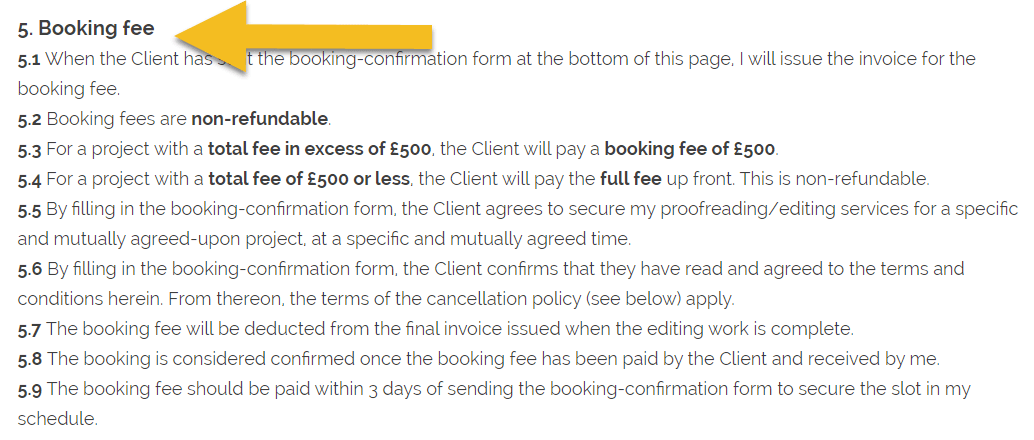
Of course, anyone required to pay a deposit knows full well that the financial definition is being referred to. Nevertheless, using the language of money – a fee – might well encourage time-wasters to think twice.
The following might also work for you:
What you charge upfront is up to you. Some editors charge a 50% booking fee rather than a flat rate. Some require one third to secure the booking, another third just before editing starts, and the remaining third upon completion of the project. You can define your own model. Do you have a booking form? You and a client can agree to your providing editorial services via email, and emails count contractually. But how about requiring a specific additional action, one that reinforces a sense of commitment? Asking someone to fill in a booking form that confirms they have read, understood and agreed to your terms and conditions, including your booking fee and your cancellation policy, means they have to make a proactive decision to commit. When it comes to filling in a form and ticking boxes, a non-committed client is less likely to feel comfortable than a good-fit one because it feels more formal. You can create a PDF booking form that you’ll email manually, or create the form on your website. My choice is the latter. I include it below my T&Cs. That way, the booking and the terms are closely linked. Here’s a screenshot of mine. Notice the boxes that must be checked in order to confirm the booking. 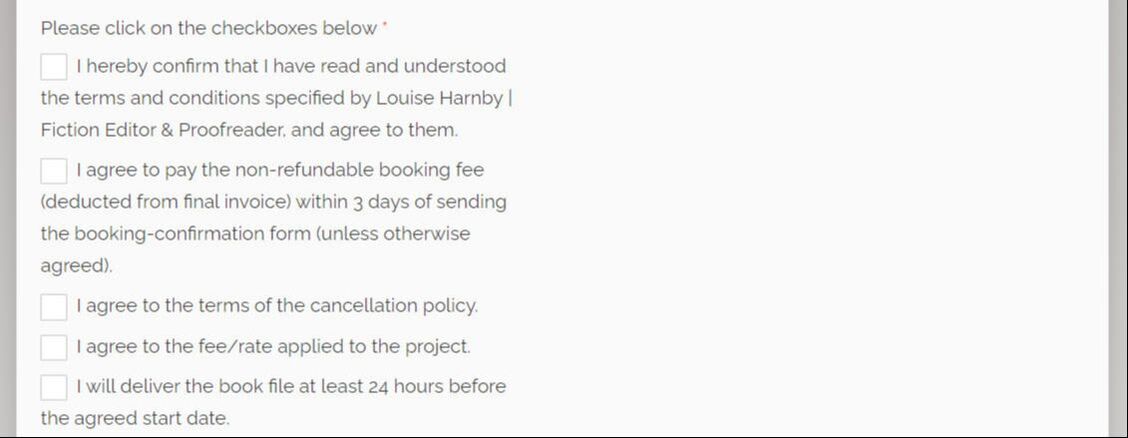
Is ‘booking form’ a strong enough term?
Even if someone is prepared to fill in a form and check some boxes, agreeing to a contract might make them think twice. That has a more legally binding feel about it; it’s more formal. And it might be the thing that repels someone who’s going to let you down. My T&Cs state that the booking-confirmation form is an agreement to the contract of services between me and the client, and the phrase ‘Contract of services agreement’ in the heading is what appears when they click on the booking-confirmation form button. 
Are your terms and conditions detailed enough?
In the main, your website should be client-focused. It should make the client feel that you understand their problems, are able to deliver solutions, and understand what the impact of your solutions will be. Your brand voice should sing out loud. In my case, for example, that means using a gentle, nurturing tone. However, when it comes to your terms and conditions, forget all the touchy-feely stuff – this is where you and the client get down to business. It’s in everyone’s interests to know what’s what. That might mean that your T&Cs are rather dull and boring. No matter. It’s the one place on your website where you’re allowed to be dull and boring! I feel like chewing my own arm off when I read my T&Cs but I don’t want any of my clients in doubt about what I’m offering and what they’re getting. Think about the following:
A non-committed client will be repelled if your terms put them at risk. A good-fit client will feel reassured that they’re dealing with a fellow professional who takes the editing work as seriously as they do. Are the basics front and centre? Many editors place links to the detailed contractual stuff in their website’s footer, which means the T&Cs are almost invisible. Even a good-fit client probably won’t see or read your T&Cs during their initial search for editorial services. That’s the case on my website. If it’s the same for you, consider placing the basics front and centre. I’ve created a box on my contact page that spells out the non-refundable booking fee I charge. 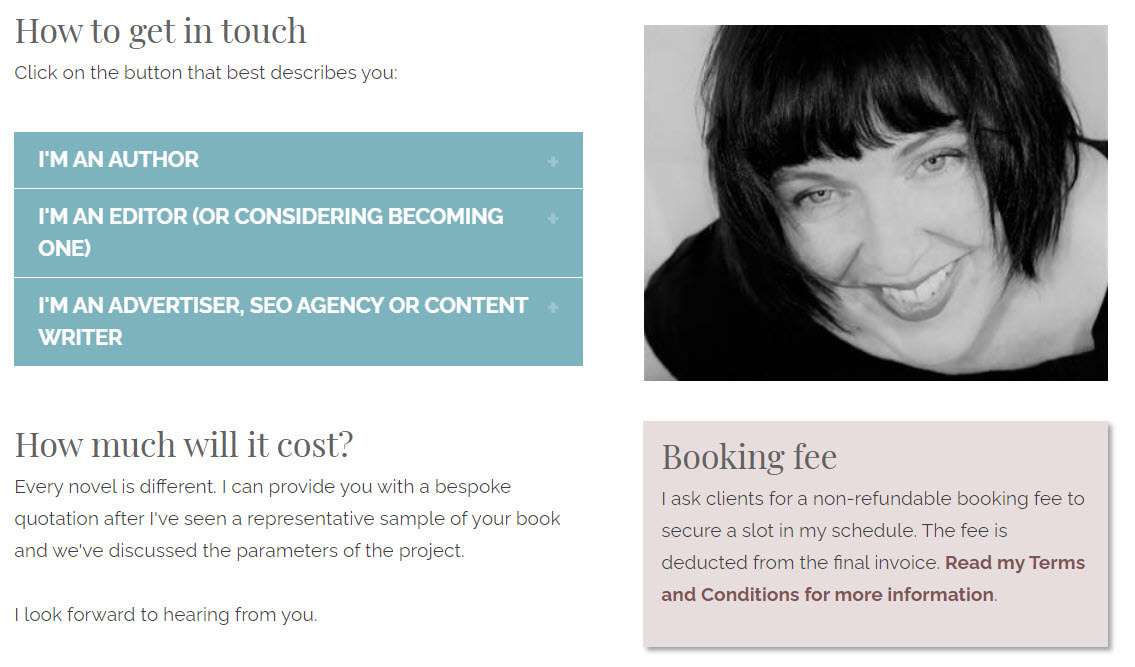
Will it put off some potential clients? Absolutely. But if someone can’t afford that booking fee or doesn’t dare take the risk of making a payment because they’re unsure whether they’ll honour the contract, they’re not the right client for me.
Spotting red flags Developing your spidey sense can reduce the likelihood of becoming entangled with those who’ll back out of confirmed bookings or fail to pay. 
Though there’s no foolproof way to protect yourself from non-committed clients, there are red flags you can look out for:
Summing up I hope these tips help you avoid non-committed clients and safeguard your business. Even if you implement some of my ideas, there are no guarantees unless you ask for 100% of your fee upfront. However, rest assured that most clients are honest, committed and trustworthy individuals who are a pleasure to work with. As for those who blow you out, a few are scoundrels. Others aren’t but are thoughtless and haven’t taken the time to understand the emotional and financial impact of cancellations and non-payment. Others have got cold feet. And some have been struck by unusual or extraordinary circumstances like bereavement. Most don’t mean to cause distress or place editors in financial hardship, even though those are two very real potential outcomes. By using real-money language and action-driving tools, we can build stronger bonds of trust with those who are serious about working with us, and repel most of those who aren’t. More resources
Louise Harnby is a line editor, copyeditor and proofreader who specializes in working with crime, mystery, suspense and thriller writers.
She is an Advanced Professional Member of the Chartered Institute of Editing and Proofreading (CIEP), a member of ACES, a Partner Member of The Alliance of Independent Authors (ALLi), and co-hosts The Editing Podcast.
Here are 10 tips to help you prepare the way for editing and proofreading fiction for independent authors and self-publishers.
If your editorial business is relatively new and you’re keen to specialize in fiction editing, there are some core issues that are worth considering. Some of these certainly apply to other specialisms, but fiction does bring its own joys and challenges.
1. Untangle the terminologyYou'll need to be sensitive to the fact that your clients may not be familiar with conventional editorial workflows or the terms we use to describe them! Clarify what the client expects, especially when using terms like ‘proofreading’ and 'editing'.
2. Discuss the revision extentClarify the extent of revision required before you agree a price.
3. Manage expectationsFind out how many stages of professional editing the file has already been through.
4. Put the client first – it’s all about the authorWhat’s required according to the editorial pro and what’s desired by the client (owing to budget or some other factor) could well be two very different things.
5. Be a champion of solutionsThe authors we’re working with are at different stages of writing-craft development. Some are complete beginners, some are emerging, others are developing and yet others are seasoned artists. If they’re in discussion with us, it’s because they think we can help.
6. Be prepared to walk awaySometimes the author and the editor are simply not a good fit for each other. In the case of fiction, this can be because the editor can't emotionally connect with the story.
7. Decide whether fiction's a good fit for youThere are challenges and benefits to fiction editing and proofreading.
8. Do a short sample edit before you commitUnless you’ve previously worked with the author, work on a short sample so that you know what you’re letting yourself in for.
9. Query like a superhero!All querying requires diplomacy, but fiction needs a particularly gentle touch.
10. Keep your clients' mistakes to yourselfSome of our self-publishing clients are pulled a thousand-and-one ways every day. And, yet, they’ve found the time and energy to write a book. We must salute them. Some are right at the beginning of the journey. There’s still a lot to learn and they’re on a budget; they’ve not taken their book through all the levels of professional editing that they might have liked to if things had been different. Some haven't attended writer workshops and taken courses, and they probably never will – there’s barely enough time in the day to deal with living a normal life, never mind writing classes. They’re doing the best they can. With that in mind, respect the journey.
We must always, always respect the writer and their writing, and acknowledge the privilege of having been selected to edit for them. Those are my 10 tips for working with indie fiction writers! I hope you find them useful as you begin your own fiction-editing journey!
Louise Harnby is a line editor, copyeditor and proofreader who specializes in working with crime, mystery, suspense and thriller writers.
She is an Advanced Professional Member of the Chartered Institute of Editing and Proofreading (CIEP), a member of ACES, a Partner Member of The Alliance of Independent Authors (ALLi), and co-hosts The Editing Podcast. Visit her business website at Louise Harnby | Fiction Editor & Proofreader, say hello on Twitter at @LouiseHarnby, connect via Facebook and LinkedIn, and check out her books and courses.
Here’s how to build a knockout editing portfolio page even if you’re relatively new to the field.
Deciding what to include, what to omit, and how to lay it out so that it grabs a potential client’s attention can be tricky. If your business is new you might not have a lot to shout about. If you’re established, you might have too much.
One thing’s for sure, though – an editing site without a visible portfolio is at a disadvantage. It’s the next best thing to the social proof of a testimonial because it demonstrates that you practise what you preach. Using stories is a method every editor can use to bring their portfolio page to life. Moving from mechanics to emotions Stories are lovely additions to any portfolio page because they give us the opportunity to take our potential clients behind the scenes ... to show them how we helped and how the project made us feel. That’s important because it shifts the attention away from mechanics and towards emotion. Those of us who work with non-publisher clients such as independent authors, academics, businesses and students are asking our clients to take a big leap ... to put their project in the hands of someone they’ve never met, and pay for the privilege. It’s a huge ask and takes not a little courage for some. Think about it from the client’s point of view:
These clients will be looking for an editor they can trust, someone who gets them, understands what their problems are and can solve them without making a song and dance about it. Trust is something that is usually earned over time – think about your friendships and partnerships. Editors and their clients don’t always have the luxury of time. What’s needed is something that will fast-track the growth of trust. Word-of-mouth recommendations are fantastic for this. Testimonials from named clients are also excellent social proof. Portfolios work in the same way. The problem is, they can be boring. 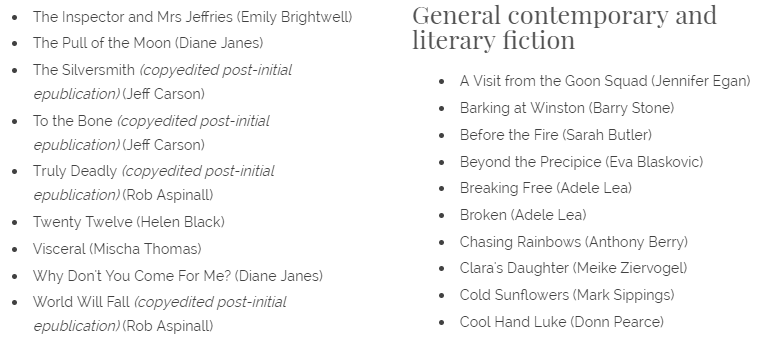
A partial screenshot of my boring but useful list!
The list: boring but powerful I’m not going to suggest you dump your long lists. Boring though they may be, I believe there’s power in them, and for two reasons:
So, if you want to keep your long lists, do so. I have. Make them more accessible and aesthetically pleasing by breaking them into subjects or genres. Add thumbnails of book jackets, journal covers or client logos (subject to securing permission from the client). Use a carousel or slideshow plug-in to show off multiple images without cluttering up the page. 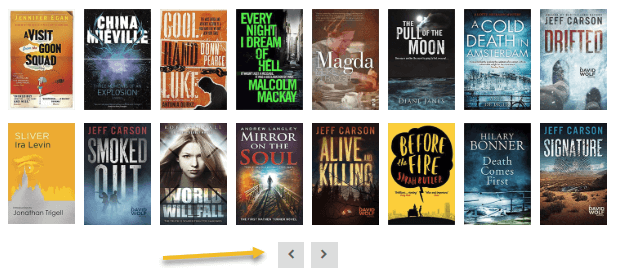
Carousel of thumbnail images with scroll buttons
Adding pizzazz with stories
Now it’s time to add the wow factor. Stories take the portfolio one stage further. They’re basically case studies of editing and proofreading in practice. Can you recognize yourself in the following list?
Stories work for all three groups of editors:
What to include It’s up to you what you include but consider the following:
Example 1
I’m a fiction editor who works for a lot of first-time novelists. Many haven’t worked with an editor and don’t know what to expect. Some feel anxious and exposed. My two portfolio stories have a friendly, informal tone. One of my case studies focuses on a self-publishing series author whose fictional world I’ve become close to. By showing how we work together and how his writing makes me feel, I demonstrate my advocacy for self-publishing and the thrill I get from working with indie authors, the emotional connection I make with the characters, and the delight I experience in seeing writers hone their craft. 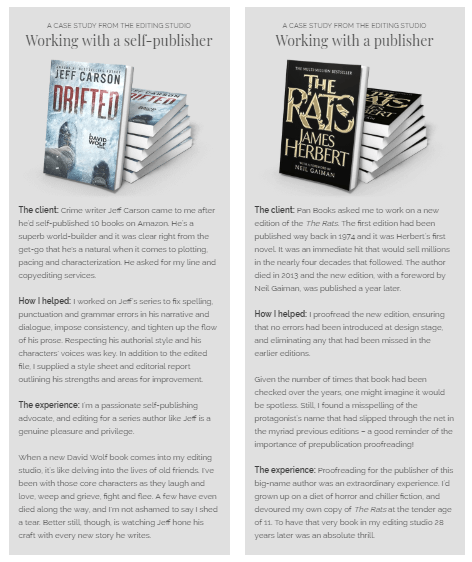
Two case studies from the editing studio
Example 2
If you work with corporates, your stories might have a reassuring, professional tone that conveys confidence and pragmatism. Your case studies could feature clients whose projects required the management of privacy and confidentiality concerns. You could use the space to talk about the challenges you faced and the successes you and your clients achieved even though the projects were complex and demanding.
Example 3
If you work with publishers, you could create case studies that show how you managed tight deadlines, a controlled brief, and a detailed style guide. The stories could highlight some of the problems you and the publisher overcame, your enthusiasm for the subject area, the pride you felt on seeing the book published, knowing the part you’d played in its publication journey. Crafting stories about relationships If your home page is all about the client, the portfolio page can be all about relationships. By crafting stories for our portfolios, we can invite potential clients onto the stage and let them experience – if only fleetingly – editing in action. And because the case studies are real, they’re a powerful tool for knocking down barriers to trust. They show a client how we might help them, just as we’ve helped others.
Louise Harnby is a line editor, copyeditor and proofreader who specializes in working with crime, mystery, suspense and thriller writers.
She is an Advanced Professional Member of the Chartered Institute of Editing and Proofreading (CIEP), a member of ACES, a Partner Member of The Alliance of Independent Authors (ALLi), and co-hosts The Editing Podcast. Visit her business website at Louise Harnby | Fiction Editor & Proofreader, say hello on Twitter at @LouiseHarnby, connect via Facebook and LinkedIn, and check out her books and courses.
Three questions for you:
If the answer to all three is yes, you’re in marketing heaven! 
I’m not kidding you. If you love learning about how to do your job better, and are prepared to make time in your business schedule for this continued professional development (CPD), you have at your fingertips all the marketing tools you need.
Here’s another question: Do you think there comes a point when you’ve learned all there is to learn about being a better editor? If you answered no to that, you’re in even better shape from a marketing point of view because you will never run out of ideas to connect with your target client. And here’s another question: Do you think you have no time in your schedule to learn how to become a better editor? If you answered yes, you need to make time. Every editor needs to continue learning. Our business isn’t static. New tools, resources and methods of working are a feature of our business landscape. Language use changes as society’s values shift. Markets expand and retract, which requires a response from us in terms of how we make ourselves visible. If you answered no, that’s great news because it means you have time for marketing. I know – you don’t like marketing. But that’s fine because we’re not calling it marketing. We’re calling it CPD, which you do like! 
Making time for business
Everyone who knows me knows I love marketing my editing business. Lucky me – it’s much easier to do something necessary when you enjoy it. What a lot of people don’t get is how I make time for it and how I get myself in the mindset to devote that time to it. I don’t have a problem with calling it marketing. But the truth is that so much of the marketing I do is not about marketing; it’s about communicating what I’ve researched and learned. I love line and copyediting crime fiction. I think I’m really good at it. But I don’t think I’ve learned everything there is to learn. Not for a single minute. That leaves me with stuff to do. I have to learn. So off I go to various national editorial societies’ websites. I head for their training pages. I look for courses that will teach me how to be a better crime-fiction editor. There aren’t any. I turn to Google. Plenty of help for writers, but not specifically for editors. That’s fine. And so here’s what I’ve done: read books about crime writing, and attended workshops, author readings, and crime-writing festivals (I live a stone’s throw away from the National Centre for Writing and the annual Noirwich festival). And I’ve continued to read a ton of crime fiction. And to help me digest what I’ve learned, I’ve taken notes along the way. It’s what I’ve done all my life when I’m learning – O levels (as they were called in my day), A levels, my degree … notes, notes and more notes. How much time has it taken? Honestly, I don’t know. I’ve been having too much fun. I love reading; I don’t count the hours I spend doing it. How long did the author event last? I’ve no clue. My husband and I had dinner afterwards though, so it was like a date. And it would have been rude to look at my watch. 
Is it a blog post?
I wrote a blog post recently about planning when writing crime. I couldn’t churn out 2,000 words just like that; I’m not the world’s authority on the subject. So I referred to my notes from the event with a famous crime writer (the one where I had a dinner date with hubby). Turns out the guy talked about planning, and told us about his and a fellow crime writer’s approach to the matter. I reread a chapter from a book on how to write crime and found additional insights there. More notes. I read 14 online articles about plotting and pantsing too. Yet more notes. And then I put all those notes together, which really helped me to order my thoughts. I created a draft. Redrafted. Edited it. And sent it to my proofreader. Soon I'll publish it and share it in various online spaces. It’ll be on my blog and on the dedicated crime writing page of my website. Some people might call it content marketing. And it is, sort of, because it helps beginner self-publishers work out when they will attend to the structure of their crime fiction – either before they start writing, or after. From that point of view, it is useful, shareable, problem-solving content, which is a perfectly reasonable definition of content marketing. 
Or is it CPD?
But look at it another way. I learned a lot of things I didn’t know before. I can use that knowledge to make me a better editor. I took notes and drafted those notes into an article. This is no different to what I did at least once a week at university. I wasn’t marketing then; I was learning. What is different is that no one but my professor was interested in my article. That’s not the case for my planning piece. That article will help some self-publishers on their writing journey. A few might just decide to hire me to line or copyedit for them. It’s happened before. Maybe it will happen again tomorrow, or next month, or next year. I don’t know. It doesn’t matter – the article will stay on my site for as long as it’s relevant. 
Change your language
If the idea of marketing your business leaves you feeling overwhelmed, rethink the language you use to describe what’s required. You probably don’t consider attending an editorial conference a marketing activity, even though it might lead to referrals. It’s more likely you think of it as a business development and networking opportunity. You probably don’t consider a training course to be marketing. It’s more likely you think of it as editorial education. You probably don’t consider reading a book about the craft of writing to be marketing. It’s more likely you consider it knowledge acquisition. So how about this?
Training, embedding knowledge, writing essays, publishing research, sharing subject knowledge. Smashing stuff. Nicely done. And between you and me, it’s great content marketing too. But, shh, let’s keep that quiet. I know you don’t like marketing. Make your marketing about your editing If you don’t like marketing, maybe that’s because the kind of marketing you’re doing isn’t likeable. In that case, think about what you do like about running your business, and make those things the pivot for your marketing. [Click to tweet] In other words, it doesn’t need to be about choosing between marketing your editing business and learning to be a better editor, but about the former being a consequence of the latter. Two birds. One stone. Me? I’m off to read the latest Poirot. Just for fun, mind you!
Louise Harnby is a line editor, copyeditor and proofreader who specializes in working with crime, mystery, suspense and thriller writers.
She is an Advanced Professional Member of the Chartered Institute of Editing and Proofreading (CIEP), a member of ACES, a Partner Member of The Alliance of Independent Authors (ALLi), and co-hosts The Editing Podcast. Visit her business website at Louise Harnby | Fiction Editor & Proofreader, say hello on Twitter at @LouiseHarnby, connect via Facebook and LinkedIn, and check out her books and courses.
This article shows you what it might cost to get your novel line edited, copyedited or proofread. However, the short answer is: it depends ...
This post headlined in Joel Friedlander's Carnival of the Indies #94
I’ll look at each of these points in turn, then offer you some ideas of what you can do to reduce the financial hit.
First of all though, a quick word on whether you should bother and, if you do, what type of service you should invest in. Do you have to work with a professional editor? Not at all – it’s your choice. That’s one of the biggest benefits of self-publishing. You get to stay in control and decide where to invest your book budget. However, I absolutely recommend that your book is edited ... by you at the very least, but ideally by a fresh set of eyes, and even more ideally by a set of eyes belonging to someone who knows what to look out for. And the reason for that recommendation is because 99.99% of the time, editing will make a book better. We can all dream about first-draft perfection, but it’s pie in the sky for most, even those who edit for a living. I’m a professional line editor, copyeditor and proofreader, and today I wrote a guest blog post for a writer. I wrote, and then I edited ... first for content, then for flow, then for errors. I found problems with each pass. That’s not because I can’t write. It’s not because I can’t string a sentence together. It’s not because I didn’t edit properly in the first round. The reason I found problems is because writing is one process – editing is another:
And the different types of editing attend to different kinds of problems and have different outcomes. Trying to do everything at once is like trying to mix a cake, bake it, ice it, eat it, and sweep up the crumbs all at the same time. Breaking down the writing and editing processes into stages is a lot less messy, and the quality of outcomes is much higher. Still, that has a cost to it, and it’s a cost that the self-publisher will have to bear because there’s no big-name press to bear the burden for them. 
Cost of editing: the individual editor
The independent editing market is global and diverse. Editors specialize in carrying out different types of editing. Some specialize by subject or genre. They have different business models and varied costs of living. And that means that despite what you might read in this or that survey, there is no single, universal rate. Neither is there a universal way of offering that rate:
My preference is to charge on a per-word basis, subject to seeing a sample of the novel. Because economies of scale come into play with longer projects, my per-word prices decrease as the project length increases. For example, in 2020, I charge 7.5 pence per word for a 1,000-word sample edit, but the fee is 20% cheaper if I'm line editing a 5,000-word story and 50–60% cheaper if I'm dealing with an 80,000-word novel. And so it depends on the parameters of the project. Some editors charge more than me, some less, and some the same. My colleagues live all over the world, and fluctuations in the currency-exchange markets mean that comparisons will yield different results from day to day. 
Cost of editing: industry surveys and reports
Some professional organizations suggest or report minimum hourly rates for the various levels of editing. They’re ballparks, nothing more, for reasons outlined below the table (fees correct as of July 2019).
ARE THESE RATES REALISTIC?
Do these figures bear any relation to what individual editors charge? Sometimes but not always. Most organizations recognize that these reported prices don’t always reflect market conditions, and they’re right to do so. Many editors and proofreaders, myself included, aim for rates at least 30% higher. Why? Because that’s what it takes for our businesses to be profitable. Editing and proofreading aren’t activities we do in our spare time. They're not side hustles. They’re careers that enable us to pay the bills. If we can’t meet our living costs, we become insolvent, just like any other business owner. The problem with these ballparks is that they don’t reflect the speed at which an individual works, the complexity of each job, the time frame requested, or the editor’s circumstances. An additional problem is that how these organizations define ‘proofreading’, ‘copyediting’ etc. might not reflect an author’s understanding of what the service involves, or what an editor has elected to include. And then there’s the age-old issue of currency-exchange rates. What might seem a high rate to you one day could turn into something quite different the next, and not because the editor’s or the author’s life has changed, but because of Trump, or the Bank of England, or a hung parliament here, or a banking crisis there. Bear in mind that independent editors are professional business owners, and just like any other business owner they are responsible for tax, insurance, sick pay, holiday pay, maternity/paternity entitlements, training and continued professional development, equipment, accounting, promotion, travelling expenses, pension provision, and other business overheads. 
Cost of editing: turnaround time
The table below gives you a rough idea of the speed at which an editor can work. Again, we’re dealing with ballpark ranges because the true speed will depend on the complexity of the project and how many hours a day the editor works.
Experienced editors have years’ worth of data that enables them to review a sample of a novel and estimate how long a project will take based on the level of editing requested.
The figures in the table above represent a working day of around 5 hours of actual editing. Additional time will be spent on business administration, marketing and training. Here’s how costs might begin to creep up. Imagine you ask your editor to copyedit your 80K-word novel. The editor estimates the job will take 50 hours, or two weeks. You need it in one. If you want to work with that editor, they’re going to have to work 10 hours a day, not 5. That means they have to pull 5 evenings on the trot in addition to their standard working day. That evening work is when they spend time with their families, recharge their batteries, catch up with friends, support their dependents, carry out the weekly food shop, help their kids with the homework ... normal stuff that lots of people do. If you want them to work during that time, it’s probably going to cost you more. For example, I charge triple my standard rate because my personal time is valuable to me – and to my child, who will need bribing! 
Cost of editing: the complexity of the project
The more the editor has to do, the longer the job will take and the higher the cost. Some authors might not be aware of the different levels of editing and what each comprises. And editors don’t help – we define our services variously too! For that reason, sometimes it makes sense to move away from the tangled terminology and focus on what each project needs to move it forward. An author might ask for a ‘proofread’ but the editor’s evaluation of the sample could indicate that a deeper level of intervention will be needed ... something more than a prepublication tidy-up. I’ve copyedited novels whose authors had nailed narrative point of view at developmental editing stage, so I didn’t have to fix the problem. I’ve also copyedited novels in which POV had become confused. The sample-chapter evaluation highlighted the problem, and I had to adjust my fee to account for the additional complexity. 
How to reduce your editing costs
So, there we have it – 1,300 words that tell you not what editing and proofreading will cost, but what they might cost, depending on this, that, and everything else! Here are some ideas for how to reduce your costs. GENERAL MONEY-SAVING TIPS
CLICK IMAGE TO DOWNLOAD
SAVING MONEY ON DEVELOPMENTAL EDITING Hone your story craft by reading books, taking writing courses, and joining writing groups through which you’ll be able to access fellow scribes! You can critique each other’s work and help each other with self-editing. I recommend these books:
Rather than commissioning a full developmental edit, you could pay for a critique or manuscript evaluation, or a mini edit. Those will help you to identify what works and what doesn’t so that you can make the adjustments yourself. SAVING MONEY ON LINE EDITING Hone your sentence-level mastery, again through books, courses and groups. Some editors offer mini line edits for this stage of editing too. Here, the editor offers a line-by-line edit on several chapters and creates a report on the sentence-level problems with the text with recommendations for fixing them. The author can then refer to the mini line edit and mimic the sentence smoothing and tightening. This kind of service is particularly useful for beginner authors who already know they’re prone to overwriting. And I have a book you might find useful:
SAVING MONEY ON COPYEDITING Learn how to use Word’s amazing onboard functionality, and macros and add-ins that flag up potential errors and inconsistencies. Here are some tools you can use:
SAVING MONEY ON PROOFREADING If you’re working on designed page proofs, there are a series of checks you can take your novel through.
That’s it! I hope this article has given you a sense of what you might have to spend, and how you might be able to save during the editing process.
Louise Harnby is a line editor, copyeditor and proofreader who specializes in working with crime, mystery, suspense and thriller writers.
She is an Advanced Professional Member of the Chartered Institute of Editing and Proofreading (CIEP), a member of ACES, a Partner Member of The Alliance of Independent Authors (ALLi), and co-hosts The Editing Podcast. Visit her business website at Louise Harnby | Fiction Editor & Proofreader, say hello on Twitter at @LouiseHarnby, connect via Facebook and LinkedIn, and check out her books and courses.
If you're suffering from yet another dry spell, this webinar will help you get editing and proofreading work in the next few days and weeks.
I'll show you 10 steps you can take to move out of famine mode quickly.
Forget theory. This is all about doing ... step-by-step guidance on short-term fixes that will give you peace of mind in the now, and head space to dig deeper in the future.
Click on the button below to find out more.
Louise Harnby is a line editor, copyeditor and proofreader who specializes in working with crime, mystery, suspense and thriller writers.
She is an Advanced Professional Member of the Chartered Institute of Editing and Proofreading (CIEP), a member of ACES, a Partner Member of The Alliance of Independent Authors (ALLi), and co-hosts The Editing Podcast.
PerfectIt is the premier consistency-checking software for many professional editors and proofreaders around the world. Developer Daniel Heuman and I sat down for a chat about what's new!
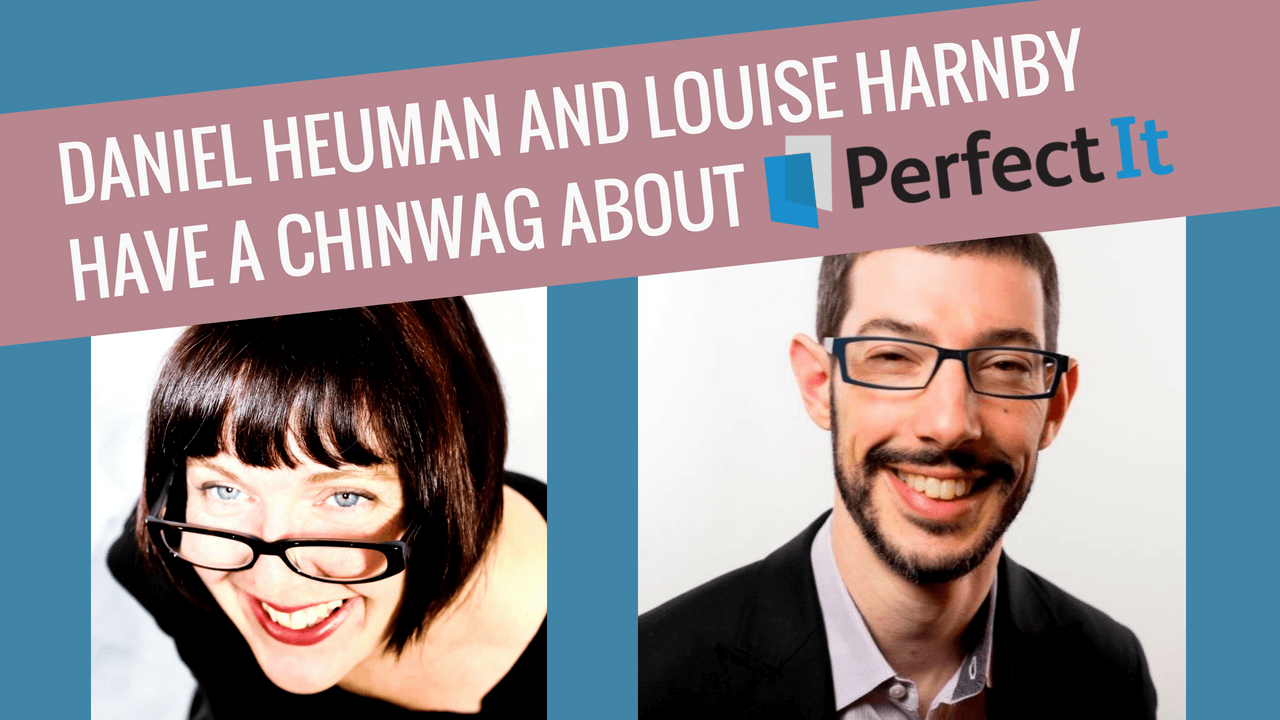
So Daniel was in New York, and I was in a tiny hamlet in Norfolk called Panxworth. Despite the 6,000 miles between us, the construction works going on outside his apartment, and the internet-connection problems in my somewhat rural neck of the woods, we managed to produce a video of our chinwag!
For those of you who want to jump to specific parts of the conversation, here are the key themes and associated time stamps: ▶️ Louise introduces Daniel Heuman, developer of PerfectIt: 00:00:00 ▶️ What PerfectIt does and why it’s useful: 00:00:24 ▶️ PerfectIt Cloud – the new solution for Mac users: 00:04:08 ▶️ Windows users: Should we buy PerfectIt Cloud?: 00:06:12 ▶️ The subscription model and a new lower price: 00:09:27 ▶️ The benefits of up-to-date editing kit: Stability and support: 00:12:27 ▶️ PerfectIt and Office 2016: 00:14:54 ▶️ PerfectIt 4: Online, in the cloud, or both? 00:18:35 ▶️ Features of PerfectIt 4: 00:20:24 ▶️ Sign-off: 00:25:44 And below is the conversation in full. Click on the Play button to begin listening. I've included subtitles in case you need to turn the sound off or can't understand our British accents! There's a full transcript below. I've edited this for readability but essentially it's the words as they were spoken on the day. THE VIDEO THE FULL TRANSCRIPT Louise introduces Daniel Heuman LH: My name is Louise Harnby and I’m a fiction editor, and today I’m going to be talking to the founder of Intelligent Editing and the developer of a piece of software beloved by many editors all over the world. And that’s PerfectIt. Before Daniel and I start chatting about all the PerfectIt news, Daniel’s going to tell us a little bit about what PerfectIt does, because some of you might not know. So over to you Daniel! What PerfectIt does and why it’s useful DH: Thank you! It’s lovely to speak to you! This is very exciting. I don’t know that they’ve ever done a video interview like this before so thank you! OK. PerfectIt – for the people who have not come across it before (which is probably exactly who won’t be watching this, but hopefully they are!) LH: You never know! DH: You never know! Exactly! So PerfectIt is mostly consistency-checking software, and the key place where it comes in is that when you’re editing work it’s almost always under, you know, time pressure, and with a pressure to produce perfect work. It’s ultimately dealing with the fact that everything is going to be on a budget. So given a limited time, what is the best document you can produce? And PerfectIt really fits in there. It saves time; it helps you edit faster. And the way I was trying to explain it the other day was at the ACES conference. I have new way of explaining it ... I thought a little bit about what gets people into editing. And I think that without delving into the deep psychology of what makes anyone an editor, I think one of the things that does not drive people is the difference between tiny consistency mistakes. So, yes, it’s fun sometimes when you spot ‘e-mail’ with a hyphen in one place and not in another but mostly that’s not what’s driving people. People get into editing because you care about words, you like reading, you care about communication, you want to explain stories, you want to help people connect better with readers. And these little tiny mistakes that take so much time to spot are not the reason. They are a distraction. They’re significant because they jump out at readers but they’re not the reason why we get into this. And they’re certainly not the reason why one should be spending a lot of time on a document. LH: And you’re so right because they take so long to deal with. I’ve had manuscripts before where, actually, particularly if an author’s got a budget, people like me are spending perhaps hours and hours and hours when we’re using just our eyes, dealing with these tiny inconsistencies, which as you say are red flags. And, yet, actually what we want to do is immerse ourselves in the narrative in front of us and to make it better. And the more time we can spend focusing on the flow of the words ... because every time you come across a hyphen that’s inconsistent, or inconsistent capitalization, as an editor, you’re dragged out of the flow of the work as well. And so being able to do that, to save time by having a piece of software like PerfectIt to do that for you is just wonderful. And you still get the pleasure of knowing that you’re bringing this consistency to the work. But it is back-breaking doing that manually. I think that’s the thing that a lot of editors feel. It’s just back-breaking work. And I would rather an author paid me to do other things with my time. I want them to feel that I’m going to do those things but I don’t want to have to spend more time than necessary doing it, and that’s where your software comes in. DH: Absolutely, and we put on the homepage something like: you spend the time on what matters most, which is your words and their meaning. LH: Yeah, yeah, that’s exactly it. PerfectIt Cloud – the solution for Mac user LH: So, Daniel, in the past, PerfectIt’s only been available to Windows users. Well, that’s not quite true. I do have Mac-using friends who have been able to use PerfectIt but they have to be running something like Parallels, or I think it’s called VM Fusion Ware or something. Or they’ve had to go buy a cheap Windows laptop. So I suppose that’s the thing that everybody’s talking about. Like, what’s new for Mac users? DH: That is the news! So first off, it’s been touching and amazing, the extent to which people have been going to use PerfectIt. Like you say, they’ve been installing Parallels. People have been buying computers to run this program, which is touching. I know that buying another computer doesn’t cost as much as it used to but, still. But for Mac users who hate Windows and just run it for one program has been phenomenal to see. But yes, no longer! So we are producing PerfectIt Cloud, which is ... you’re going to have to forgive ... in the background you can probably hear the construction noise! I’ll do my best to speak over it. So we’re producing PerfectIt Cloud, which is an Office Store add-in. And the great thing about Office Store add-ins is that they are compatible in any version of Office 2016. So if you are on a Mac, if you’re on a PC, if you’re on an iPad, even in Word Online (which I don’t know that anyone actually uses), no matter which version you’re on, you see the same add-in. So the functionality is exactly the same across. And we’ve been developing this for ... I mean, you know, the amount of times people have heard me saying, ‘A Mac version is coming soon. It’s just a few months. It’s just a few months.’ But, no, as of 26 June we will have PerfectIt Cloud, which brings compatibility to Mac and to iPad for the very first time. So it’s really exciting! Windows users: Should we buy PerfectIt Cloud? LH: So what about Windows users? I have PerfectIt 3. I’ve had all the versions since it first launched. I work on a PC. Should I rush out and get PerfectIt Cloud? DH: In a word, no. So the introduction of PerfectIt Cloud is primarily for Mac and iPad users at this stage. So if you’re using PerfectIt 3, if you’ve got a Windows PC, that’s still going to be the best version that we offer. And it’s going to be strange because PerfectIt Cloud looks so much better! The interface is even easier than it was before. It’s a beautiful product, but underneath there are a few things that PerfectIt 3 can do that we haven’t been able to do for Cloud yet. So the most important one of those is customization of styles. That’s still going to take some time to bring into PerfectIt Cloud. The ability to check footnotes – we’re going to be dependent on Microsoft for them to make some changes before we can bring that in. So if you have PerfectIt 3, if you have a PC, in most cases the thing to do is not to rush out, and not to buy this at least until we produce a new version for the PC, which will be PerfectIt 4. There’s one exception, which is, you know, all those people who ... the ones, the amazing wonderful users that you’ve described who have gone and bought VMware, and Parallels, and even separate computers. A bunch of those users are really frustrated with having to turn them on every time, and going through Windows updates, which take forever. And just to get PerfectIt up and running takes two hours. And it’s saving them a lot of time so they do it, but if you’re one of those people who has both a PC and a Mac, in those cases, yes, you would. Not all the options are included but it’s close enough that you may not want to be uploading and updating your Windows computer each time just to run PerfectIt. LH: Yeah, and I suppose also for people perhaps who are, I don’t know ... I was thinking about the increasing number of editors who are location-independent. And, actually, maybe they don’t always have the latest ... you know, they’re don't want to be worried if their computers break ... and the idea perhaps of just knowing that it doesn’t matter which PC you’re on, or which Mac you’re on, that if you’ve got something, a machine in front of you, you can do your work and you can access the core functionality of PerfectIt wherever you are. And that’s an important thing, I guess. I mean, I’m not location- independent. I am very much dependent! I’m in Norfolk with a rubbish broadband speed and so I’m kind of quite keen to keep things offline and local when I can. But knowing that I’ve got the choice – that will be a big issue for me. The subscription model and a new lower price LH: Can we talk about price now? Because in the past, once every two or three years, you bring out a new version, and I’ve paid you, I don’t know, $90? I can’t remember the price off the top of my head. So that’s the way it’s worked. But you’re doing things slightly differently now, aren’t you? DH: Yes. So we are switching to a subscription ... sort of a subscription. And I know the minute I use that word people are turning off this video, don’t want to know anything more. because everyone is sick to death of subscriptions with, you know, Netflix and Amazon, and, oh my God, you can get a subscription for your vegetable delivery now, which is bonkers! But I think what we’re doing is really different to that. We switched to a once-a-year payment. At this point at least, there’s no handover-your-credit- card or anything like that. You pay each year if you want to continue using it. And switching to that kind of model means we can drop the price by a lot. So instead of being a $99 one-off purchase, we’ve made it $70 per year. And on top of that, we’ve really dropped the price for, you know, independent editors. So we’ve worked with as many of the editing societies around the world as we can – certainly all the big ones – to have a kind of a discount. And that’s going to be an additional 30%, so the price is going to be just $49 per year for independent editors who are, you know, a member of any of the big editing societies anywhere in the world. So subscriptions mean we can get down the price down a lot, and they mean we can create a really compelling, simple offer, which is that you will buy PerfectIt and then you will get any version you want on any number of devices you want, and not pay a separate charge, which I think is really what bothers a lot of people. So you buy PerfectIt and you can install the PC version on your PC, you can install the Cloud version on your iPad. You only pay once for that and you don’t get stuck with that additional charge you described, which was the upgrade charge. So, yes, we used to have a one-off price but people liked this product and much more than 60% of people paid the upgrade price anyway. So, really, there was a hidden recurring element. And by switching to ... we can call it a subscription, we’ve made everything included in that price very transparent. And you get all the upgrades, you get all the updates, you get support. So I think the way we’ve switched the pricing is really gonna be attractive, and especially attractive for independent editors. The benefits of up-to-date editing kit: Stability and support LH: I think it’s wonderful because, I mean, I’m a big fan of the subscription model, even with things like Microsoft Office, because I’m a professional, I want the latest software, and I want it to work in an environment that’s stable as well. And so I like having the most up-to-date version of Word. I had a situation a few years back when I first plonked a download of Windows 10 on my Windows 8, or Windows 7 computer or something, and I was trying to get PerfectIt to operate in an environment basically with two operating systems, and guess what? It wasn’t happy. And so at that point ... because PerfectIt was key to my editorial day-to-day working, it was one of the things that triggered me to actually think, ‘You know what? You need to get yourself an up-to-date computer with the latest operating system already installed, so it's not fighting with anything else.’ And to know now that I’m always going to be running the latest edition of Word on the latest operating system and that the plugins that fit into that software, like PerfectIt, are going to be the latest editions too ... for me, that’s just one less worry. It means that I can get on doing the business of editing rather than thinking, ‘I want to be able to do X, Y or Z but I can’t because it’s broken.’ And so I’m really excited about this because, as you say, it’s upfront, it’s clear, everybody knows what they’re gonna pay and what they’re getting. And you mentioned something there as well, and that was the issue of support. Because in days past, it was the case that if you decided to stick with an older version of PerfectIt you wouldn’t have access to you. And sometimes, you know when you get stuck on things, you just want to be able to ask the person who actually really knows the answer. It’s not guesswork. And knowing that that’s always going to be ... you get the full package. So I’m really excited about it. I think it’s a really good deal. I think the price is a steal as well. And for those of us who are members of professional societies, what a perk of membership to know that you can get one of your core pieces of editing software at such a huge discount! Thank you! DH: Yeah, those societies and the editors within them are absolutely the reason why we are where we are today. That’s been the core of this business so now I absolutely think that it’s important to support them. PerfectIt and Office 2016 DH: And I agree with you completely about thinking about Office and updates that way. I know that a lot of editors have been disappointed when we’ve said that PerfectIt Cloud is only gonna work in Office 2016. And they said, ‘Well, I’m never moving to Office 2016 because I’ve heard all these terrible things about it.’ And I just wonder every time I hear that ... I think, I know those stories are true – when you have a piece of software like Microsoft that is installed everywhere then you always are going to have some things that don’t work and that are gonna get on Facebook. And they’re gonna look to seek help. And they’re always going to be the ones who have some kind of problem. You never get someone who installs the latest version of Microsoft and says, ‘Yep, that worked’ and tells all their friends. So our perception of these versions has been really sort of distorted by, I think, the relatively lower number of people who have had problems in perspective to the total, in relation to total. And as you say, when you actually look at the package and what Microsoft are offering, I think it’s really good. And I’m fortunate that I’ve never had any sort of problems with it. I’ve used Word on the iPad, I use Word on the PC. I think they’ve done a really good job of making those two similar and in line. In the past, there’s been big differences between those things. You know, I was able to switch as a long-time PC-user to the iPad version. I had no trouble doing that. And they do it at a low monthly price. And what I’ve sort of been saying to anyone who’s asked about it is something like, yes, there are some users who’ve had problems, and there have doubtless been lots of glitches, and there always are with endless Microsoft updates, but what about trying it for one month? They offer a monthly price. And see if it works for you. And you’ve got your old version and you can always go back, but those old versions, they’re at this point ... you know, Microsoft has stopped supporting Office 2011 anyway, so we’re out of that period really. Yeah, I think I think as you say, the package they’re offering is very good, and especially the kind of value in the monthly offer. It makes a lot of sense. LH: Yeah, and I think the other thing to mention is that, you know, I think sometimes there are people in, well, not just the editing community but all sorts of communities who are trying to run say 2016, or with all the updates, 2018 software but on decade-old computers. And that’s a bit like taking your mobile phone to medieval times and complaining you haven’t got signal! You know, we need as editors to be, I think, working with the latest equipment. Within a budget, of course. Most of us aren’t rich. But I always think, get the best RAM you can ... get the best processor you can for your money. And then things like PerfectIt, within Word, within Microsoft Office, will work the best for you. DH: Absolutely! And we all make these mistakes! I’ve been screaming at my printer all morning and pressing over and over again, and wasting so much time trying to get this printer to work. And I know the reason why it doesn’t work – it’s because it’s really old, and would cost next to nothing to replace. But, you know, we’re old enough to remember that these things used to be very expensive, and it’s so difficult to get rid of them. But, actually, you know, when running a business, to spend my morning yelling at a printer is probably not the best use of my time! PerfectIt 4: Online, in the cloud, or both? LH: So can I just check something with you? Can we talk then about the next version of PerfectIt that will be also usable locally? So we’ve got PerfectIt Cloud but there’ll come a point I’m assuming when there’ll be the next version, like PerfectIt 4 that will be in the cloud. Will that also be something that someone like me who’s got a little bit of an iffy broadband connection can, if they want to, download to their computer? DH: Oh, so we are NOT moving to the cloud in any way, shape or form. We’re doing very much that kind of approach that Microsoft has gone for where you pay once and you have different parallel versions for different devices. We are not switching to the cloud. There will always be a local version. As I said earlier, it’s still kind of the best version for a number of reasons. And so at the moment, if you get a subscription, you will get PerfectIt 3 and PerfectIt Cloud, and as of the end of this year you’ll get PerfectIt 4 and PerfectIt Cloud. And we’ll keep the two in parallel so that they’re running off ultimately the same code, so that you’ll get the update for PerfectIt 4 locally, and at the same time, almost at the same time, we will update PerfectIt Cloud automatically, and they’ll offer the same checking. LH: OK, great, that’s good. I just wanted to be sure of that because ... just because my broadband is a bit of a nightmare here! DH: No, no, I don’t think we communicated that properly in our in our literature so it’s a really good question to ask. I’m sure a lot of people will be concerned about that. Features of PerfectIt 4 LH: So can we talk about ... do you have any specific plans for what will be new with PerfectIt 4 yet, or can we suggest things? DH: Well, obviously, I’m going to dodge that question because the trouble with that question is that if I start saying we’ve got plans for PerfectIt 4, that we’re working on ... I suspect if I start saying the things that I’m working on, the disappointment that will follow when we say we’ve failed ... [laughing]. But I like the idea of suggestions. As I said, this business has very much been built by support from editors, and feedback from editors. So if we wind the clock like all the way back to the first time that I was at SfEP conference, I remember someone mentioning en dashes and and why they could be in the hyphenation-consistency check. And let’s let’s be honest, at that point, which was been ten years ago or so, I didn’t understand the significance of that. Why would we need to be looking for en dashes and hyphenation? What’s the point? And actually it was that feedback which we then took on. And it got quite a few people explaining and saying, well, actually, this is the error that we’re looking for. This is what comes up. It’s really difficult to spot because of this. Is there anything you can do? And I think it was in PerfectIt 2 but certainly in PerfectIt 3. And we’ve built in an en dash versus spaced-hyphen consistency check. LH: And em dashes too. DH: Yes, the way we do the checking for those is a little different but, yeah, it ultimately came down to the same reason, which is editors suggesting that these were the things that they wanted to see. And I’d love to get those suggestions for PerfectIt 4. So, particularly ... LH: I’m thinking legal and medical might be obvious. DH: Yes, legal. I’ve got a long, long list of changes that we want to make for legal, but medical, pharmaceutical scientific ... I know we have a lot of editors working in those kinds of fields and I feel like we haven’t done as much for them as we should and could. So I’d love to get suggestions from every kind of editor, but especially those ones would be really good, because we need to do more in that area. LH: And speaking as a fiction editor as well, I think there are certain functions I’m using ... the possibilities are there but there are certainly things I could think of in terms of the similar-word-find function that maybe even we could put forward some suggestions that might help you to push that stuff further forward, and help us to adapt the style sheets more so that we could get more benefits in that field too. And I’ll certainly be thinking if there’s anything else from a fiction point of view that I can push your way. DH: Definitely. You know, we always get a nonfiction writer saying, ‘Can this be used for nonfiction too?’ We get fiction writers saying, ‘Can it be used for fiction?’ And we hadn’t been quite communicated clear enough that, yes, it’s for all of those things. And, yeah, the similar-words function. Lots of people are using that for character names. Can we improve that? Can we make it clearer that that’s a possibility for character names? Can we look and see if there are ways of improving that? And already you have got me talking about features that I swore just two seconds ago I wouldn’t get into! Some of those things people are really gonna be telling me, ‘But you promised, but you promised!’ I will avoid saying more about that but I am excited by that kind of change and by doing things that are specific to different kinds of editing, for sure. LH: I think from my point of view as an editor, and for people who are watching this who haven’t tried PerfectIt yet, knowing that you’re responsive to ways in which you can develop the software is a really important thing to emphasize, because the various iterations that I’ve used over the years have just got better and better. And that means I’ve saved more and more time. And so I want to say to people that when you invest in this software you are working with a company and a business owner who will listen to you, and that's a good thing. DH: Thank you! And my guess is that at this point in the video, between the dogs barking outside and the helicopter going overhead, anyone who is completely new to this software will probably have stopped watching 20 minutes ago! But, yes, anyone with us longer hopefully has experienced that we are ... it’s actually the other way around. It’s editors who’ve helped build this and made all this stuff possible, so we are absolutely listening, and will continue to iterate and improve. If we improve the product for actual editors, everyone else who uses the software benefits. And, you know, we really have the best people in the world advising us, so I think it’s fantastic. Sign-off LH: Daniel, thanks very much! That’s been really, really useful. So I’m excited about ... not just the cloud but also PerfectIt 4 coming out. I’m excited that I’m going to be able to use it on multiple platforms, in different spaces. I’m excited that I’m going to be able to get it cheaper than I did last year! So thanks for taking the time to talk to me. It’s been brilliant. DH: Thank you! And thank you for all the support through all the years. The excitement and enthusiasm is so encouraging after we’ve been telling people, you know, soon, soon just another month, just another couple of months. Now that it’s done, now this here, it’s fantastic! Thank you. 
Contact Daniel Heuman: daniel@intelligentediting.com
Visit the PerfectIt website: www.intelligentediting.com Don't forget to check whether there's a discount available via your national editorial society.
Louise Harnby is a fiction copyeditor and proofreader who specializes in helping self-publishing writers prepare their novels for market.
She is the author of several books on business planning and marketing for editors, and runs online courses from within the Craft Your Editorial Fingerprint series. She is also an Advanced Professional Member of the Society for Editors and Proofreaders. Louise loves books, coffee and craft gin, though not always in that order. Visit her business website at Louise Harnby | Proofreader & Copyeditor, say hello on Twitter at @LouiseHarnby, or connect via Facebook and LinkedIn. If you're an author, take a look at Louise’s Writing Library and access her latest self-publishing resources, all of which are free and available instantly.
Running an editing or proofreading business is a journey, not a moment in time. Some of us will be offered work that’s not ideal because of fee, content, client type, time frame, or for some other reason.
Some might tell us it’s a bum job, that we should run a mile. But is it? Should we? Would acceptance be a compromise or an opportunity? 
The problem with ‘ideal’
Ideal is something to aim for but rarely what lands in our laps, especially in the start-up phase of a business.
The challenge of visibility Being discoverable is a challenge for many new starters. Ideal projects are out there, but the editor or proofreader isn’t yet visible enough in the relevant spaces. And even if they can be found, they might not yet have enough experience to instil the trust that leads to initial contact. Broadly, it’s easier to get in front of publishers because we know who and where they are. They’re used to being contacted by us, too, so we can go direct and cold. With non-publishers, it’s more difficult. Not every business, charity, school, indie author, or student wants an editor or understands the value we might bring to the table. Going direct and cold is a trickier proposition. The issue of trust It’s not just the mechanics of visibility. Emotion plays a part too, especially trust. 
With publishers it’s easier to overcome the trust barrier. They know what they want, what we do, are used to working with us, speak our language, and are experienced in evaluating our competence.
Non-publisher clients are more of a challenge. They might not be familiar with the different levels of editing. Many will not have worked with a professional editor before. Some – for example fiction writers – might be anxious about exposing their writing to someone they don’t know. And for the inexperienced client, evaluating a good fit is more difficult. In the start-up phase of business ownership, editors and proofreaders with less experience might therefore find it easier to acquire work with publishers than with non-publishers. The choices on the business journey So visibility and trust issues mean that new entrants to the field might not have the same breadth of choice as the more mature business owner. It might mean deciding to accept work that isn’t ideal in the shorter term. We could describe this as a compromise, but might it in fact be an opportunity? Does the terminology matter? I believe the terminology does matter because a compromise has negative connotations.
Negatives leave us feeling dissatisfied, that we’ve been ripped off, that we’re not in control. We’re more likely to begrudge the choices we’ve made. Positives are empowering. We’re more likely to see the choices we’ve made as rational and informed. All of this might sound like a mindset game but there’s more to it than that. Decisions to accept work that isn’t ideal have measurable benefits. However, we need a longer-term approach, and that can be tough for the new starter who’s surrounded by colleagues who are booked up months in advance with the work that they want. If that sounds like you, think of your editing business like a garden. The editorial garden What you do this year is not separate from what will happen next year, or the year after, or five years down the road. All the choices you make on your business journey are connected. 
The seeds you plant now will grow if you look after them. Give them a little additional feed and they might sprout this season ... if the weather holds and you’re lucky. However, you will not get a tree, not this year, I guarantee it. Trees come later.
If you don’t plant anything, however, nothing will spout, not now, not next year, not five years down the road. You will be treeless. Is planting the seeds a compromise? I don’t think so. It’s the opportunity to grow a tree. Should we begrudge all that work of watering and feeding for just a few green shoots in this season? Again, not to my mind. The effort we make now will bear fruit later. Our businesses are the same. A patch of my editorial garden I thought it might be helpful to share a story about my own business journey. It’s about how I accepted work that was way below my ideal price point, and did so with pleasure, because I believed I’d be able to leverage it later. See these books? 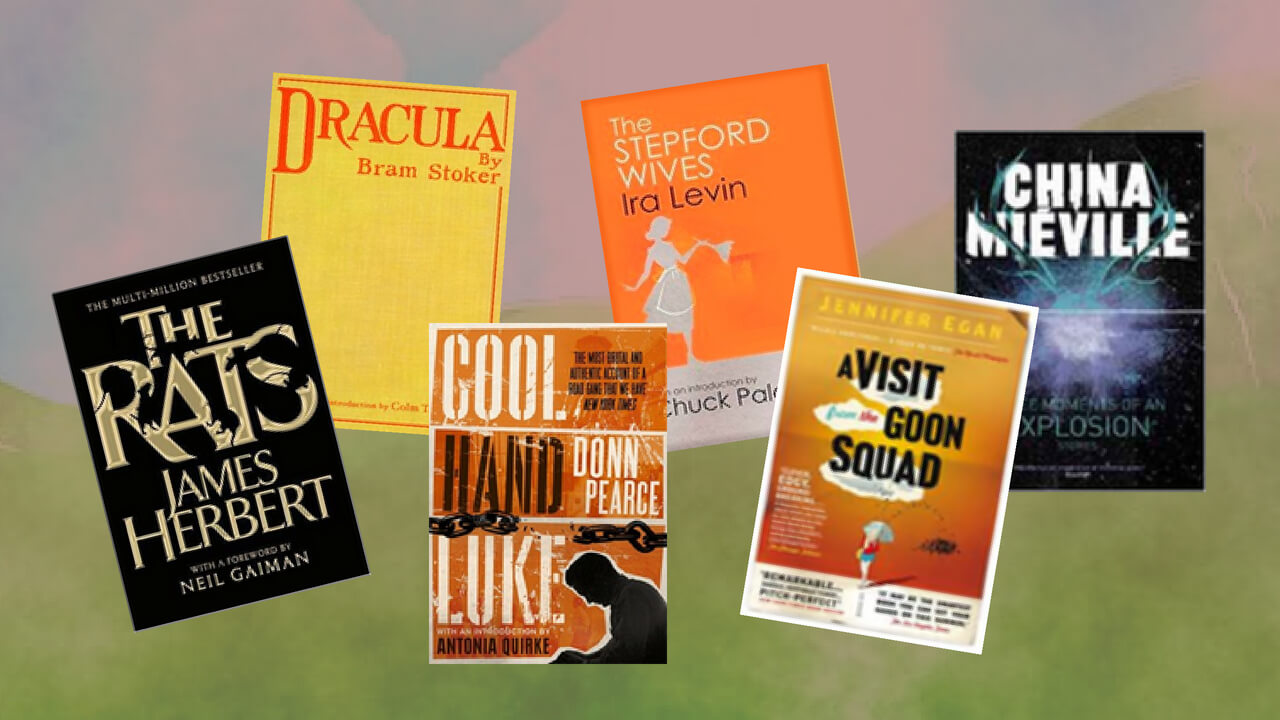
These are some of the books I was commissioned by publishers to proofread a few years ago. I proofread these books for about 13 quid an hour. These days, I aim to earn between £35 and £40 per hour. It doesn’t always work out that way, but I hit my mark in the last financial year when I averaged out my annual project earnings. A few years ago, my aim was around the £30 mark. Those books pictured above earned me less than half what I was aiming for. Did I compromise? Well, it depends how you look at it. 
If I believe that each decision I make exists in the bubble of now, and that nothing affects anything else further down the road, then yes, I compromised. If I think that what I’m earning now is despite my decision to accept those proofreading projects, it was a massive compromise.
If, however, I decide that each decision I make can affect my choices down the road, that the walls around those individual decisions are permeable, it’s a different story. If I think that what I’m earning now is because of my decision to accept those proofreading projects, it’s a story of opportunity. Authors make decisions to work with editors based on a whole host of factors, but the first step is deciding to get in touch in the belief that the person they’ve found feels like a good fit. Back to trust To take one example, those of us who edit fiction for self-publishers are asking those authors to put their novels into the hands of complete strangers. Many of those authors have never worked with an independent editor. Some are anxious about the process of being edited. And for some, the editor’s might be only the second pair of eyes to read the text. It’s a big ask that takes courage. And that’s where the trust comes in. The editor who can instil trust quickly is more likely to compel authors to make the leap and hit the contact button. And what better way to instil trust than offer a portfolio of mainstream published books written by big-name authors? And that’s how I leveraged those half-my-ideal-fee books. They tell an anxious indie author that publishers of big-name books trusted me a few years ago. And that helps the author trust me now. Those proofreading projects – and the £13 ph fees that came with them – encourage authors to contact me now, and trust that my £35–£40 ph line/copyediting fee is a worthwhile investment. And I know it’s true because they’ve told me it's so. I didn’t compromise. I planted a seed. Now the tree has grown, and I’m able to harvest the fruit. I had to wait a few years but the decisions I made then affect the choices I have now. And that’s how an editing garden grows. Your choice I’m a great believer in leveraging for future opportunity. It’s not everyone’s bag. It doesn’t fit with every editor or proofreader’s business model. And that’s fine. I offer this not as THE way of thinking, but as one approach. It’s something that those at the beginning of their journey might like to consider if they are still building visibility, but struggling with the age-old rates debate! As independent business owners, we are free to accept or decline fees from price-setting clients as we see fit. We are also free to propose rates that meet our individual needs, regardless of what our colleagues are offering. If you’re offered work, can see the benefit of that work for your portfolio, but can’t stomach the price, decline. But if you wish to accept, even though others tell you the price is ‘too low’ or ‘unfair’, go for it. The hive mind of the international editorial community is there to offer support and to share its wealth of experience, but no one knows your business and your needs better than you! More resources
Louise Harnby is a line editor, copyeditor and proofreader who specializes in working with crime, mystery, suspense and thriller writers.
She is an Advanced Professional Member of the Chartered Institute of Editing and Proofreading (CIEP), a member of ACES, a Partner Member of The Alliance of Independent Authors (ALLi), and co-hosts The Editing Podcast.
If speaking in public gives you the heebie-jeebies, professional presenter Simon Raybould has some advice that will improve your performance and calm your nerves.
Over to Simon … 
You edit words for a living, right? It’s a cool job, I admit, and not one I could conceivably aspire to.
As someone once put it, 'Simon, being your proofreader must be like being Seán McGowan’s dentist.’ And yes, it’s true. She once sent me an email with the words ‘… first paragraph alone! Are you doing it on purpose? Are you trying to annoy me?’ But I think I have an even more cool option for you. Instead of editing words, why not edit minds? I’m not talking about some sci-fi concept – it’s what I do for a living. A good presentation will change someone’s mind ... and with it, their world. A good presentation is a form of telepathy – sending ideas from your mind to someone else’s. The upsides are awesome, but the downsides are pretty serious too:
But all is not lost – there are cures … or at least things that will help. Here are a few quick-to-master ideas and tools that will help you to present at conferences (or anywhere else) with confidence. Some are easy, some are harder, but all of them work. 
1. The least popular tool – just doing it
Let’s start with the least popular option. When I ask people why they want to be confident, I often receive answers such as ‘If I were confident I’d be able to XYZ.’ And that’s great – they have a specific thing in mind. What’s not so great is that they seem to think that confidence alone will mean they don’t have to invest time in doing XYZ. I’m going to be blunt … you can’t shortcut your way to confidence. Don’t try to get confident before you do something. You can only get confident by doing that thing. Think about how you learned to ride a bike. Did you look at it, thinking, Cool! What an awesome bike. As soon as I’m a confident cyclist I’ll hop right on and go for rides in the hills? Nope. What you did was sit on it, fall off, get back on, fall off, get back on … and so on. Presenting is like that. Of course, with bikes you have stabilizers (and parents) holding you up. Stick with the analogy for a moment and figure out how you can make presentations in safer ways and places – stabilizers, as it were. How about making presentations under the following conditions:
I’m sure you get the idea. To mix my movement metaphors … don’t run before you can walk. 
2. Know what success looks like
We all know what could go wrong, right? People might laugh at us; we could fall off the stage; cold sweat might drip down our backs or melt our mascara. And that’s the thing… we know what the bad things look like. But what about success? Not fainting on stage doesn’t count. Things like this count:
Define it. After all, if all you can identify is failure, that’s what you’ll concentrate on. But if you can define success, you stand a chance of concentrating on that instead. (Defining success also helps you to design your conference presentation more effectively. If you don’t know what you want to achieve, you’re more likely to omit core material.) 
3. Sentence zero ... the breathing tool
When we’re scared, we breathe from the top of our lungs. Air comes out in a rush, making our voices sound thinner, breathier and – frankly – less authoritative. Hold that thought in your head for a moment and think about this: Lots of people tell me that once they get going in a presentation, things get better. So the important thing is to start well, right? Right. If you can control your breathing at the start, things are going to go better. Sentence zero is a handy tool for doing just that. Get the very first sentence of your presentation straight in your head. Be specific. For now, let’s pretend that Sentence One is ‘Hello, my name is Simon.’ Now think of a sentence that could go before it, finishing with the word ‘and’. For now, let’s pretend it’s 'Goodness, what a hideous lime green that back wall is, and …' We’ll call this Sentence Zero. Now, as you start your presentation, say Sentence Zero+Sentence One in one breath, but only use your voice for Sentence One. What that means is that your audience only hears Sentence One but you’ve already used the high-pressure, anxiety-sounding breath from the top of your lungs on the silent Sentence Zero.

4. Ditch the script
Writing is difficult. That’s why authors need you, right? So what on earth makes you think you can write a script for your presentation? If it was that easy, we’d all be writing massively successful West End and Broadway plays. Don’t try. Instead, define your structure.
Then, when you stand up to present, use the keywords as markers around which you improvise. Trust me, you’ll sound more natural and be much, much more interesting. Plus, you won’t spend time worrying about the massive confidence-drainer that is 'Did I get the wording absolutely right according to the script?' As an aside, the answer is no. No one does unless they’re RSC-grade actors. What you’ll lose in the occasional fumble you’ll more than gain in sounding more relaxed and natural. Plus, you won’t commit the ultimate presenter’s sin of using Latin words. It’s an over-simplification but we’re more likely write using the Latin-orientated words (‘commence’ rather than ‘start’) and speak using the Saxon versions (‘guts’ rather than ‘intestines’). Ditching the script means you don’t speak like a textbook. 
5. Wasp-swatting: The power of the list
A while ago, my team and I sat down for a meeting. Pizza and wine might have been involved. One of the things we asked each other was what made us nervous. It turned out that about one-third of our conference nerves came not from the presentation but from the logistics that went with it.
Logisitical/trivial problems are like wasps. One seems manageable. A swarm’s a different matter. Each issue might be negligible on its own, but all of them together have a noticeable impact. Similarly, each on its own is easily dealt with, but taken together the problem loses its perspective. The solution is simple: a list. At least two weeks in advance of the conference, create a simple checklist – one line for every issue. For example, I don’t have a 'cables' tick box on my list; I have entry for the power cable, another for the VGA adaptor, and another for the HDMI adaptor, and so on. Before you go live, check the list. That way, when it’s time to perform, you can do so confident that you’ve not forgotten anything. It also frees up the parts of your brain you’d otherwise have wasted on trying to remember things. 6. Practice and rehearsal This is so fundamental it probably shouldn't come last. It also needs the fewest words. You will perform better if you go over your presentation and practise improvising using your keywords. Wrapping up There’s a lot more you can do to conquer your nerves – ideas range from breathing techniques to standing in certain positions – but these are good starting points. So go change the world and edit people’s heads!
Want to know more?
Simon's a presentations expert and productivity guru. If you want to get in touch beforehand, here's what you need:
Louise Harnby is a line editor, copyeditor and proofreader who specializes in working with crime, mystery, suspense and thriller writers.
She is an Advanced Professional Member of the Chartered Institute of Editing and Proofreading (CIEP), a member of ACES, a Partner Member of The Alliance of Independent Authors (ALLi), and co-hosts The Editing Podcast. Visit her business website at Louise Harnby | Fiction Editor & Proofreader, say hello on Twitter at @LouiseHarnby, connect via Facebook and LinkedIn, and check out her books and courses.
Here's a treat for PerfectIt users ... a custom style sheet that includes the find-and-replace strings in my free ebook, Formatting in Word.
If Formatting in Word has made your life easier, you'll love what my colleague Andrea Kay of Yours Truleigh Editing has done. Yep, she's upped the efficiency game for all of us by creating a custom style sheet that can be imported into PerfectIt.
Thank you so much, Andrea! For those unfamiliar with either the software or the booklet, I've provided an overview of both, and the benefits of importing the style sheet. Below that are the installation instructions and the ready-to-download files for Formatting in Word.
What's PerfectIt?
For those readers who are not familiar with this software, PerfectIt is a sophisticated consistency checker that works with Microsoft Word. By customizing its built-in style sheets, or creating your own, you can define your preferences and let PerfectIt locate variations and possible errors. I recommend every professional editor add it to their toolbox. You can read my more detailed review of the product here: PerfectIt 3 – must-have software for the editorial freelancing pro. If you don't yet have PerfectIt, contact Intelligent Editing for pricing and download information.
Ebook: Formatting in Word
This free ebook helps editors and self-publishing authors tidy up Word documents. In addition to showing you how to use some simple macros, it includes search strings to help you locate and fix potential problems, including rogue spaces at the beginning and end of paragraphs, double line returns, tabbed paragraph indents, lower-case letters at the beginning of paragraphs, paragraphs that end with no punctuation, and more.
What's the style sheet?
Andrea Kay just saved PerfectIt users a ton of time by building an importable custom style sheet that features the key search strings from the ebook! That means you don't have to manually type the strings into your Word document one by one, then repeat the process each time you work on a new document. Instead, import the style sheet, run PerfectIt, and let the software locate the potential problems for you. All you have to do is decide whether to implement the suggested change in your document. How to import your style sheet Importing the style sheet is a doddle, I promise, Follow the instructions and screenshots below. If PerfectIt is already installed, the process will take no longer than 20 seconds. 1. First, email me to get the style sheet.
2. Once you've installed PerfectIt, open the Word document you want to check.
3. Launch PerfectIt. 4. Click on Manage Styles. 
5. Click on the Import button.
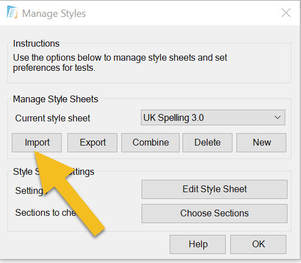
6. Select the pft from your device and click OK.
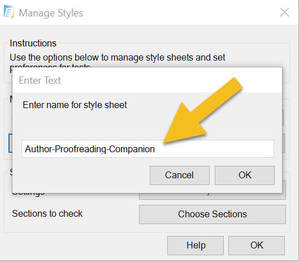
7. Click OK in the Manage Styles window.
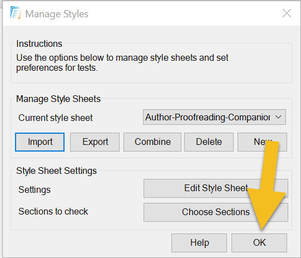
8. Select the your pft from the Current Style drop-down box.

9. To run PerfectIt on your current Word document using the custom style sheet, press Start.
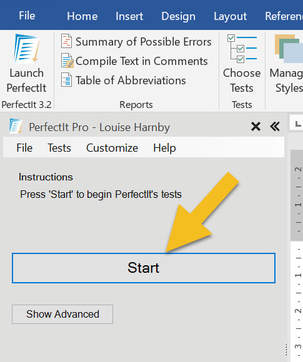
If you're not a PerfectIt user ...
If you're not yet ready to invest in PerfectIt but still want access to the find-and-replace strings and other tools in the ebook, click on the image below. 
Louise Harnby is a line editor, copyeditor and proofreader who specializes in working with crime, mystery, suspense and thriller writers.
She is an Advanced Professional Member of the Chartered Institute of Editing and Proofreading (CIEP), a member of ACES, a Partner Member of The Alliance of Independent Authors (ALLi), and co-hosts The Editing Podcast. Visit her business website at Louise Harnby | Fiction Editor & Proofreader, say hello on Twitter at @LouiseHarnby, connect via Facebook and LinkedIn, and check out her books and courses.
If we’re serious about setting up an editing and proofreading business, free resources will get us so far, but only so far.
What free is good for
Free is brilliant when we’re starting out, particularly in the following circumstances:
Free is equally great when we’re experienced but looking to shift the goalposts:
Free stuff is about discovery, so that when the time comes to reach into the coffers we’re spending money in the right place. Free helps us to turn expense into investment. What free is not good for Free isn’t great in the long term because the offering usually comes with limitations. It will give us a glimpse, enough to help us on the journey. But that’s all. The reason free has its limitations is because even creating free stuff and offering free help takes time, and time is money. Imagine the following scenarios:
CASE STUDY 1
Jane wants to offer developmental editing but has no experience. She does some research and finds the following:
CASE STUDY 2
Jack has identified a skills gap. He’s a great editor but a poor marketer and is dissatisfied with the rates he’s earning from his existing client base. Currently, he works with project-management agencies who find publisher work for him. And those publishers find authors for the agency. There’s a cost to that author-acquisition work – those agencies and publishers take a cut of the fee at each stage because they have to invest their own time and expertise in making themselves visible. It's that visibility that puts the editing work on Jack's desk. He starts a discussion in a large editorial Facebook group about his concerns and is offered the following:
What tasters teach us ... and what they don't In both cases, the freebies are of exceptionally high quality and Jane and Jack learn a ton from them. Creating that content must have taken time and effort. However, free articles, blog posts and webinars are tasters. Those kinds of things help us understand the lie of the land, and give us a deeper sense of what more we need to learn. What they won’t do is teach us everything we need to know. We can’t learn how to become professional developmental editors from those resources alone ... any more than we could learn to cut hair or wire a house to acceptable standards without proper training and guidance. Same goes for marketing. Take me, for example. It’s not luck and Google that made me a strong marketer. I pay a monthly sub to learn how to do it well from professional marketers, and invest time in implementing the strategies I’m learning. If Jane wants to become a professional developmental editor and Jack wants to become a strong editorial marketer, both need to take all those freebies and use them to make informed decisions about the money they will invest to turn their investigations into reality. Examples might include:
Free will help Jane and Jack make decisions. Investment will make them fit for professional purpose. 
A better money mindset
It’s perfectly okay to decide that you can’t afford to run a professional editorial business ... but only as long as you decide not to run a professional editorial business. No one on the planet owns a business that doesn’t have operating costs. Business owners have to take responsibility for training, equipment, invoicing, money transfer, software, marketing, client acquisition, office space, pension provision, taxation responsibilities, and more. It’s true that the international editorial community is incredibly generous, which means that free resources and guidance abound on multiple platforms. However, those who are serious about running an editorial business know they have to avoid hobbyist and employee mindsets.

The shoe on the other foot – when you’re asked for a freebie
We can’t have everything we want when we want it. We have to make choices. Freebies help us make the right choices so that the money we spend actually increases our prospects and income in the longer term. And imagine yourself on the other side of the fence for a moment. A potential client calls you. They have a book that needs copyediting. ‘The thing is,’ they say, ‘I can’t afford professional editing. How can I get out of paying you? To be honest, I’m just looking for free stuff.’ How fast would you hang up? Now imagine another writer calls you. ‘I’m in the middle of doing as much self-editing as I can using some free tutorials I found online and some advice from my writing group. There’s a fair way to go,’ they say, ‘but I figured I’d start saving now. Can you give me a rough idea of how much it might cost and how much notice you’d need? That way I can start planning my book budget.’ That’s the kind of client I’m excited about working with. The editor with the same mindset will be rewarded with guidance and help because they deserve it. The editor who wants it all for nothing won’t and doesn’t. By all means, grab all the freebies. The creators of those resources want you to have them. Making free stuff that’s invisible and unused is a waste of time and effort. Just don’t forget that free is the starting blocks. Investment is what gets us to the finish line! Further reading
Louise Harnby is a line editor, copyeditor and proofreader who specializes in working with crime, mystery, suspense and thriller writers.
She is an Advanced Professional Member of the Chartered Institute of Editing and Proofreading (CIEP), a member of ACES, a Partner Member of The Alliance of Independent Authors (ALLi), and co-hosts The Editing Podcast. Visit her business website at Louise Harnby | Fiction Editor & Proofreader, say hello on Twitter at @LouiseHarnby, connect via Facebook and LinkedIn, and check out her books and courses.
If you’re an editor or proofreader who finds marketing your business overwhelming, here are 6 ideas to help you rethink your mindset and pull you out of the mire.
Recent discussions with colleagues on social media made me realize two things:
It made me sad to think that some of my colleagues could be negatively affected by those of us who find marketing easier or who enjoy it more. If you're one of those who's struggling, this article is for you. It looks at the perceptions that might be triggering your discomfort and offers you new ways of thinking about each problem so that you can move forward. If you want a reminder to pin on your wall, download the infographic at the bottom of the post. Or download the free PDF booklet to your preferred device. Perception 1: It shouldn’t be done unless you can do it perfectly Some editors are suffocated by their perfectionism. Not being able to do marketing perfectly and completely stops them from starting it. And so nothing gets done. Here are five examples that reflect the truth of the matter:
I have been blogging since 2011 and I only just got around to uploading a banner image that reflected the parlour theme of the blog. I’m confident that my audience will forgive me. Those who won’t are likely not my audience. If you’re someone who finds themselves falling into this trap, give yourself a break, please. Everyone else will. Social media profiles can be tweaked, banners can be uploaded, testimonials can be added, and headshots can be updated. In fact, everything about your marketing strategy can be amended, deleted or completely rethought whenever you wish. Ask yourself this: When you edit for a client, do you guarantee perfection? Do you think it’s even possible? I don’t. One reason is that much of what I do depends on brief, style, preference or voice. Editing work isn’t an exact science. I have some good news for you – nor is effective marketing. Overcoming marketing overwhelm: Tip 1
You don’t have to do it perfectly. You just have to do it.
Perception 2: Everyone else is doing way more than you It might look like that but the reality is probably different. A colleague recently told me: ‘I know how hard you work on marketing. I can tell by how many posts you write and share on LinkedIn each day.’ I tend to share 7 blog articles throughout the day on both LinkedIn and Twitter. That’s 49 social media shares of my blog content every week on each platform. But I write one blog post a week. Just one. I share that new post on a Monday. The other 48 are reshares of older blog articles that I hope my community will be interested in if they missed them the first time around. And people might well have missed them. Tweets and posts on Facebook are more likely to be missed than seen on busy social feeds with ever-changing algorithms. That’s why many editors reshare their older content. Those of us who’ve been blogging for a few years have a lot of content banked, which means we have plenty to share. If you’re starting out on your blogging journey, you’ll have a smaller bank. And that’s absolutely fine! It’s not a numbers game; it’s a content-delivery game. If you have older blog posts, reshare them. If you don’t, wait until you do and then reshare. And if you'd rather write an article every two weeks, or once a month, that's your choice too. It matters not that I’m sharing 49 articles and you’re sharing 2 or 5 or whatever. What matters is that we’re delivering articles that will solve our colleagues’ and clients’ problems, and making our businesses more visible. Don’t waste precious time worrying about my 49. Those are mine and for me to worry about. You need to think only about how to promote your 2 (or 5 or whatever) posts because those are what will drive traffic to your website. Overcoming marketing overwhelm: Tip 2
Focus on delivery not numerical comparisons.
All that’s relevant is what you do for your business. Perception 3: Some editors don’t do any marketing but have loads of work anyway Marketing has many faces. Remember my 49 blog-post shares? Those are part of a strategy to make me discoverable online and appealing to self-publishing authors of fiction. What I do with my blog is a very visible form of marketing because the international editorial community is active on social media, and I use social media as one delivery tool for my blog content. But what if an editor has a different target client base? Imagine Dan. He’s a copyeditor who specializes in social science books. His primary client base is publishers. Last week he did the following:
None of this marketing activity has been tweeted, liked, shared or commented on. No one knows what Dan was up to last week. However, it’s excellent, targeted promotion, and worth every minute he spent on it. What one editor does to put themselves in front of potential clients will not necessarily mirror what another is doing. An editor whose schedule is full but who doesn’t appear to be busy with marketing is likely promoting their services in less visible but just as powerful ways. None of us is handed work. We have to find it, or enable it to find us. Perhaps the marketing work you need to do is not about blogging, vlogging, tweeting or chatting. Maybe it’s about making a telephone call, attending a networking group, writing an email, sending a letter, or advertising in appropriate spaces. Overcoming marketing overwhelm: Tip 3
Follow your own path. Marketing doesn’t have to be shiny and out there. Good marketing focuses on your business and clients not your colleagues’.
Perception 4: Unlike everyone else, you don’t have anything to show off about I bet you do! Once a week in my Facebook group, I host a marketing #Carnival. It’s a celebration of wins. Any wins – big or small. And it isn’t just shiny-shiny stuff like winning an award, securing a new client, launching a new product, or publishing a 2,000-word blog post. It could also be completing a test, sending out 10 letters to prospective clients, filling out a LinkedIn profile, uploading a picture to a website, booking a course, securing a testimonial, creating a marketing to-do list, buying a domain name, or applying for a membership upgrade to a professional editorial society. Anything that takes our businesses forward is worth celebrating. I’m good at holding a list of my wins in my head but you might prefer to keep a physical record of your achievements. You don’t need anything fancy – a spreadsheet, a notebook or a space on your wall for Post-it notes. Then, when the overwhelm hits, look at that spreadsheet, notebook or wall, and remind yourself of all that you’ve achieved. That focuses attention on what’s been done rather than what’s left to do. Overcoming marketing overwhelm: Tip 4
Create your own carnival. Record what you’ve achieved as well as what’s left to do. Busy people's wins deserve to be celebrated.
Perception 5: Editor X is producing a seemingly impossible amount of regular new content Unlikely! I suspect repurposing is what's going on. Bear in mind the following:
I've done the following with some of my older blog posts:
There are even more ways to repurpose content for promotional means but you get the picture. Repurposing is quicker than creating from scratch and therefore great for the time-poor editor. But it also respects the fact that people like to access help in different ways and at different times. Even if an editor appears to produce a lot of visible content, it’s more likely that they’re taking shortcuts to make life easier. And so can you! Overcoming marketing overwhelm: Tip 5
The busiest marketing editors are not magicians; they’re just good at recycling! You can repurpose your content too.
Perception 6: There’s just way too much to do at once You’ve made a list of all the things you’ve seen others doing and it’s huge. Overwhelming, in fact. Ugh. There’s so much:
You don’t have nearly enough time in your life to get all of it sorted. It would take months and months and months to do all that! Yep, it would. It might even take a couple of years to get up to full speed. And you know what? That’s fine! It’s supposed to be like that because you're a professional editor not a professional marketer. So, if you feel overwhelmed by all that needs to be done, take a breath and think in ones. Even the most visible and active of marketing editors started out with just one blog post, just one tweet, just one small list of publishers, just one directory entry, just one page on a website, just one online group they lurked in. Everyone has to start somewhere. None of us creates a marketing strategy and nails it a month later. And marketing gets easier over time because there comes a point where it starts to work for you instead of being a burden. Take me, for example ...
Some years back, I was still in the process of developing that stuff. I didn’t do it all at once. I did a bit, then a bit more, then a bit more. Over time, the foundational work was completed, leaving me space to focus on the marketing activities that work best for me now. Look at your marketing list. Instead of seeing it as an ocean in which to drown, break it down into cups from which you can sip. Create a doable schedule. Choose a couple of things and an acceptable time frame in which to do them. Then choose a couple more and do those ... small steps that respect and reflect your client base, your personality, and the demands of your work and personal life. Overcoming marketing overwhelm: Tip 6
Think in ones. Schedule step by step so that your goals are achievable in the long term and suit your business, not mine or anyone else’s.
Beating the overwhelm: A downloadable checklist There’s more than one way to do marketing. Your way might look different to mine. It might be less visible. It might involve targeting different clients. It might require a different pace. That's all fine. Download the infographic below and pin it on your wall. It'll remind you that marketing is not about catching up with colleagues. It's a journey, a building process. It does require your time, but you get to choose the methods and the schedule. If you feel the paralysis setting in, join my Facebook group, tell me what's holding you back, and we'll work out some steps to get you moving in a way that works for you. 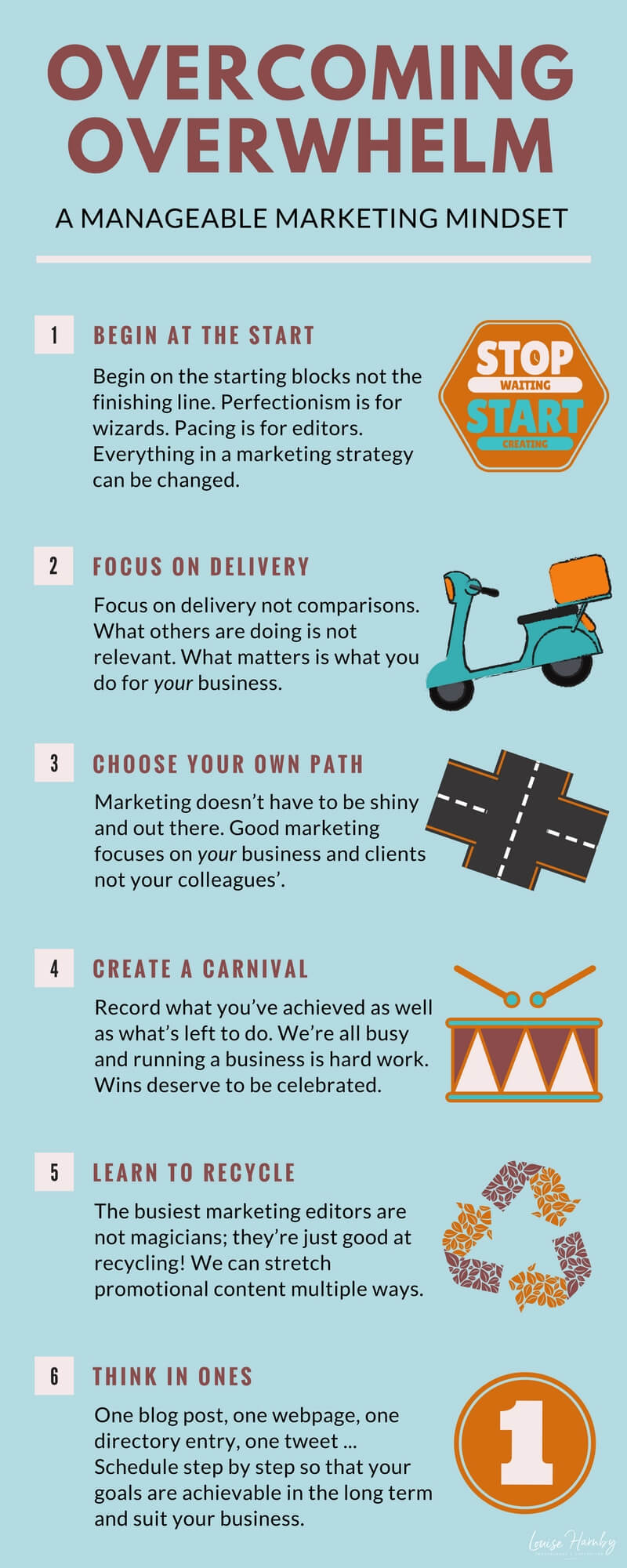
CLICK TO DOWNLOAD
Louise Harnby is a line editor, copyeditor and proofreader who specializes in working with crime, mystery, suspense and thriller writers.
She is an Advanced Professional Member of the Chartered Institute of Editing and Proofreading (CIEP), a member of ACES, a Partner Member of The Alliance of Independent Authors (ALLi), and co-hosts The Editing Podcast. FIND OUT MORE > Get in touch: Louise Harnby | Fiction Editor & Proofreader > Connect: Twitter at @LouiseHarnby, Facebook and LinkedIn > Learn: Books and courses > Discover: Resources for authors and editors
If you’re an editor, making Word work hard for you is a must. The new and revised edition of Editing in Word 2016 is one of my recommended resources. Here's why.
I’m a fiction editor who works solely for indie authors and self-publishers. I work on raw-text files, and Microsoft Word is one piece of software that I cannot afford to be without.
Word has its snafus but I don’t know of any word-processing software that comes close to offering its superb functionality. I don’t just edit in Word; I’ve also created print- and digital-ready books directly in it. So when fellow editor and author Adrienne Montgomerie asked me to review the second edition of Editing in Word 2016, I couldn’t wait to get stuck in. I’ve been using Word since 1991, so could Montgomerie teach this old dog a few new tricks? How about younger pups? Let’s see ... More than an ebook This is a digital self-study course. Yes, you get the ebook with all the contextual information and foundational teaching. But there are also videos that show Word in action, and a bunch of exercises with which to practise what you learn at each stage of the process. I love the fact that the advice is actionable. You read, you see, you learn, and then you do. There’s no better way to ensure it’s all sunk in. A focus on core tools
‘We need a resource that gets right to the tools editors can’t live without; the tools that make our job easier and faster. We need to know about the tools that are the very reason we use Word at all.’
PREFACE, Editing in Word 2016
We certainly do. Here are some of the tools that Montgomerie focuses on:
If you don’t know 8 out of 10 of the above tools inside out, you’re likely not as efficient or productive as you could be. That alone makes this course a worthy purchase. That it’s a steal at just under 25 quid (excluding VAT) makes it a no-brainer. Let’s dig a little deeper ... Screens, operating systems and how we work with Word One of the best things about this course is its acknowledgement that editors work in different ways.
Top tips This course is rammed with useful and actionable tips on how to get stuff done and in ways that respect your preferences. For example:
And along the way, Montgomerie includes ‘Pro tips’, ‘Read more’ and ‘Troubleshooting’ callouts to keep you on track. Video demos I’m a big fan of multimedia learning. And when it comes to editing, sometimes just hearing your tutor’s voice and watching them go through the motions onscreen can trump the written word. In addition to the ebook, there's a support website with 27 video tutorials for both Mac and Windows users. 
This feature is excellent. I’ve come across a lot of editors who’d like to enhance their digital skills but are held back through fear. Montgomerie takes the stress away via accessible walkthroughs that even the most tech-nervous of nellies will be able to follow.
Here are just 3 examples:
Practice makes perfect There are 24 exercises in this course that help you to hone your skills and start doing what’s written in the book and shown in the videos. Just a few examples include:
A note on versions This course was created in 2017 using Word 365 on Windows 10 and Sierra OS. Given that the author’s using the latest software and operating systems, you might find that the instructions need a little tweaking here and there if you’re using medieval Word (or should that be Wordeth?)! For example, older versions of Word might have different ribbon displays, icons and menu options. That’s unavoidable, and a reminder that, as professionals, we should be aspiring to use up-to-date equipment. I’d prefer my dentist not to fill my teeth with 10-year-old composites; we should treat our clients similarly. My verdict Did I learn anything new? Yes, I did. But editorial training isn’t just about finding out what you don’t know; it’s also great for affirmation of what you do know. I was pleased to learn from a pro that a lot of my Word usage is on track. Here’s another thing, though: there are functions in Word that I use infrequently (e.g. erasing time stamps). I know it’s possible but I’ve simply forgotten how. And instead of trawling Google or spending valuable time asking questions in editing forums, I can have Editing in Word open on my desktop. From there, I can search, locate and solve my problem in seconds. I recommend this without reservation for any editor who wants to get the very best from Word with a one-stop shop, especially those who've been held back by fear. Montgomerie will take that away from you – I promise.
Louise Harnby is a line editor, copyeditor and proofreader who specializes in working with crime, mystery, suspense and thriller writers.
She is an Advanced Professional Member of the Chartered Institute of Editing and Proofreading (CIEP), a member of ACES, a Partner Member of The Alliance of Independent Authors (ALLi), and co-hosts The Editing Podcast. Visit her business website at Louise Harnby | Fiction Editor & Proofreader, say hello on Twitter at @LouiseHarnby, connect via Facebook and LinkedIn, and check out her books and courses.
How do you get fiction editing and proofreading work? This post offers some pointers for newbie freelancers, and experienced editors looking to shift specialisms.
1. Start with baseline training
To be fit for working in any editing discipline, fiction or otherwise, training is the foundation. Even if you’ve been devouring your favourite genres for years, you need to understand publishing-industry standards. This isn’t about snobbery. It’s about serving the client honestly and well, especially the self-publisher, who might not have enough mainstream publishing knowledge to assess whether you’re capable of amending in a way that respects industry conventions. It’s about the reader too. Readers are canny, and often wedded to particular genres. They’re used to browsing in bookshops and bingeing on their favourite authors. They have their own standards and expectations. One of our jobs as editorial professionals is to ensure we have the skills to push the book forward, make it the best it can be, so that it’s ready for those readers and meets their expectations. And so if you want to proofread or edit for fiction publishers and independent authors, high-quality editorial training isn’t a luxury: it’s the baseline. What kind of training you need will depend on what services you plan to offer. 
CLICK IMAGE TO TWEET
Courses
I recommend the Publishing Training Centre and the Chartered Institute of Editing and Proofreading (CIEP) for foundational copyediting and proofreading training. I’m based in the UK, and those are the two training suppliers I have experience of so I’m in a position to recommend them. That doesn’t mean that other suppliers aren’t worth exploring. Rather, I don’t recommend what I haven’t tested. Keep an open mind. Check a range of suppliers and their course curricula. Then choose what suits your needs.
If you want more information about how the PTC and CIEP courses compare, talk to the organizations’ training directors. 2. Decide which fiction editing services you want to offer Some beginner self-publishers don’t understand the differences between the different levels of editing, which means they might ask for something that’s not in their best interests (e.g. a quick proofread even though the book hasn’t been critiqued, structurally edited, line- and copyedited). It’s essential that the professional fiction editor is able to communicate which levels of editing they provide, and recommend what’s appropriate for the author. That doesn’t mean the author will take the advice, but the editor must be able to articulate her recommendations so that independent authors can make informed decisions. 
CLICK IMAGE TO TWEET
3. Invest in appropriate specialist fiction training
The next step is to gain skills and confidence with fiction editing and proofreading work. As with any type of editing, the kinds of things the editor will be amending, querying and checking will depend on whether the work is structural, sentence-based or pre-publication quality control. When deciding what specialist fiction editing courses to invest in, bear in mind the following:
Courses and reading Explore the following to assess whether they will fill the gaps in your knowledge. Check the curricula carefully to ensure that the modules focus on the types of fiction editing you wish to offer and provide you with the depth required to push you forward.
This isn’t a definitive list but it’ll set you on the right track. 
CLICK IMAGE TO TWEET
4. Get in the right mindset
Fiction editing requires a particular mindset for several reasons: Style and voice We’re not only respecting the author, but the POV character(s) too. The fiction editor who doesn’t respect the voices in a novel is at risk of butchery. Being able to immerse oneself in the world the writer’s built is essential so that we can get under the skin of the writing. If we don’t feel it, we can’t edit it elegantly and sensitively. Intimacy Non-fiction is born from the author’s knowledge. Fiction is born from the author’s heart and soul. If that sounds a little cheesy, I’ll not apologize. Many of the writers with whom I work are anxious about working with an editor because they’ve put their own life, love and fear into the world they’ve built. A good fiction editor needs to respect the intimacy of being trusted with a novel. If that doesn’t sound like your bag, this probably isn’t for you. Unreliable rules At a fiction roundtable hosted by the Norfolk group of the Chartered Institute of Editing and Proofreading, guest Sian Evans – an experienced playwright and screenwriter – talked about how punctuation in screenplays is as much about ‘the breaths’ the actor is being directed to take as about sentence clarity. These ‘breaths’ exist in prose. They help the reader make sense of a sentence ... not just grammatically, but emotionally. And so the addition or removal of just one comma for the sake of pedantry can make a sentence ‘correct’, or standard, but shift tone and tension dramatically. The fiction editor needs to be able to move beyond prescriptivism and read the scene for its emotionality, so that the author’s intention is intact but the reader can move fluidly through the world on the page and relish it. All of which is a rather long-winded way of saying that if you want to get fiction editing work, and keep on getting it, you’ll need to embrace rule-breaking with artistry! Fiction work requires us to respect both readability and style. The two can sometimes clash so gentle diplomacy and a kind hand will need to be in your toolbox. 5. Read fiction If you don’t love reading fiction, don’t edit it. And if you don’t love reading a particular genre, don’t edit it. Editing the type of fiction you love to read is a joy, and an advantage. If you read a lot of romance fiction, you’ll already be aware of some of the narrative conventions that readers expect and enjoy. I started reading crime fiction, mysteries and thrillers before I’d hit my teens. I turned 51 in March and my passion for those genres hasn’t waned. That stuff makes up over eighty per cent of my work schedule too. Here’s the thing though – my pleasure-reading has supported my business. I get to see first-hand how different authors handle plot, how they build and release tension, how they play with punctuation, idiomatic phrasing, and sentence length such that the reader experiences emotion, immediacy and immersion. And that helps me edit responsively. Honestly, reading fiction is training for editing fiction. In itself, it’s not enough. But professional training isn’t enough either. Love it and learn it. 
CLICK IMAGE TO TWEET
6. Learn from writers
If you want to understand the problems facing the self-publishing author community, listen and learn. Join the Alliance of Independent Authors. Even lurking in the forum will give you important insights into what self-publishers struggle with an how you might help. Take advantage of online webinars aimed at beginner writers. Penguin Random House offers a suite of free online resources. Experienced writers and instructors take you on whistle-stop tours of setting, dialogue, characterization, point of view, crime fiction writing, children's books and a whole lot more. Listen to published novelists’ stories. My local Waterstones hosts regular author readings/signings. I’ve seen Garth Nix, Jonathan Pinnock and Alison Moore speak. In April 2018, Harry Brett is chairing a session on how to write crime with Julia Heaberlin and Sophie Hannah. In May, fellow editor Sophie Playle and I are attending 'Why Writing Matters', an event hosted by the Writers' Centre Norwich in association with the Norwich & Norfolk Festival. And Jeffery Deaver's coming to town too. Ticket booked! These workshops cost from nothing to £12. That's a tiny investment for any fiction editor wanting to better themselves. 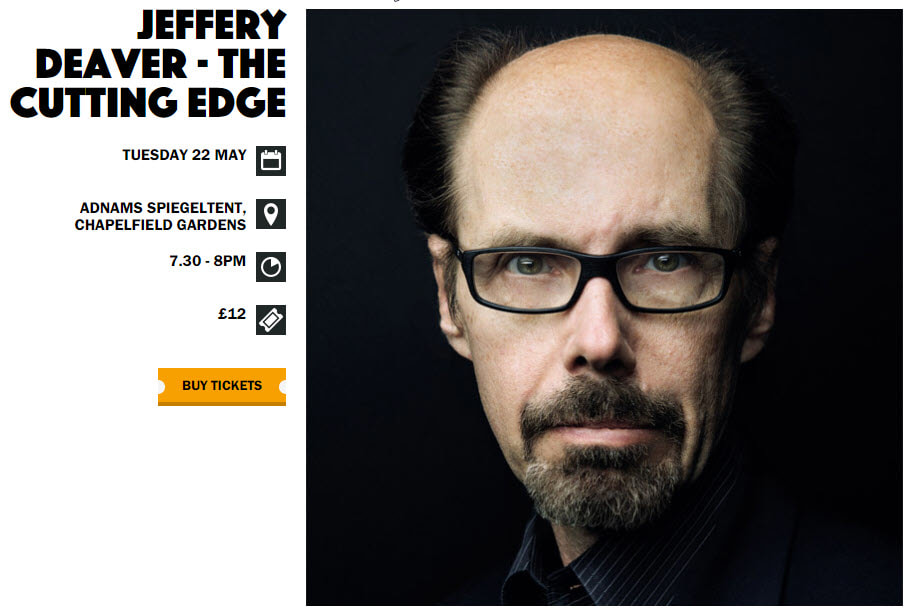
7. Get in front of publishers
The best way to get publisher eyes on your editing skills is to go direct. Experienced fiction editors are sometimes contacted direct but sitting around waiting to be offered work never got the independent business owner very far and never will. Experienced ... but not in fiction If you’re an experienced editor or proofreader who already has publisher clients but they’re in a different discipline (e.g. social sciences, humanities) you’ll likely have built some strong relationships with in-house editors. Publishing is a small world – in-house staff move presses and meet each other at publishing events. It might well be that one of your contacts knows someone who works in fiction and, more importantly, will be happy to vouch for your skills. With specialist fiction training, you’ll be able to leverage that referral to the max. So, if you have a good relationship with an in-house academic editor, tell them you’d like to explore fiction editing and ask them if they’d be prepared to share a name and email and give you a recommendation. Newbie If you’re a new entrant to the field, it’s unlikely that a cold call to HarperCollins or Penguin will be fruitful. The larger presses tend to hire experienced editors with a track record of hitting the ground running. There are two options:
CLICK IMAGE TO TWEET
8. Be visible online
There’s no excuse for any twenty-first-century professional editor to be invisible. There’s no one way to visibility – take a multipronged approach. Directories If you’re a member of a national editorial society, and they have a directory, advertise in it as a specialist fiction editor/proofreader. If you’re not a member, become one. It won’t be free, but running a business has costs attached to it. If we want to succeed, we need to be seen. That doesn’t land on our plates; we must invest. If your society doesn’t have an online directory, lobby for one to be set up and promoted. I’d go as far as to argue that a professional editorial society that isn’t prioritizing the visibility of its members isn’t doing its job properly.
Create content for indie fiction authors Any self-publishing fiction writer looking for editorial assistance is more likely to think you’re wowser if you help them before they’ve asked for it. Create resources that offer your potential clients value and you’ll stand out. It makes your website about them rather than you. And it demonstrates your knowledge and experience. Doing this might require you to do a lot of research, but what a great way to learn. Don’t think of it as cutting into your personal time but as professional development that makes you a better editor. And think about it like this: Who would you rather buy shoes from? The shop where the sales assistant tells you all about her, or the shop where the sales assistant helps you find shoes that fit? It's no different for authors choosing editors. I have an several pages dedicated to resources for fiction authors. I’m not alone. These fiction editors have resource hubs too: Beth Hill, Sophie Playle, Lisa Poisso, Kia Thomas and Katherine Trail. There are others but I’m already over the 2,000-word mark! 
CLICK IMAGE TO TWEET
Shout out your fiction specialism
Shout your fiction specialism from your website’s rooftop. Why would a fiction writer hire someone who doesn’t specialize in fiction when there are so many people dedicated to it? 
Related reading
Here are some additional articles that you might find useful if you're considering moving into the field of fiction.
Good luck with your fiction editing journey!
Louise Harnby is a line editor, copyeditor and proofreader who specializes in working with crime, mystery, suspense and thriller writers.
She is an Advanced Professional Member of the Chartered Institute of Editing and Proofreading (CIEP), a member of ACES, a Partner Member of The Alliance of Independent Authors (ALLi), and co-hosts The Editing Podcast. Visit her business website at Louise Harnby | Fiction Editor & Proofreader, say hello on Twitter at @LouiseHarnby, connect via Facebook and LinkedIn, and check out her books and courses.
Some blogs are poorly right from the get-go. If yours is feeling under the weather, here are 6 treatments that will turn it, and your website, into a vibrant resource centre that drives your business forward.
I’ve been blogging since 2011 and my blog is the single biggest driver of traffic to my website – around 36,000 page views per month. Given that 99% all of my clients come to me via Google and two online directories, having a strong web presence is the difference between being booked up six months in advance and being unemployed.
Those visitors end up on my blog for three reasons:
Big-picture focus This article doesn’t focus on the technical minutiae of whether to use Wordpress or Weebly, filling in metadata, writing great headlines, breaking up text with pictures, adding in calls to action, SEO keywords, paragraph length and so on and so forth. That’s not because all the micro stuff isn’t important, but because none of it will amount to anything if the macro issues aren’t in order. Instead, I focus on six big-picture reasons why blogs become poorly, and offer some medicine that will turn them, and the websites hosting them, into vibrant resource centres that drive our businesses forward. 
Problem 1: The blog doesn’t solve problems
Some of the blogs I wrote between 2011 and 2015 are a technical disgrace but they worked – and still work – because the content is helpful and shareable. A blog that doesn’t solve problems is a written exercise in self-indulgence and won’t make us the go-to professionals for anything. At best, we’ll be instantly forgettable; at worst, people will talk about us for all the wrong reasons. A colleague recently told me about a piece of video content he’d watched: ‘After 10 minutes I’d lost the will to live. After 20, I’d lost the will for the vlogger to live.’ I trust my colleague, whereas I don’t know or trust that vlogger. Consequently, I didn’t watch the video. There are a ton of online examples of desperate business owners employing attention-seeking methods to get eyes on their content. It can work once, maybe twice. But if we rely on shock, surprise, upset or gaining sympathy with our audience, and no solution, our content-marketing successes will be short-lived. Don’t puke over the reader We all have problems – that doesn’t mean we have to vomit over our audience with our content. Plus, shock and controversy have a short shelf-life. Today’s audiences are easily desensitized and quickly bored, so high-quality problem-solving content will trump the shock factor every time. Nothing should appear on our blogs that doesn’t help the reader move forward in some way. And if we can’t solve a problem, we should hold off, research and rewrite. Only once we have a solution should we publish. When we do solve problems, we make ourselves valuable. People are more likely to talk about, share, like and comment on our blog content. And that has huge SEO benefits over time because the search engines love seeing evidence of a great user experience. Focus on solving the audience’s problems from the get-go and we are well on the way to building a platform that puts us top of mind and discoverable in the search engines. 
Problem 2: The blog is published irregularly
Lack of regularity is probably the most common reason for blog failure. We do it for a bit, then run out of ideas, or time, or passion. This is how a reader perceives a blog that publishes content irregularly:
Those feelings don’t inspire trust. If your window cleaner couldn’t be bothered to clean your windows on a regular basis how quickly would you try to find a replacement? It’s the same with blogging. No one’s going to talk about or share our content if we can’t be bothered to create it regularly. Earning the rankings and referrals We have to earn the right to be top of mind for referrals and benefit from our colleagues’ and clients’ SEO-driving activity. And without those likes and shares, Google won’t recognize us as business owners who are actively engaging. That will impact negatively on our rankings. Build a blog plan If you don’t have the time or commitment for blogging, that’s absolutely fine. Don’t do it – focus on making your business visible in other ways. Blogging is just one option. However, if you do want your blog to be your primary content platform, the solution is to build a blog plan beforehand. Here are four initial steps for your plan:
Here are four ideas for how to generate content:
Here are four ideas for how to save time:

Problem 3: The blog is unnavigable
No one searches online for a blog. They search online for solutions. If they click through to our websites, the first place they’ll head for is unlikely to be the blog tab. And even if is, will our visitor find the answer to their problems in the content that’s visible on the first page of the blog? If we only have 10 pieces of content, yes. What if we have 40? How about 500? Second homes The solution is to create second homes for our blog content – libraries, hubs, resource centres ... call them what you will. I have two on my website – a self-publishers page and an editor resources page. There is not one single piece of fresh content on those pages. They’re libraries of titled images that depict what problem I’m solving. However, if you click on the images you’ll end up reading the full articles on the blog. These libraries help my audience find my very best content – the stuff that’s most likely to be talked about, get me known, and make my visitors think I’m helpful and knowledgeable. I only started creating content for one of those libraries in May; it’s already the fourth most popular page on my site ... and that’s because it’s obvious what’s on offer and whom it’s for. Few business bloggers funnel their content through to other pages, and it’s the biggest lost opportunity I can think of. Do this and you will stand out from your competitors for very little additional effort. Here, we’re using our blog content to turn our websites into resource centres rather than all-about-me-and-how-great-I-am sites. 
Problem 4: The blog is shallow
My marketing coaches Andrew and Pete preach the art of creating content that makes people fall in love with you. I love this idea because it focuses on emotion – of getting under people’s skin, making them feel something. This sits nicely with the problem-solving principle discussed above. When we solve problems we make people feel something – happy, grateful, relieved, empowered. Emotion born from solutions Just to be clear, those emotions should be evoked as a result of our solving a problem. For example, our funnies alone won’t be enough to make anyone subscribe to and share our content in the long term. No one will waste time reading a funny photographer’s blog if he or she doesn’t solve photography problems too. That’s because if all we want is a laugh, Dara Ó Briain and Rich Hall will do it better. Tone on top of solutions Even if our content is technically good, we have competition. Readers need to hear our voices and our personalities in our posts so that we stand out. I tend to go for warm and friendly. Other tone options might include cheeky, funny, blunt, sweary or ranty. All of that stuff is great but bear in mind that it’s just dressing at the end of the day. It should always hang on a body of solutions. Going deeper with solutions There are already a bajillion blogs with the basics just, about everything. Repeating the same old stuff is boring, and boring blogs are a killer. We need to bring our blog posts alive with case studies (made-up ones if necessary), and stories based on our own experiences, so that our readers have gravy on the meat and two veg. That kind of deeper detail draws people in, makes them feel like we’re really talking to them, not just stuffing our websites with keywords. That is not to say we shouldn’t aim our content at beginners or focus on the basics – far from it. Rather, our content needs to have personality and detail. When we go deep we make an old subject sound fresh because it’s rich with our voices and our experiences. 
Problem 5: The blog doesn’t fulfil audience expectations
I don’t visit a dentist’s website expecting to find a treatment for the verruca on my foot. I’m there to sort out my teeth. A blog needs to have a recognizable and understandable raison d’être too. We’re busy and none of us has time to read everything, join every group, watch every vlog, listen to every podcast, do our jobs, and have a life. Blogs that don’t give people a very good reason to be there are doomed. They won’t be bookmarked, subscribed to or shared. If a reader doesn’t understand why they should bother, they’ll quickly lose patience and go elsewhere. There are two reasons why an audience could become confused and disengage: The content is coherent but isn’t aligned with the business creating it. This happens when the blogger has misunderstood the audience’s expectations even though there are myriad specialist solutions that could be offered. The content is incoherent and there are too many audiences. This can happen when a business – usually a product-based one – can’t sustain long-term content creation around the product alone. To compensate, the blogger covers multiple topics for multiple audiences whose problems are already being solved in depth by relevant specialist bloggers elsewhere. Here are two examples where those problems have been solved. Coherent and aligned: The pro presenter There’s plenty one can write about presenting, and that content can be targeted at non-presenters who need to tackle the process, and those who want to run a presentations business. Relevant content might cover the following: dealing with stress, introversion, lack of confidence, speech impediments, organization and planning, which software to use, which venues are best, managing acoustics, scheduling, equipment, payment terms, contract problems, learning resources, apps and plugins to aid preparation, training opportunities, marketing a presentations business, getting published, creating engaging slides, finding and retaining clients, and so on. The presenter is blogging about topics aligned to their core service and targeting an audience with problems related directly to it. The blog is therefore coherent and aligned. Coherent and side-aligned: The condom company There’s only so much one can write about condoms. Durex knows that it will not be able to sustain its audience’s interest in latex and lube, and there are only so many flavours and colours. However, it also knows that its audience is interested in sex, otherwise people wouldn’t need condoms. Durex has created a blog called Love Sex that offers all sorts of tips about perfect massages, advice on STDs, relationships, other forms of contraception, orgasms, positions ... you name it, it’s there. It’s a very clever way of creating content about a related but more interesting issue. If you can’t sustain long-term content creation around your product or service, shift your thinking sideways but make sure it’s focused on your audience’s problems. Durex isn’t blogging about condoms, but it’s still focusing on content that’s related sideways to its core product. Its blog is therefore coherent and side-aligned. Nudging with a name Naming our blogs can help signal purpose. Mine’s called The Proofreader’s Parlour, which should be an indication that my focus is on words. I also publish a lot of content about marketing, but it’s marketing for editors and proofreaders. And I offer content about training, but it’s training for editors and proofreaders. It’s not as interesting as the Durex blog but it solves my clients’ and colleagues’ problems and that’s all that matters! 
Problem 6: The blog is invisible
Blogging without blog promotion is a supreme waste of time. It matters little that we’ve nailed all of the above if our blog’s invisible. We could spend hours crafting beautiful content for our target audience, but if we don’t invest the time or effort in making it visible it will have no purposeful business or economic value. Superhero delivery There are numerous ways to promote a blog, and what works for you might not work for me. One thing’s for sure though – social media is the superhero when it comes to content delivery. Three huge platforms – LinkedIn, Twitter and Facebook – offer a superb suite of tools to help us get seen out there. What clear is that it’s about more than just posting links and pretty pictures, now more than ever. Indeed, we have to work increasingly hard on these busy platforms with their ever-shifting algorithms. However, persistence pays and there is no faster way to get your blog content, and your business, in front of people than by embracing social media. Automating to make space for crafting Content should be scheduled regularly because on some platforms, Twitter especially, the feed moves so fast that your blog-post links are more likely to be missed than seen. I post on Twitter ten times a day, seven days a week. Automate your evergreen posts where you can (full automation will shortly not be possible on Twitter via the likes of Recurpost). That will free up time for posting manually on your core platforms. Manual posting allows us to craft our posts with the algorithms in mind. An example: Crafting for Facebook Here are some of the ways in which you might promote your blog content on Facebook:
Six-tip summary
Good luck building a healthy blog! Here's a free ebook. Visit the Blogging page in my resource library to download this free booklet. And if you're ready to dig even deeper, take a look at my course Blogging for Business Growth. 
Louise Harnby is a line editor, copyeditor and proofreader who specializes in working with crime, mystery, suspense and thriller writers.
She is an Advanced Professional Member of the Chartered Institute of Editing and Proofreading (CIEP), a member of ACES, a Partner Member of The Alliance of Independent Authors (ALLi), and co-hosts The Editing Podcast. FIND OUT MORE > Get in touch: Louise Harnby | Fiction Editor & Proofreader > Connect: Twitter at @LouiseHarnby, Facebook and LinkedIn > Learn: Books and courses > Discover: Resources for authors and editors
If you’re feeling the pinch because publishers, packagers and agencies aren’t offering your desired fees, think about the issue from a marketing perspective.
The fees on offer from publishers and packagers are a perennial topic of conversation for professional editors and proofreaders. Some feel frustrated and anxious about the rates; others enjoy the security afforded by a stable workflow that requires no client-acquisition effort.
It’s important to remember that not everyone’s lowest-paying clients are publishers. If yours are, it might be that you need to switch clients not types of client. Here’s my wise friend and fellow editor Liz Jones: ‘It’s often said that publishers don’t pay as well as non-publishers. In my experience, this isn’t necessarily true. There isn’t much difference in the mid-range, and fewer of my non-publishers feature at the low end, but my highest payers in 2016 were still publishers.’ Crunching the Numbers
Here are a couple of made-up case studies. The numbers are inevitably loose – editorial earnings vary hugely depending on subject area, type of editing, country of residence, and individual experience so it’s impossible to generalize. And global comparisons are problematic because of currency fluctuations and cost-of-living variances.
Just think of these examples as glimpses rather than universal statements of how the market is! 
Case study 1: Working with publishers
Joe Word-King is a professional proofreader specializing in the social sciences. He works exclusively for publishers. In the past 12 months he’s been commissioned by 5 publishers to proofread 32 books by 32 authors. Joe’s working day Joe starts at 9 a.m. and finishes at 4.30 p.m. He takes an hour for lunch and 15-minute breaks every 90 minutes to give his eyes a rest. This means he has a total of 6 hours per day available for proofreading. During the breaks he does stuff like checking his emails, grabbing cups of tea and something to eat, and taking a little fresh air. How he acquired those publisher clients One found him in the Society for Editors and Proofreaders’ Directory of Editorial Services. Four added him to their freelance list after he emailed them and asked if he could take their proofreading test (which he passed). How the work offers come in The publishers do the author-acquisition work. The book production managers from those presses email him to ask if he’s free to take on a project of A pages, B words, with a budget of C hours and a total fee of £D. Joe decides whether he will accept or decline the work. 
Case study 2: Working with self-publishers
Alicia Sentence-Queen is a professional copyeditor. She works exclusively for independent fiction authors. In the past 12 months she’s been directly commissioned by 19 authors to copyedit 19 books. Alicia’s working day Alicia starts at 9 a.m. and finishes at 4.30 p.m. She takes an hour for lunch and 15-minute breaks every 90 minutes to give her eyes a break. She also spends an average of 75 minutes per day writing blog articles and sharing her content online so that her website is visible in the search engines. This means she has a total of 4 hours and 45 minutes available per day for copyediting. During the breaks she does stuff like checking her emails and social media accounts, grabbing cups of tea and something to eat, and taking a little fresh air. How she acquired those self-publisher clients Fourteen came directly from Google, three from the CIEP’s Directory of Editorial Services, and two from Reedsy. How the work offers come in Alicia does the author-acquisition work. She makes herself visible online so that her clients can find her. They then get in touch directly. A process of evaluation, sampling and quoting begins. Alicia offers a price for the project and waits to see whether the author will accept or decline. Most of the enquiries that Alicia receives don’t turn into paid work – perhaps the author doesn’t like the price, the time frame doesn’t work, or Alicia doesn’t feel she’s the right fit for the job. For that reason, Alicia needs to attract enough people for whom the price, the time frame and the fit will work. 
Alicia has a change of heart!
Alicia’s heart is in copyediting and she figures that if she had a bunch of publisher clients doing all the author-acquisition work she wouldn’t have to devote 75 minutes per day to making herself visible. She earns a minimum of £35 per hour. Given that she spends 6 hours and 15 minutes each week marketing, that time costs her £218.75. That works out at nearly a grand a month! She and Joe are good mates so she gets in touch with him and tells him that she’s thinking about working for publishers. They chat about fees – Joe says he earns an average of £23 per hour, which is two thirds of what she’s getting from her indie authors. Given that Joe proofreads for academic presses, Alicia does a little more digging. She talks to a few fiction specialists. The fees for trade publishers seem to be lower still, such that she could end up averaging around £18 an hour, half of what she’s earning now.
What could Alicia do? If Alicia loathes marketing and can meet her weekly needs with £540, she could take the hit and switch to working with publishers, who will do all her author-acquisition work for her and let her concentrate on doing what she loves best. Yes, she’ll earn less but she’ll be happier. If Alicia loathes marketing but needs to earn at least £750 a week to meet her needs, the switch won’t work. She can’t not do the marketing because the reason why she’s able to attract the clients who are prepared to pay her £35/hr fee is because she’s visible, and being visible means doing marketing. If Alicia’s determined to switch solely to publishers, she’ll have to make up a shortfall of £210. That means reducing her monthly spend or increasing the hours she spends on copyediting. She’ll need to decide whether either option would add a level of stress into her life that exceeds her hatred of marketing. If it does, she’d be better off maintaining the status quo! Joe has a change of heart too! After chatting with Alicia, Joe feels a little strung out. Thirty-five quid an hour? He’d love to earn that. Joe’s not averse to putting in the marketing work, not if he can earn the money that Alicia’s on, but it’s not going to happen overnight – Alicia told him that it took a few years for her marketing strategy to kick in so that’s she’s never without work. At the moment, Joe doesn’t have to do anything to find his authors; the publishers do all the grind for him. Sure, he had to get those publisher clients, and he put in a lot of effort – he contacted 70+ presses initially, most of whom weren’t taking on new indie proofreaders. Nevertheless, having now secured a strong publisher base, he sits back and lets the work come to him. There’s a cost to this, of course – someone else is finding the authors and so they get to control the price. His only control over the rate is his right to accept or decline the work. What could Joe do? If Joe can introduce efficiencies into the proofreading process he’ll be able to improve his hourly rate. If he’s already as efficient as he can be, he’ll need get his marketing hat on now and start building his visibility. Over time, he’ll be able to slide out his lower-paying publishers, confident that he’ll attract enough good-fit clients to provide him with the same income stability that the publishers currently afford him. If he needs to maintain his current earnings, he’ll have to do the additional marketing work outside of his normal office hours. In the longer term, as the visibility strategy kicks in, he’ll be able to mimic Alicia’s model and build this marketing activity into his business day. Joe needs to decide whether the impact on his work/life balance is something he’s prepared for. He needs to set the pressure of the additional work against the anxiety born from the publisher fees, and decide whether the change is the right move for him. 
Different markets, different benefits, different burdens
On the surface, it might seem like the Alicias of this world have a better deal than the Joes. But there’s more to running a business than just numbers. We have to take into account not just what we need to earn but also what we have to do for what we earn. If you’re happy to be an editor and a marketer, you’ll be able to reap the benefits from wearing those two hats purposefully. If your heart lies in editing only, you have some choices:
I worked exclusively for publishers for a good few years and at the time it suited my life very well. I had a toddler to look after and preschool trumped business promotion. Now I have a teenager and marketing trumps Minecraft! Plus, I happen to love marketing my editorial business so it's not a stress point for me. But that might not be the same for you. Furthermore, the editorial market isn’t binary. Joe and Alicia might look nothing like you. You might sit somewhere in between. You might earn more than them or less than them, and have a ton of demands in your life that J&A will never experience. There’s no one size fits all. Just don’t forget that if you’re not finding your own clients, but your schedule is full, someone else is doing the job for you. There’s a cost to that, and it’s fair that there should be. Further reading
Louise Harnby is a line editor, copyeditor and proofreader who specializes in working with crime, mystery, suspense and thriller writers.
She is an Advanced Professional Member of the Chartered Institute of Editing and Proofreading (CIEP), a member of ACES, a Partner Member of The Alliance of Independent Authors (ALLi), and co-hosts The Editing Podcast. Visit her business website at Louise Harnby | Fiction Editor & Proofreader, say hello on Twitter at @LouiseHarnby, connect via Facebook and LinkedIn, and check out her books and courses.
Want to increase your productivity? My guest Simon Raybould has an innovative approach to organizing your work day that might just cut you some slack and help you get more done. Over to Simon ...
We’ve all done it … worked our little socks off only to feel like we’re banging our heads against a brick wall.
I know a few editors and proofreaders, and there’s always more for them to do – either doing the job itself or marketing the job so that there is a job to be done. I assume you’re like them, so I won’t try to convince you that you’re working too hard, and that, by definition, ‘good enough’ is exactly that. Despite the logic of that statement it falls on deaf ears too often to be worth it. I’m going to pick my fights! So instead of looking at how long we should work on something in total, I’m talking about how long we should work on it in any one go. Rational Man Economists (and some others) use a concept called Rational Man. Let’s call him Fred. Fred knows everything he needs to know to make an optimal choice for every decision, and – being rational – makes it. In other words, Fred gets perfect choices each time there’s a choice to be made. If you’re Fred, there’s a perfectly straight and positive relationship between how much effort you put into something and how much output you get out:
It couldn’t be simpler, could it? But it’s not real. You know that. Imagine sitting down at your desk and being productive from the first second. Unlikely. How life really is If you’re anything like me, when you sit down to work, the first few minutes of your time don’t create any output. Instead you:
Okay, so you might not be as bad as that, but you take my point. I’ve labeled this in the graph as the time between A and B. 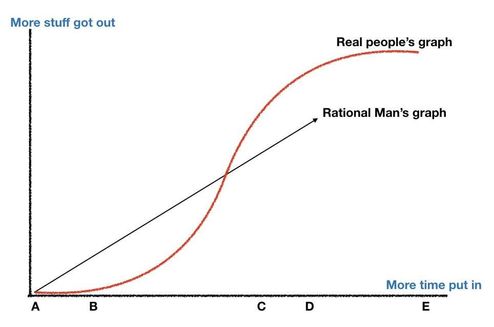
But once you get going, warm up, well then you really hit your stride. Each minute produces not only output but more output than the previous one. In the graph, this is the time between B and C.
Eventually, of course, you start to get tired. You’re still getting things done but each minute achieves a little less than its predecessor, until you’re barely getting anything more done for each moment. In the graph, this is the time between C and D. Here’s the rub though… most of us are conditioned to just work, work, work, work, work, and we carry on doing so until:
Let’s be blunt – most of us work on towards E. The last time I talked about this in a workshop I was greeted by a chorus of ‘E? More like the whole damned alphabet!’ We do this out of habit because we’ve never stopped to think about it. However, I’m hoping it’s pretty obvious from that graph that common sense suggests locating the point at which we should stop if we want to be most productive. When it’s pointed out to them like this, most people point to somewhere around D and say that’s where to stop. (Mathematically it’s C, but D is close enough.) The point is, it’s got to be before E, obviously. But it’s only obvious when you step back from the grindstone and look at it like this. How long is your A–D? Ah, now… that’s the question. It’s different for different people, and for different tasks for the same person. For example, I start to lose the will to live after about 15 minutes of proofreading. After about 20 I lose the will for anyone within reach to live, too. You have been warned. By comparison, I have a member of my team (hello, Clare!) who can smell a misplaced comma in the dark, before I turn on the computer on, and at a range of over 200 miles. For proofreading, her A–D is about 90 minutes. Conversely, when it comes to research I can work solidly for up to two and a half hours or so. (I spent 24 years as a university researcher.) 
How should we use this?
Here’s a simple tool that will help you be as mind-bendingly productive as possible. Jot down all the major things in your job – ignore stuff you only ever do once in a blue moon. And be quite crude about it if you need to. Then make your best guess of your A–D for that time. I asked Louise, our host, to put together some numbers. These are crude estimates but they give you an idea.
Remember, these are Louise’s first guesses for how long she can undertake each task until she becomes tired and unproductive, not how long she should work on any given document/book or whatever. When you know how long you’re at maximum productivity for, block those things into your diary in time chunks that match, less about 20 minutes or so (use some common sense here for things with only a short A–D!). Lots of people find it handy to set up an alert on their phone for the t−20 moment; when it goes off, you should ask yourself a brutally hard question – formally, consciously and with intent: Am I in the C bit of the graph or past it? If things are good, you’re golden. If not, adjust the time in your diary and the alert on your phone. Use the new information in the future. Back to Louise. This is what her typical working day looks like at the moment. Note that she’s only got six hours in a day, so straight away you can see that something’s got to give! 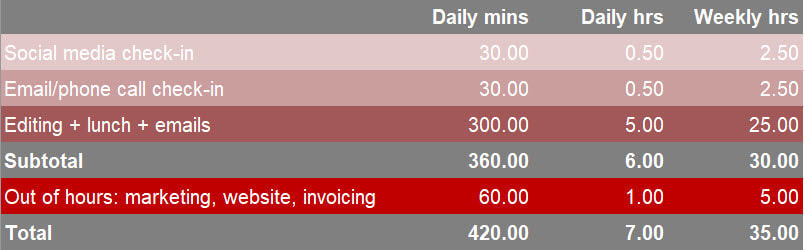
That way she’s be working at her maximum productivity for much more of the time.
Wouldn’t it be lovely if by upping how much work she can cover in a six-hour day, she doesn’t need to steal time from her husband in the evening? (Your mileage may vary of course! You might want to have the excuse!) The downside What’s the snag? Well, the main drawback of this is that your diary will look like an explosion in a rainbow factory and you’ll have to put some effort in to make it work. Nothing worth doing works without a bit of initial mental sweat. Implementing this change might require a complete shift in your mindset. And for that you’re gonna need a whole lot of chutzpah. But trust me – it’s worth it. You spend units of ‘courage’ and get back units of time. Personal note (or bragging, if you prefer) Still not convinced? By making sure I chopped my day up to what worked best for me, a couple of years ago, in only a three-month period I achieved the following:
You may have detected a degree of smugness there. Sorry! Your turn! What do you think? How long are your A–C periods? And your C–E periods? The ratio between those two could give you a reasonable idea of how much time you’re wasting. Let us know!
Want to know more?
Simon's a presentations expert as well as a productivity guru. If you want to get in touch, here's what you need:
Louise Harnby is a line editor, copyeditor and proofreader who specializes in working with crime, mystery, suspense and thriller writers.
She is an Advanced Professional Member of the Chartered Institute of Editing and Proofreading (CIEP), a member of ACES, a Partner Member of The Alliance of Independent Authors (ALLi), and co-hosts The Editing Podcast. Visit her business website at Louise Harnby | Fiction Editor & Proofreader, say hello on Twitter at @LouiseHarnby, connect via Facebook and LinkedIn, and check out her books and courses.
Proofreading for publishers is something every professionally trained new entrant to the field should consider. Many of my experienced colleagues work exclusively for publishers. I used to and don't regret it for a minute.
And it can be profitable, despite what you might have heard. 
Just a few of the benefits of publisher work include:
Some proofreaders are finding that publisher work is not as profitable as it once was. Perhaps the fees haven't increased in real terms, or the proofreader is being expected to check more words per paid page. Being efficient has become key to sustaining these valuable client relationships. The PDF below includes some tips and tricks on how to make proofreading for publishers (and packagers) profitable by spicing up your digital efficiency. The advice is based on my experience of working for academic publishers for over a decade. Click on the image to download your free copy. I hope you find it useful. 
Louise Harnby is a line editor, copyeditor and proofreader who specializes in working with crime, mystery, suspense and thriller writers.
She is an Advanced Professional Member of the Chartered Institute of Editing and Proofreading (CIEP), a member of ACES, a Partner Member of The Alliance of Independent Authors (ALLi), and co-hosts The Editing Podcast. Visit her business website at Louise Harnby | Fiction Editor & Proofreader, say hello on Twitter at @LouiseHarnby, connect via Facebook and LinkedIn, and check out her books and courses.
Anna is training to be a proofreader and plans to set up her own business in the near future. She’s ready to upgrade her kit but wants to make sure her investment is fit for purpose.
Says Anna:
At the moment I am working on an old-ish MacBook Pro but know I need to upgrade very soon. The dilemma is whether to buy an improved laptop or move to a desktop. My preference is for Apple products as I know my way around them better. I’m tempted to get a better laptop. I like the freedom of being able to move around and I often travel. But I know that a desktop would give me a significantly bigger screen. What are your thoughts on screen size for proofreading? How important is it to have a large screen, or is it easier to use two screens side by side at times? And if you use a laptop how small a screen would you consider too small?
Hi, Anna!
Great question. In short, I think you should go for what suits your lifestyle best. But let's look at some options. The greedy option This is my choice! In my shed, I have a desktop with two large screens. In my house I have a backup 14” notebook. 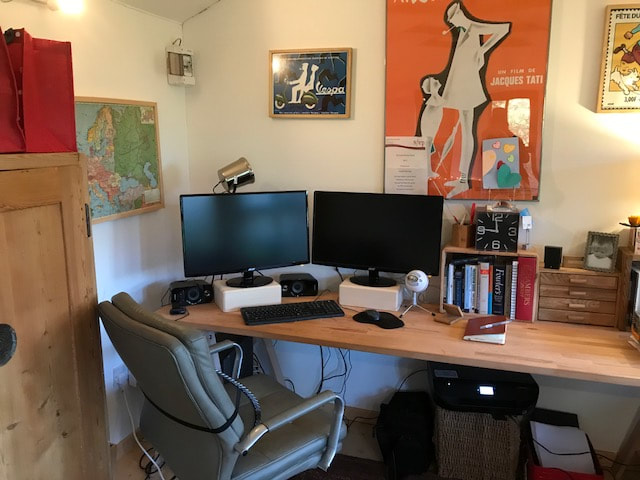
Some of my editing colleagues have three or four large screens rigged up to their desktops. That’s great if your machine can handle it (some can’t) and if you have the space (some don’t).
If I’m honest, until recently I considered it unthinkable to work five hours a day on my HP Pavilion notebook. My desktop and double screenage setup was a necessity! I suspect there's evidence of that thinking somewhere here on the blog! But that’s hogwash. In November, a family member became poorly and I had to relocate from my office (at the bottom of my garden) to the dining table in my house. 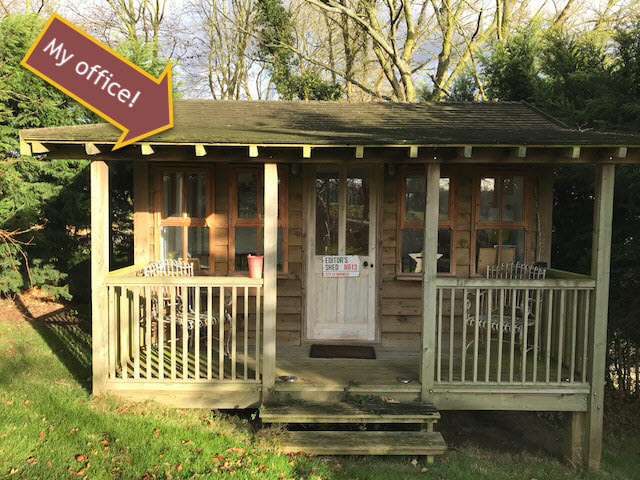
We’re now past the middle of January and I’m still there, though I’ll be heading back to the shed in a week.
But you know what? It’s been fine ... more than fine. Yes, I've had to toggle a lot more but that’s such a first-world problem! And I do have a second screen! My pal and fellow editor Kat Trail told me about an app called Duet that allows me to hook up my Windows notebook to an an iPad ... MS to iOS. Who'd have thought? And she showed off her new lap-desk. Like a sheep, I bought the whole caboodle! It works like a dream. Thanks, Kat! 
The light option
You say you like to travel. Meet Kate Haigh, another editor friend of mine. She’s location independent. She works with a laptop and nothing else. It gives her the flexibility and mobility she needs to travel the world. She’s in Guatemala City as I write! Once upon a time, she had multiple large monitors, but she adapted. Given your itchy feet, you might like to read her posts about location-independent editing and proofreading (see the Taking Your Proofreading Service on the Road series via For Editors and Proofreaders section on the Kateproof blog). There are lots of tips and tools on offer for editors who want to lighten the load. One of Kate’s favourite pieces of equipment is the lightweight, foldable Roost laptop stand If you decide to commit to a new laptop but want an additional largish monitor, hook up your existing MacBook Pro or splash out on an additional monitor especially for home use. What’s too small? I’d recommend a screen that's at least big enough to house the full width of one page at a viewing scale that’s readable, with some room in the margins to spare. That way you can call up a navigation pane in the sidebar without having to scroll across the page. Additional navigation panes could include the Find pane in Word or the Bookmarks pane in a PDF reader. I can achieve this comfortably with my 14” notebook screen. Beyond the screen: RAM and processor I think that screen size is less important than RAM and a decent processor. The more programs we’re running, the bigger the demands on our kit. When we’re professionally editing and proofreading, we’ll likely have multiple files open simultaneously. We’ll be running Word and/or PDF readers. We’ll be using additional software (macros, for example) to complement our beady eyes. And there are online tools and resources (e.g. email, dictionary and style manual) that we’ll need to access. Regardless of whether seeing all that stuff requires a quick keyboard toggle or is viewable on multiple screens, it’s greedy. Focus on performance first and screen size second. Smaller screens can be adapted to. Poor processor performance and memory can’t – they're just a frustration and will slow you down. Back to my notebook: the screen is only 14" but it has an Intel Core i5 7th gen processor (not the highest spec but good enough), 8GB of RAM, and a 256GB SSD, all of which means the machine can fire on all cylinders while I'm putting it through its paces. In a nutshell You don’t need one large screen to do a pro job. You certainly don’t need three. You might well find them rather marvellous if you have room and are not looking to go anywhere anytime soon. But if they’re going to clutter up your living space and remain unused much of the time because you’re on the road, they’re a waste of your money. Invest in the equipment you feel comfortable with and that works hard for you, and you’ll not go far wrong. Good luck with your training!
Louise Harnby is a line editor, copyeditor and proofreader who specializes in working with crime, mystery, suspense and thriller writers.
She is an Advanced Professional Member of the Chartered Institute of Editing and Proofreading (CIEP), a member of ACES, a Partner Member of The Alliance of Independent Authors (ALLi), and co-hosts The Editing Podcast. Visit her business website at Louise Harnby | Fiction Editor & Proofreader, say hello on Twitter at @LouiseHarnby, connect via Facebook and LinkedIn, and check out her books and courses.
Many independent authors want to see a sample of an editor or proofreader's work prior to signing a contract for editorial services. This post discusses sample edits, why they're useful, and what they cost.
Sample edits give the author the opportunity to compare the work of several different professionals and to assess the editing or proofreading against the price being quoted.
The editor needs to be sensitive to the author’s style, the characters’ voices and the mood of the scene such that the soul of the writing remains intact. Samples help the author to compare editors’ technical competence and their emotional responsiveness to the text. In this case, the question is not so much 'Who’s the best?' but 'Who’s the best fit?' What’s in it for the editor or proofreader? Samples are beneficial for the editorial pro, too. Here are some of my reasons for doing sample edits: Tangled terminology Definitions of the different levels of editing vary widely from client to client and editor to editor. What X calls proofreading, Y would call copyediting. What Y calls copyediting might be called line editing by Z. And where definitions differ, so do expectations. Working on a sample enables me to assess what’s required – regardless of the word(s) being used to describe that service. Time: How long does it take? Doing a sample edit shows me how long it takes to work through, say, a thousand words. That means I can estimate how many hours the project will take to complete and whether/when there’s an appropriate slot in my schedule. A 100K-word novel that needs copyediting for spelling, punctuation and grammar errors and inconsistencies, and only a little tweaking for clarity may take 35 hours (one to two weeks in my schedule); a novel of the same length that requires a deeper line edit may take 100 hours (four to six working weeks in my schedule). Appropriate pricing Once I know roughly how long the project will take to complete, I can price it accordingly. Am I a good fit? I usually find that the process of immersing myself in the author’s words comes easily. In the case of a deeper line-editing sample, the work will certainly be time-consuming but I can feel my way through – mimicking the author so that my edits (or suggested recasts) improve and complement the original writing rather than rubbing up against it. This isn’t always the case, though. Sometimes I’m just not a good fit – it’s not obvious how I can put the ooh! into the writing. It’s not that the amendments I’m making are technically incorrect but rather that I’m not able to find that emotional responsiveness that the client needs. When that happens, it’s time to thank the author for the opportunity to do the sample and provide a quotation, but recommend they work with someone else. Why I charge a fee for samples I usually charge a set fee of £50 for a sample of 1,000 words. Some of my colleagues offer free sample edits, so why do I charge? My professional time has a cost to it Every minute that I spend doing free editorial work is a minute I could be spending on paid-for work for clients or maintaining my business’s visibility (which is what leads clients to me in the first place). Scheduling problems Because I’m visible, I have little spare time in my schedule to fit in additional work, and certainly not free work. It’s not as off-putting as you might think I was curious as to whether potential clients would object to my charging for samples. In fact, since I introduced the policy last year, most enquirers have reacted to my fee positively – ‘Of course, not a problem’ is the standard response. This allows me to treat sampling like any other job I’m commissioned for. Filtering There have been cases, though they’re rare, where a client has asked 20 or 30 editors from my professional editorial society for a sample edit, and the chapters offered are all different. It appears that the enquirer is looking for a backdoor to a free complete book edit, farming out bits and pieces here and there. Charging for samples enables me to filter out the cheats. The benefits of the gratis option Charging for sample edits may not be the best course of action for all editorial freelancers. While I’ve encountered little objection to date, there are some perfectly legitimate clients who expect a small sample to be edited for free on the understanding that an hour or two of gratis work is acceptable given the reasonable odds of securing the full project. Here are some reasons why you might decide that free sample edits are the best option: New entrant/low visibility If you’re a new entrant to the field and are still building your discoverability, you might well decide that you want to take every opportunity possible to secure paying work. And if that means doing a few small freebies here and there, that’s a price you’re willing to pay. In this case, you’d be justified in regarding free samples as part of your marketing strategy. I think this is a valid argument. In my start-up phase, I didn’t charge for samples for this very reason. Scheduling If you’re still building your business, you may have space in your schedule that more experienced and visible colleagues don’t have. In that case, the opportunity cost of doing a free sample will not be as high. Continued professional development (CPD) You could view the opportunity to do free samples as a way of developing your experience. You can apply what you’ve learned in training to live test cases. By tracking whether these sample edits convert into commissions, you’ll be able to glean whether what you’re doing is appealing (or not) to potential clients. If you’re a new entrant to the field, sampling can be an invaluable teaching tool that gently introduces you to texts that need very different levels of attention. The safe space When I started up my business, the one thing that worried me was the element of surprise. What if the proofread I’d been commissioned for turned out to be a complete nightmare? What if in only reading the text, rather than actually working on it, I’d vastly underestimated the speed at which I could work and therefore undercharged? Doing samples is a great way for the new starter to get a good sense of what they’re taking on, but in a safe space with no obligations. And because no money’s changed hands, there’s no chance of complaint because of misunderstandings over what’s on offer (from either the editor or the client). It's not worth charging Our international editing community is diverse, and we do a lot of different things for many different client types. Sometimes charging is more effort than it's worth. Here's Erin Brenner: 'I do free samples of up to 1,000 words. This allows me to show my value and ease any concerns about the edit. However, I work for corporate clients with ongoing work and multiple stakeholders. Charging for a sample edit would also mean getting the accounting department involved, which is more effort than its worth for both sides.' Make your own choice I charge for sample edits (most of the time); others offer freebies. Some of my colleagues don’t offer sample edits at all, free or paid-for. There’s no right or wrong choice. How you decide to handle the issue should be based on what’s right for you, not on what others are doing. Consider your availability, your stage of editorial business ownership, whether free sampling could be a marketing or CPD tool, and how comfortable you are with the possibility that some legitimate clients could be discouraged by charges. Think about doing a test over the course of a year – commit four months each to offering free samples, paid-for samples and no samples, and track your conversions. The results may surprise you! Here's something to help you decide whether free, fee or test is the best approach to handling sample edits. Hope you find it useful! And if you want a flavour of what other editors are doing, take a look at the lively discussions on LinkedIn and Facebook that emerged when I posted links to this article. 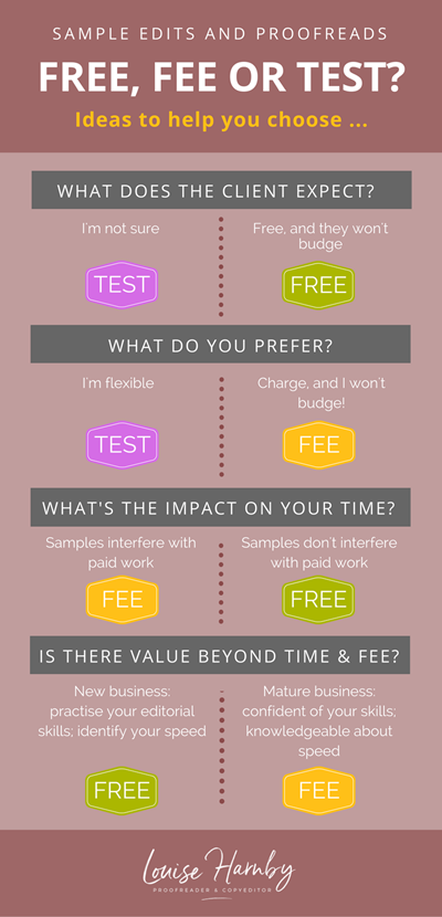
Louise Harnby is a line editor, copyeditor and proofreader who specializes in working with crime, mystery, suspense and thriller writers.
She is an Advanced Professional Member of the Chartered Institute of Editing and Proofreading (CIEP), a member of ACES, a Partner Member of The Alliance of Independent Authors (ALLi), and co-hosts The Editing Podcast. Visit her business website at Louise Harnby | Fiction Editor & Proofreader, say hello on Twitter at @LouiseHarnby, connect via Facebook and LinkedIn, and check out her books and courses.
The topic of editing and proofreading rates is always hot in our community. And the 'race to the bottom' especially has been known to garner more attention than an Olympic 100-metre final. So what should we do about it?
Competing with cheap
Here in Norwich there’s a mall. In that mall is a discount store selling techie stuff ... phones, tablets and whatnot. You go into that shop expecting a deal. It’s where people go when they’re price-shopping. Not because they’re terrible people who are always looking for cheap but because the coffers are low. Maybe the car failed its MOT and they had to find an extra seven hundred quid that month. Or they recently lost their job. Or something. In that mall on the floor above is an Apple store selling shiny things for shiny people. You don’t go into that shop expecting a deal. You go in expecting to pay what you have to pay to get the shiny thing you want. It’s where people go when they’re product- or service-shopping. The coffers are flush. The car passed its MOT and the job is secure. Or something. 
All clients are not the same
Now, Apple could decide not to have a store in that mall. It could say, ‘This is ridiculous. No one’s going to buy our stuff when they can get similar products from the shop on the floor below for one fifth of the price. Being in that mall is a race to the bottom.’ But Apple doesn’t say that. Why? Because it knows that the customers who come into the mall aren’t all the same. Some won’t come near its store because the prices are too high. But others – those who are looking specifically for an Apple product, those who are Apple fans, those whose cars passed their MOTs – might pay Apple a visit. If it doesn’t have a store in the mall, Apple knows it will lose the custom of all the people who’d like to buy there but can’t because it’s decided not to set up shop ... and all because it got the hump about the race-to-the-bottom store on the floor below. In fact, Apple doesn’t focus on the store below. It doesn’t care what that store is charging. That store can service the price-shoppers – those customers whose budgets are limited – because those customers are NOT Apple’s customers. Instead, Apple invests its energy in making the service-shoppers – its fans – have an amazing experience ... lots of knowledgeable, passionate staff on hand, a Genius Bar, technicians out back who’ll fix or replace a product in-store or replace it, and lots of lovely shiny stuff to play with while we wait. Apple knows that there’s room in the mall for both types of store and both types of customer. And it’s the same for editors and proofreaders. 
Standing up for the market or hiding behind a curtain?
If you decide not to make yourself visible in particular directories or other online spaces because you know there are colleagues charging what you consider to be unacceptably low rates, and you think no one will hire you because you’re charging more, you’re assuming that all clients are the same. But they’re not. Some clients will have low incomes or busted cars that need expensive repairs, and they will be attracted to the discount editors. Some will have more flexible budgets and will be focused on finding the right-fit editor first and foremost. Price will not be the clincher for the latter group. However, clients can only commission services from an editor whom they know exists. If you have the hump about the race to the bottom and have decided not to join the party, you’re not standing up for the editorial market. All you’re doing is hiding behind the curtain, making yourself invisible to those clients who would have liked to work with you if they’d been able to find you. And don’t forget that Google is the biggest directory of all. There’s no other online space with more editors in it. Some of them are cheap as chips. Has that stopped you having a website? No. The same logic should apply elsewhere. How to be the Apple editor Of course, we can’t have it both ways. If we don’t want to compete with discount editors then we need to get attention in a way that shifts the client’s focus away from price. Expecting to benefit from the same footfall as the discount editor without offering a compelling alternative is just wanting to have our cake and eat it. We need to stand out for some other reason. We need to make the client think: That editor looks perfect for me, seems to get me, is really generous and knowledgeable. I hope she’s available and that if I save up I can afford her. Sure, the price-focused clients aren’t going to touch us with a barge pole. But that’s fine because we’re not targeting them; we’re targeting the service-focused clients. To be the Apple editor we need to present potential clients with an amazing experience – a story that says we have solutions, that we have their backs, that we can help them achieve their goals ... a story that persuades them we’re worth waiting for and worth paying for. It’s about the words we use to convey our understanding of our clients’ problems. It’s about the images we use to convey our professional values. Blurry headshots with our mates or kids in them won’t do. It’s about how we instil trust. Telling them that we know our stuff – that we have the skills, the knowledge and the experience – is one thing. Showing them with free resources and a knowledge base that helps them more easily walk the publication path ... that’s quite another. 
Time well spent on standing out
Every minute we spend worrying about what other editors are charging is a minute in which we could be building our own compelling brand identity and creating our own valuable resources, stuff that helps our potential clients feel we’re the right fit. Every directory that we don’t advertise in because we think it’s a race to the bottom is another tick on our invisibility list. If you’re invisible, it doesn’t matter how high your prices are. No one will hire you. Not because your prices are too high but because you can’t be seen. Being invisible is of no economic value to any editor or proofreader. So charge what you want to charge. If you want to compete on price, go ahead. If you want to compete on compulsion, go ahead. The compulsion route isn’t easy. It means investing time and effort in standing out – all that content marketing stuff I bang on about! It means thinking deeply about how every word of your directory entries and every page of your website helps a potential client and makes them feel that you’re just too wowser to ignore. All that hard graft pays off though. You can sit beside the cheaper editors without fear. You can let them have the price-shoppers while you work with those who can afford you. Just like Apple and the discount store, we’re dealing with two different markets. The idea that your business could be undermined by a colleague charging way lower than what you deem to be acceptable is, says Jake Poinier, ‘nonsense. Creative freelancing is a market, and only you can establish the value you bring to it. I don’t view the low end of the freelance rate scale as my competition’ (Stop worrying about freelancers who undercharge). I agree with Jake. Honestly, there’s room for everyone. Don’t waste your valuable time on the issue. Instead, build your business, your brand identity, your visibility and your value. Therein lies success. Want a reminder of this article? Download this free ebook to your preferred device. Head over to the Money Matters section of my Resource Library to get your copy. 
Louise Harnby is a line editor, copyeditor and proofreader who specializes in working with crime, mystery, suspense and thriller writers.
She is an Advanced Professional Member of the Chartered Institute of Editing and Proofreading (CIEP), a member of ACES, a Partner Member of The Alliance of Independent Authors (ALLi), and co-hosts The Editing Podcast.
Yolanda is a self-published author who wants to build a fiction proofreading and copyediting business. In this Q&A I consider the steps she should take to get her editorial business off the ground and fit for purpose.
Says Yolanda:
I am a fiction author located in U.S. and I've been self-publishing for almost 6 years under various pen names. I still work full-time (over 20 years in the administrative field), however I would like to start a freelance career as a fiction proofreader/copy-editor. I am a certified legal proofreader but outside of my day job & my own books I don't have experience proofing. I intend to use freelance job sites & my connections with self-published authors to build my portfolio. As far as blogging, I'm not sure what I would discuss since my focus is fiction & I'm not an expert yet to give other proofreaders advice. What would be my next steps to transition from fiction author to fiction proofreader/ copy-editor for self-published authors as far as getting my business up & running, classes (if any), pricing, etc? Hi, Yolanda! Thanks for your question. I’ve broken down my advice as follows:
Training I think you’re wise to consider training. It’s essential that your knowledge of grammar, spelling and punctuation conventions is top-notch. If it’s not, you won’t be able to correct your clients’ files to industry standards. I'd recommend that you search for a grammar brush-up course as a first step. That will enable you to discover whether your technical knowledge is on point and if there are any weaknesses that you need to attend to. Here are a couple of options for you to consider:
Fiction work does require an empathetic hand because editors and proofreaders are often faced with the dilemma of how to amend such that we remove errors and improve readability but respect narrative voice and flow. However, it’s only when you know what a problem is that you can decide whether to fix it! Training is absolutely the right place to discover your weak points. Better that than via a disgruntled client. Your second step should be to undertake professional editorial skills training. This will be of particular use to you because it'll move you into the editing mindset and away from the authorial one that you're used to. I appreciate that you've self-edited, but editing one's own work is a very different proposition to offering professional services to paying customers, as you clearly realize. Professional training will also enable you to determine the level of intervention that each type of editing requires. In turn, that will help you avoid scope-creep and undercharging. Especially when proofreading, knowing when to leave well enough alone is an art in itself! Here are some reputable US-based programmes to consider:
Services
You’ll need to develop a service model that differentiates between the different levels of editing. Many self-publishing authors don’t know the differences between proofreading, copyediting, line editing, and developmental editing. Many editors' definitions vary too. And so while the lines are often blurred, especially when we compare different independent editors’ service descriptions, professional training will help you clarify how you'll describe your services so that your clients understand exactly what’s on offer. You can see some examples of how I’ve tackled definitional issues here:
I’d advise taking a look at a range of editors’ websites to familiarize yourself with the breadth of services on offer and the way your future colleagues describe these. There’s no right or wrong. Rather, it’s all about clear communication and helping the client understand how you can solve their problems. 
Visibility
Blogging needn't necessarily be your primary content platform, though I think it works well for editors and proofreaders because our wordy clients are comfortable with wordy information! Even if you don't concentrate on vlogging or podcasting, at least think about how you can introduce audio-visual material into your marketing mix in order to stand out and offer your audience alternative ways to get what you're offering. You don’t need to focus on colleagues either. Far from it. Fifty per cent of my content is created for beginner authors. I’d recommend you consider using your experience as a self-published author of fiction to guide potential clients on how to navigate their own publishing journeys. Think about what their problems and questions might be. Think about what your own problems and questions were! For example, you mentioned having used a pen name; that would be an interesting topic to any beginner author wondering whether they should publish under their own name. Great content marketing solves problems. If you decide to blog, offer fantastic value by helping other writers solve their conundruns using all your knowledge and experience ... the rough and the smooth. Everything you’ve learned on your own journey has the potential to help others. Don’t forget that your experience of self-publishing can be used as a unique selling point that makes you stand out. Combine that with high-quality training and you’ll be on the way to building a compelling online presence. Consider how you might make your content visible beyond the blog (or vlog or podcast) by creating a resource hub that makes what you’ve created accessible via different pages on your website. It’s my belief that having an individual, standout online fingerprint is essential for those entering the editorial freelancing market. There’s too much competition out there to create a website that looks just like everyone else’s. So do focus on your marketing so that over time you can be as discoverable as possible. Here are a few examples:
Pricing
Many national editorial societies have guidelines or suggested minimums for what editors should charge. I look at these but don’t use them to determine my own rates because they distract me from the important things than any pricing model needs to take account of. These are:
In relation to your needs, it matters little if the Editorial Freelancers Association thinks that $30–50 per hour is a common and acceptable rate for copyediting if you need $70 per hour to keep the bailiffs from the door. With that in mind, when you start to think about pricing, work out first what you need to earn as a minimum to make your business viable. That’s your baseline. From there you can work upwards to what you want to earn and what your clients will bear. Self-publishing authors aren’t a homogeneous market when it comes to writing skill, genre or budget. Some will be shopping for an editor whose fees are lower than that which you need to earn. Others will be prepared to pay more than you want to earn. Yet others will sit somewhere in the middle. It’s not only the budget that will vary; your authors' locations will too. And so if your potential client is based in Sweden, it’s likely that what $40 will buy in Sweden is not the same as what it will buy in the US. Since the cost of living varies from country to country, what an American client thinks is a high rate might seem an absolute steal to the Swede. And that’s another problem with professional association pricing tables – they focus on the domestic market whereas your potential market lies well beyond the sovereign state in which you reside. That’s why it makes more sense to build your pricing model on your own needs rather than some notion that there’s one universally applicable rate (or range) for editing or proofreading. There isn’t. There’s some excellent detailed guidance on editorial rate-setting from Rich Adin on the American Editor blog. Start with the following: Sign-off I hope all that gives you a few ideas for how to move forward, Yolanda, and I wish you well on your editorial business-building journey! There’s plenty more information on my blog in the following archives: Money Matters, Marketing, Starting Out and Training. Dig into that and start connecting with other editorial pros online. There are lots of us on Facebook (the Editors’ Association of Earth is a good place to start), Twitter and LinkedIn ... and beyond! See you there!
Louise Harnby is a fiction copyeditor and proofreader who specializes in helping self-publishing writers prepare their novels for market.
She is the author of several books on business planning and marketing for editors, and runs online courses from within the Craft Your Editorial Fingerprint series. She is also an Advanced Professional Member of the Society for Editors and Proofreaders. Louise loves books, coffee and craft gin, though not always in that order. Visit her business website at Louise Harnby | Proofreader & Copyeditor, say hello on Twitter at @LouiseHarnby, or connect via Facebook and LinkedIn. If you're an author, take a look at Louise’s Writing Library and access her latest self-publishing resources, all of which are free and available instantly. |
PDF MARKUP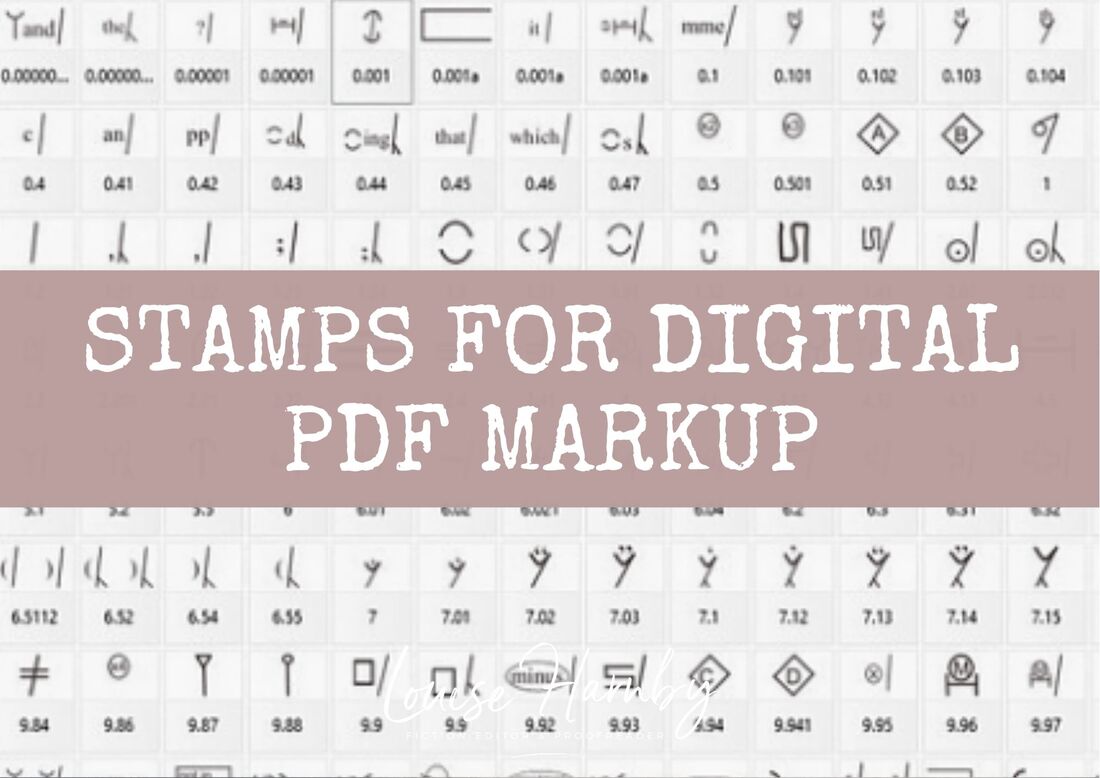
AUTHOR RESOURCES
EDITOR RESOURCES
TESTIMONIALSDare Rogers'Louise uses her expertise to hone a story until it's razor sharp, while still allowing the author’s voice to remain dominant.'Jeff Carson'I wholeheartedly recommend her services ... Just don’t hire her when I need her.'J B Turner'Sincere thanks for a beautiful and elegant piece of work. First class.'Ayshe Gemedzhy'What makes her stand out and shine is her ability to immerse herself in your story.'Salt Publishing'A million thanks – your mark-up is perfect, as always.'CATEGORIES
All
ARCHIVES
April 2024
|


 RSS Feed
 |

|

|

|

|
|
|
|
© 2011–2024 Louise Harnby