
|
Learn about 5 things you can do to give your editing and proofreading business a new-year polish.
|
|
Tier 1: EditPod Tea Pot
Perhaps you’d like to buy us a pot of tea to help fuel us during the writing and recording process! 
|
Tier 2: EditPod Tea Party
Or for just a few quid more, meet and chat with us live during our quarterly tea parties. 
|
With the tea-party tier, you’ll receive exclusive invitations every 3 months to join us on Zoom for an hour’s conversation about topics related to editing and running an editorial business.
Ask questions, get guidance on how to solve your editorial business problems, or just sit back and soak up the chat.
Music credit
‘Vivacity’ Kevin MacLeod (incompetech.com). Licensed under Creative Commons: By Attribution 3.0 License. http://creativecommons.org/licenses/by/3.0/
Louise Harnby is a line editor, copyeditor and proofreader who specializes in working with crime, mystery, suspense and thriller writers.
She is an Advanced Professional Member of the Chartered Institute of Editing and Proofreading (CIEP), a member of ACES, a Partner Member of The Alliance of Independent Authors (ALLi), and co-hosts The Editing Podcast.
She is an Advanced Professional Member of the Chartered Institute of Editing and Proofreading (CIEP), a member of ACES, a Partner Member of The Alliance of Independent Authors (ALLi), and co-hosts The Editing Podcast.
- Get in touch: Louise Harnby | Fiction Editor & Proofreader
- Connect: Twitter at @LouiseHarnby, Facebook and LinkedIn
- Learn: Books and courses
- Discover: Resources for authors and editors
Fancy treating yourself in the run-up to the holidays? You can save a whopping 30% on any course you buy from me between now and 24 December 2021.
To get your festive savings, enter the coupon code CRACKER2021 at checkout.
To get your festive savings, enter the coupon code CRACKER2021 at checkout.

Which courses are included?
The special offer applies to all my online courses. Everything I teach is based on my own practical experience, so I know it works.
Here's a whistle-stop tour of what's available.
EDITORIAL BUSINESS GROWTH COURSES
FICTION EDITING COURSES
COURSES FOR WRITERS
The coupon code is CRACKER2021 and expires on 24 December 2021.
Here's a whistle-stop tour of what's available.
EDITORIAL BUSINESS GROWTH COURSES
- Create a unique editorial brand identity with Branding for Business Growth.
- Craft a powerful, branded website that entices clients with Editor Website Essentials.
- Power up your promotion game with the Marketing Toolbox for Editors.
- Master the art of content that creates work leads with Blogging for Business Growth.
- Learn how to secure work fast with 10 Ways to Get Editing Work Quickly.
- Develop a social media strategy that increases visibility with Social Media for Business Growth.
- Find out how to create great content that gets you seen and saves you time with To Visibility and Beyond.
FICTION EDITING COURSES
- Write gorgeous reports that serve your clients and your business with How to Write the Perfect Fiction Editorial Report.
- Find out how to become a fiction editor with Switching to Fiction.
- Recognize and control psychic distance in your editing practice with Narrative Distance: A Toolbox for Writers and Editors.
COURSES FOR WRITERS
- Recognize and control psychic distance in your writing practice with Narrative Distance: A Toolbox for Writers and Editors.
- Learn 11 pithy line-editing tips that make a substantive difference to writing flow and reader experience with Preparing Your Book for Submission.
The coupon code is CRACKER2021 and expires on 24 December 2021.
Thank you for reading The Editing Blog, listening to The Editing Podcast with me and Denise, and just being there as friends and colleagues during another challenging year. You're all stars!
I wish you all the best for the rest of 2021 and the new year ahead.
I wish you all the best for the rest of 2021 and the new year ahead.

Louise Harnby is a line editor, copyeditor and proofreader who specializes in working with crime, mystery, suspense and thriller writers.
She is an Advanced Professional Member of the Chartered Institute of Editing and Proofreading (CIEP), a member of ACES, a Partner Member of The Alliance of Independent Authors (ALLi), and co-hosts The Editing Podcast.
She is an Advanced Professional Member of the Chartered Institute of Editing and Proofreading (CIEP), a member of ACES, a Partner Member of The Alliance of Independent Authors (ALLi), and co-hosts The Editing Podcast.
- Get in touch: Louise Harnby | Fiction Editor & Proofreader
- Connect: Twitter at @LouiseHarnby, Facebook and LinkedIn
- Learn: Books and courses
- Discover: Resources for authors and editors
A common stumbling block for editorial business owners is making time for marketing. Here’s why we must make time, and some resources to help you organize your business-promotion schedule.
What’s in this post …
Read on to find out more about:
- Why running a business means finding clients
- Working for others – being an employee
- Working on your business and in your business
- Setting up a business and marketing: The order of play
- Shifting from a no-time mindset to an all-the-time mindset
- Taking a strategic approach to marketing
Why running a business means finding clients
Every time an editor or proofreader says they don’t have time to build and implement a marketing strategy, they’re saying they don’t have time to find work.
None of us can run a business if there’s no business to run. Editing and proofreading work is essential. Otherwise we’re nothing more than a fancy title on a business card.
If marketing isn’t a part of your business model, it’s time either to work for someone else or shift your mindset.
None of us can run a business if there’s no business to run. Editing and proofreading work is essential. Otherwise we’re nothing more than a fancy title on a business card.
If marketing isn’t a part of your business model, it’s time either to work for someone else or shift your mindset.
Working for others – being an employee
There’s nothing wrong with being an employee. For some it’s a more suitable career choice. Unless you apply for a job in the marketing department, it will be someone else’s responsibility to do the company’s promotional work, to pull in the clients.
If you want to do your own thing, however, a commitment to business marketing must be part of the mix. That’s the difference between being self-employed and self-unemployed.
If you want to do your own thing, however, a commitment to business marketing must be part of the mix. That’s the difference between being self-employed and self-unemployed.
Working on your business and in your business
Every independent editorial business owner has two jobs:
There’s no way around this. The approach we use to find work will depend on who our target clients are. Think social media, content marketing, advertising, directory listings, professional membership, a visible website, letters, emails, networking, phone calls, and SEO. All or some of these will be in play.
If a no-time mindset is tripping you up, ask yourself whether you can imagine saying any of the following:
Those statements sound daft, don’t they? Of course we’d make time for editing, invoicing and checking spelling! We’re professionals and we’re business owners – those things are essential.
Finding work is just as important. If we don’t, there’s no editing to do, no invoices to send, no spellings to check.
Since we’re employers (of ourselves), not employees, we must do our own marketing, right from the get-go, and continue to do it for as long as we’re in business.
- The work they do
- And the work they do to get the work they do
There’s no way around this. The approach we use to find work will depend on who our target clients are. Think social media, content marketing, advertising, directory listings, professional membership, a visible website, letters, emails, networking, phone calls, and SEO. All or some of these will be in play.
If a no-time mindset is tripping you up, ask yourself whether you can imagine saying any of the following:
- I don’t have time to do editing.
- I don’t have time to send invoices.
- I don’t have time to check the spelling of a word in a dictionary.
Those statements sound daft, don’t they? Of course we’d make time for editing, invoicing and checking spelling! We’re professionals and we’re business owners – those things are essential.
Finding work is just as important. If we don’t, there’s no editing to do, no invoices to send, no spellings to check.
Since we’re employers (of ourselves), not employees, we must do our own marketing, right from the get-go, and continue to do it for as long as we’re in business.
Setting up a business and marketing: The order of play

Marketing doesn’t come after we’ve set up our business. That’s a misfire. It views marketing as if it’s a separate entity.
If we spend 12 months training to be a professional editor but dedicate no time to our marketing strategy, all we’ll have at the end is a skillset that’s invisible to everyone but us.
I know how to make lasagne, change a tyre, and remove a thorn from a Labrador’s paw, but those skills in themselves don’t mean people are offering me work as a chef, a mechanic or a veterinary nurse. Why would they? No one but me, my husband, my kid and my dog know I can do that stuff. I’ve not promoted those skills or set up a business around them (nor do I plan to, just in case you’re wondering!).
If you’re serious about becoming a professional editor, so much so that you’ve invested your hard-earned cash in a high-quality training course, start working on your marketing strategy at the same time so that you don’t end up as a professional thumb-twiddler!
If we spend 12 months training to be a professional editor but dedicate no time to our marketing strategy, all we’ll have at the end is a skillset that’s invisible to everyone but us.
I know how to make lasagne, change a tyre, and remove a thorn from a Labrador’s paw, but those skills in themselves don’t mean people are offering me work as a chef, a mechanic or a veterinary nurse. Why would they? No one but me, my husband, my kid and my dog know I can do that stuff. I’ve not promoted those skills or set up a business around them (nor do I plan to, just in case you’re wondering!).
If you’re serious about becoming a professional editor, so much so that you’ve invested your hard-earned cash in a high-quality training course, start working on your marketing strategy at the same time so that you don’t end up as a professional thumb-twiddler!
Shifting from a no-time mindset to an all-the-time mindset
Whatever marketing approach(es) you choose, do them regularly so that they’re a normal part of editorial business ownership.
Invoicing and tax returns are my least favourite aspects of running a business but I do them anyway. I have to. We all do.
Same thing with marketing. You don’t have to love marketing. You don’t even have to like it. Just do it anyway, all the time. Dedicate time in your business week to the task.
Every time you’re tempted to use that slot in your schedule to do something else, remind yourself that you don’t want to be self-unemployed, that you do want to earn a living from your editing business, and that when the client cupboard is bare it makes you feel miserable and stressed.
Invoicing and tax returns are my least favourite aspects of running a business but I do them anyway. I have to. We all do.
Same thing with marketing. You don’t have to love marketing. You don’t even have to like it. Just do it anyway, all the time. Dedicate time in your business week to the task.
Every time you’re tempted to use that slot in your schedule to do something else, remind yourself that you don’t want to be self-unemployed, that you do want to earn a living from your editing business, and that when the client cupboard is bare it makes you feel miserable and stressed.
Taking a strategic approach to marketing
Here are three things every editor needs to recognize about strategy:
A long-term marketing strategy is planned, targeted, and implemented continuously. That’s what keeps the cupboard full of good-fit clients, and what gives us the power to decide a project’s not a good fit, the price isn’t right, or the scheduling’s too tight.
- ‘I'd better do a bit of marketing because I’ve got no work lined up next month’ is not a strategy. It’s an emergency.
- ‘Great! I just got some work for next month so I don’t have to do any marketing for a while’ is not a strategy. It’s a recipe for a future emergency.
- ‘I’ll accept that horrible low-paid job because it’s better than nothing’ is not a strategy. It’s a business model that puts others in control.
A long-term marketing strategy is planned, targeted, and implemented continuously. That’s what keeps the cupboard full of good-fit clients, and what gives us the power to decide a project’s not a good fit, the price isn’t right, or the scheduling’s too tight.
Summing up
If you’re already marketing your editing business, fantastic. If you’re not, start now and don’t stop!
You don’t have to do your marketing the way I do my marketing. The foundation of my strategy is content marketing, but that’s because I work exclusively with independent authors in a specialist genre, and want those authors to find me via Google.
Your marketing strategy should reflect the best method of being visible to your ideal clients. That might mean sending emails, making phones calls, engaging in a group or forum, or advertising in a particular space.
And even if you don’t like marketing, make it part of your business practice anyway. Place it alongside the other aspects of your business that you’re obliged to do but would rather not. Why? Because marketing can mean the difference between working and walking away. If you’ve already invested your energy and money in training, that’s a waste of your valuable skills. You deserve more than that.
And who knows? You might even enjoy promoting your business once you start reaping the fruits of your labour!
You don’t have to do your marketing the way I do my marketing. The foundation of my strategy is content marketing, but that’s because I work exclusively with independent authors in a specialist genre, and want those authors to find me via Google.
Your marketing strategy should reflect the best method of being visible to your ideal clients. That might mean sending emails, making phones calls, engaging in a group or forum, or advertising in a particular space.
And even if you don’t like marketing, make it part of your business practice anyway. Place it alongside the other aspects of your business that you’re obliged to do but would rather not. Why? Because marketing can mean the difference between working and walking away. If you’ve already invested your energy and money in training, that’s a waste of your valuable skills. You deserve more than that.
And who knows? You might even enjoy promoting your business once you start reaping the fruits of your labour!
More marketing resources
Check out these additional resources about building a sustainable editorial business:
- Blogging for Business Growth (course)
- Branding for Business Growth (course)
- Business Skills Collection (6 ebooks)
- Marketing resource library (books, booklets and blogs and podcasts)
- Marketing Toolbox for Editors (multimedia course)
- Marketing Your Editing and Proofreading Business (book)
Louise Harnby is a line editor, copyeditor and proofreader who specializes in working with crime, mystery, suspense and thriller writers.
She is an Advanced Professional Member of the Chartered Institute of Editing and Proofreading (CIEP), a member of ACES, a Partner Member of The Alliance of Independent Authors (ALLi), and co-hosts The Editing Podcast.
She is an Advanced Professional Member of the Chartered Institute of Editing and Proofreading (CIEP), a member of ACES, a Partner Member of The Alliance of Independent Authors (ALLi), and co-hosts The Editing Podcast.
- Get in touch: Louise Harnby | Fiction Editor & Proofreader
- Connect: Twitter at @LouiseHarnby, Facebook and LinkedIn
- Learn: Books and courses
- Discover: Resources for authors and editors
Does ‘said’ come before or after the subject in a dialogue tag? Does it matter? This post explores the options and offers practical recommendations that serve writers seeking to build their author platform.
In this post ...
Read on to find out more about the following:
- What a dialogue tag is
- Why tags should support, not supplant dialogue
- Tagging: Positioning the verb in relation to pronouns
- Tagging: Positioning the verb in relation to nouns
- Standing out in ways that serve reader expectations
What a dialogue tag is
A dialogue tag, or speech tag, is the short piece of text that tells a reader that a character is speaking, and which character is speaking. For example:
Effective dialogue tags use verbs from which the reader can infer that the action of speech is taking place. Examples include ‘said’, ‘asked’, ‘replied’, ‘whispered’, ‘muttered’, ‘yelled’, ‘continued’ and ‘added’.
Ineffective dialogue tags use verbs that bring to mind action that’s not related precisely to speech but to some other behaviour. Examples include ‘sneered’, ‘grimaced’, ‘laughed’, ‘harrumphed’, ‘huffed’, ‘sighed’, ‘snarled’ and ‘urged’.
In this post, I’m going to focus on a question that beginner fiction authors and editors often ask about: where to locate ‘said’ and other effective tagging verbs.
First, though, here’s a quick recap about why ‘said’ is such a popular dialogue tag.
- ‘Are you enjoying reading that blog post,’ Louise said.
- ‘I’m interested in learning about dialogue,’ ze replied.
- ‘Can I stick to non-fiction editing?’ he asked.
Effective dialogue tags use verbs from which the reader can infer that the action of speech is taking place. Examples include ‘said’, ‘asked’, ‘replied’, ‘whispered’, ‘muttered’, ‘yelled’, ‘continued’ and ‘added’.
Ineffective dialogue tags use verbs that bring to mind action that’s not related precisely to speech but to some other behaviour. Examples include ‘sneered’, ‘grimaced’, ‘laughed’, ‘harrumphed’, ‘huffed’, ‘sighed’, ‘snarled’ and ‘urged’.
In this post, I’m going to focus on a question that beginner fiction authors and editors often ask about: where to locate ‘said’ and other effective tagging verbs.
First, though, here’s a quick recap about why ‘said’ is such a popular dialogue tag.
Why tags should support, not supplant dialogue
‘Said’ is the most popular speech tag in English-language writing because it’s virtually invisible. Readers are so used to seeing it that they ignore it and instead focus on its mechanical function – to verify who’s doing the speaking.
It’s become so conventional that when authors go out of their way to replace every instance of ‘said’ with alternatives, they risk creating prose that feels laboured.
Showy speech tags in particular stand out, and that means they pull the reader’s attention away from the dialogue and push it towards the speech tag.
That’s not a good reader experience because when characters communicate through speech, that’s where the action is in that moment. The tag should support that action, not supplant it.
You can find out more about how to tag dialogue in Editing Fiction at Sentence Level, including:
Now let’s look at where to place ‘said’ and other tagging verbs.
It’s become so conventional that when authors go out of their way to replace every instance of ‘said’ with alternatives, they risk creating prose that feels laboured.
Showy speech tags in particular stand out, and that means they pull the reader’s attention away from the dialogue and push it towards the speech tag.
That’s not a good reader experience because when characters communicate through speech, that’s where the action is in that moment. The tag should support that action, not supplant it.
You can find out more about how to tag dialogue in Editing Fiction at Sentence Level, including:
- Showy speech tags and underdeveloped dialogue
- Showy speech tags and double-telling
- Non-speech-based dialogue tags and the reality flop
- Alternatives to showy speech tags – more on action beats
- Using proper nouns and pronouns in dialogue tags
- Omitting dialogue tags
Now let’s look at where to place ‘said’ and other tagging verbs.
Tagging: Positioning the verb in relation to pronouns
Regardless of which pronouns are in play, it’s conventional in contemporary commercial fiction to place ‘said’ or any other tagging verb after the pronoun. Take a look at what’s on your bookshelf. Examples are easy to find. Here are some from my collection.
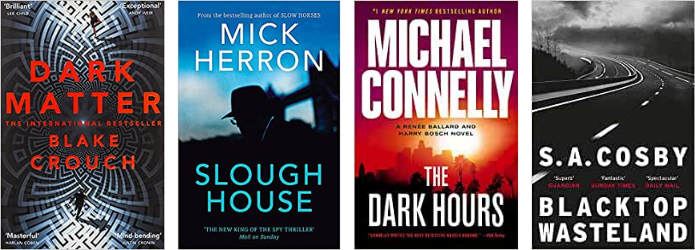
- “I know,” she says. “I’m violating the cardinal rule of family night.” (Crouch: Dark Matter)
- ‘I could do your job myself, if that’s what you mean,’ he’d said at last. (Herron: Slough House)
- “I don’t have no fucking mask,” he said. (Connelly: The Dark Hours)
- “Me and Jaymie will call it. You want your boy to go too?” he said. (Crosby: Blacktop Wasteland)
Let’s have a look at those examples when the verb is placed before the pronouns.
- “I know,” says she. “I’m violating the cardinal rule of family night.”
- ‘I could do your job myself, if that’s what you mean,’ said he at last.
- “I don’t have no fucking mask,” said he.
- “Me and Jaymie will call it. You want your boy to go too?” said he.
There’s actually nothing grammatically wrong with any of the edited examples, though I wasn't able to retain the past perfect in the second. What has gone awry is the narrative setting.
The dialogue is written in contemporary English but the verb placement evokes a distinctly historical feel that’s inappropriate.
So how about when nouns rather than pronouns are in play?
Tagging: Positioning the verb in relation to nouns
Authors published by mainstream presses tend to follow the same convention: the verb follows the noun. Once more, a visit to your bookshelf will confirm the frequency in contemporary commercial fiction. Here are some more examples from my collection.
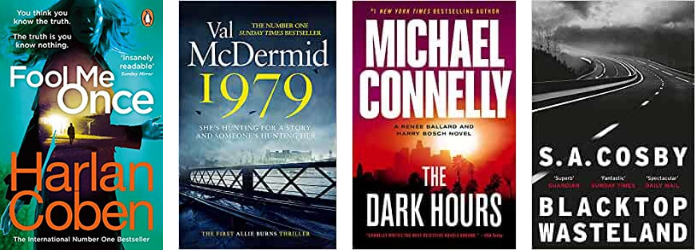
- “There was nothing you could have done,” Judith said. (Coben: Fool Me Once)
- ‘Are you feeling the cold?’ Danny asked. (McDermid: 1979)
- “Sir, I can’t help you until you get a mask,” Moore said. (Connelly: The Dark Hours)
- “The question is, do you have the balls to back it up?” Kelvin said. (Crosby: Blacktop Wasteland)
Now let’s move the verb so that it sits before the noun.
- “There was nothing you could have done,” said Judith.
- ‘Are you feeling the cold?’ asked Danny.
- “Sir, I can’t help you until you get a mask,” said Moore.
- “The question is, do you have the balls to back it up?” said Kelvin.
Again, there’s nothing grammatically problematic about this structure. Furthermore, the switch doesn’t jar in the same way as when the subjects are pronouns.
So how should independent authors (and the editors who support them) approach the structure of a tag?
Standing out in ways that serve reader expectations
I recommend my authors follow the noun-first convention, not because it’s right, or best, or grammatically correct, or the only one true way, but because when it comes to contemporary commercial fiction:
When readers are presented with stories that break with convention, there’s a risk that the story’s no longer the standout feature. Instead, those with strong preferences focus on minutiae that challenge their expectations.
That focus isn’t serving a writer who’s trying to build their author platform.
Mick Herron has built enough trust with his readership with his brilliant Jackson Lamb series that no one will bat an eyelid when they read the following in Slough House:
‘Ian Fleming,’ said Diana Taverner. ‘Means “Death to spies”.’
Nevertheless, I scoured the first chapter of that book and found that in the main he still favours placing the verb after the subject.
- lots of potential buyers of their books have come to expect this construction
- and it's the approach that mainstream presses tend to take.
When readers are presented with stories that break with convention, there’s a risk that the story’s no longer the standout feature. Instead, those with strong preferences focus on minutiae that challenge their expectations.
That focus isn’t serving a writer who’s trying to build their author platform.
Mick Herron has built enough trust with his readership with his brilliant Jackson Lamb series that no one will bat an eyelid when they read the following in Slough House:
‘Ian Fleming,’ said Diana Taverner. ‘Means “Death to spies”.’
Nevertheless, I scoured the first chapter of that book and found that in the main he still favours placing the verb after the subject.
Summing up
Placing ‘said’ and other speech-related verbs after the subject isn’t a ‘rule’ that must be applied in order to ensure a dialogue tag is grammatically correct.
However, it’s such a common convention that I recommend indie authors of contemporary commercial fiction follow it.
When the subjects in a tag are pronouns, this structure is essential for retaining a contemporary feel. When the subjects are nouns, placing them first gives the pedants one less thing to gripe about.
However, it’s such a common convention that I recommend indie authors of contemporary commercial fiction follow it.
When the subjects in a tag are pronouns, this structure is essential for retaining a contemporary feel. When the subjects are nouns, placing them first gives the pedants one less thing to gripe about.
Related reading and training
- Coben, H., Fool Me Once, Arrow, 2016 (Chapter 1, Kindle edition)
- Connelly, M, The Dark Hours, Orion, 2021 (Chapter 1, Kindle edition)
- Crosby, SA, Blacktop Wasteland, Headline, 2021 (Chapter 1, Kindle edition)
- Crouch, B, Dark Matter, Pan, 2017 (Chapter 1, Kindle edition)
- Harnby, L, Editing Fiction at Sentence Level, Panx Press, 2020
- Herron, M, Slough House, John Murray, 2021 (Chapter 1, Kindle edition)
- McDermid, V, 1979, Little, Brown, 2021 (Chapter 1, Kindle edition)
Fiction editing training courses
Louise Harnby is a line editor, copyeditor and proofreader who specializes in working with crime, mystery, suspense and thriller writers.
She is an Advanced Professional Member of the Chartered Institute of Editing and Proofreading (CIEP), a member of ACES, a Partner Member of The Alliance of Independent Authors (ALLi), and co-hosts The Editing Podcast.
She is an Advanced Professional Member of the Chartered Institute of Editing and Proofreading (CIEP), a member of ACES, a Partner Member of The Alliance of Independent Authors (ALLi), and co-hosts The Editing Podcast.
- Get in touch: Louise Harnby | Fiction Editor & Proofreader
- Connect: Twitter at @LouiseHarnby, Facebook and LinkedIn
- Learn: Books and courses
- Discover: Resources for authors and editors
Are your thriller’s sentences front-loaded with filter words? If so, you could be slowing your reader down. This post explains what filter words are, how they affect a sentence and how to decide whether to include them or ditch them.
What’s in this post ...
Read on to find out more about:
- Why the start of a sentence is important.
- What filter words are.
- How filter words reduce momentum.
- How filter words make space for reflection.
Why the start of a sentence is important
If you’ve read any guidance about online writing, you’ll have come across the concept of front-loading a sentence. It means putting the most important stuff at the start. The idea is that website visitors are busy and scan for relevance. The quicker they find it, the more likely they are to engage.
While a novel that reads like a Google snippet from start to finish isn’t likely to win any prizes, the principle is worth paying attention to because the information at the start of a novel’s sentence is still what the reader will pay most attention to.
The start of a sentence is therefore valuable real estate. If filter words are being assigned to that top spot too often, more interesting subjects and verbs are likely being demoted.
While a novel that reads like a Google snippet from start to finish isn’t likely to win any prizes, the principle is worth paying attention to because the information at the start of a novel’s sentence is still what the reader will pay most attention to.
The start of a sentence is therefore valuable real estate. If filter words are being assigned to that top spot too often, more interesting subjects and verbs are likely being demoted.
What are filter words?
In everyday speech, we sometimes use the term ‘filter’ to convey a sense of slowdown or separation, usually because of a barrier of some sort. For example:
In literature, filter words are verbs that do a similar thing – they slow down the reader’s access to what the viewpoint character is experiencing.
Examples include 'watched', 'saw', 'noticed', 'spotted', 'looked at', 'felt', 'thought', 'wondered', 'heard', 'realised' and 'knew'.
Take a look at this short excerpt from Chapter 2 of Razorblade Tears by S.A. Cosby.
- Sunlight filtered through the tree canopy.
- Over the next couple of hours, information about the explosion filtered out of the camp.
- The children filtered through the turnstile and lined up in in yard.
In literature, filter words are verbs that do a similar thing – they slow down the reader’s access to what the viewpoint character is experiencing.
Examples include 'watched', 'saw', 'noticed', 'spotted', 'looked at', 'felt', 'thought', 'wondered', 'heard', 'realised' and 'knew'.
Take a look at this short excerpt from Chapter 2 of Razorblade Tears by S.A. Cosby.
|
Ike Randolph let go of his wife's hand. She slumped against him. |
Ike is the viewpoint character, which means we experience the scene from his perspective.
Notice first what’s front-loading those two sentences. The subjects (Ike in the first, ‘she’ – Ike’s wife – in the second) and the verbs ‘let go’ and ‘slumped’.
That front-loading forces our gaze outwards – first towards Ike, then towards the movement of Ike’s wife’s body.
Now let’s introduce a filter word.
Ike Randolph let go of his wife's hand. He watched as she slumped against him.
Now the second sentence is front-loaded with a new verb – ‘watched’. Our access to the movement (the slumping) has been slowed down. We can’t shift directly to it without taking an extra step that involves centring our gaze for just a second on Ike’s watching.
In that brief moment, we’re no longer looking outward at what Ike’s experiencing. Instead, we’re looking inward at Ike and how he acquires that experience – by watching.
Less experienced writers can be tempted to overuse filter words. Indeed, it’s one of the most common problems I see in my editing studio. At sentence-level revision stage – whether that work’s being done by the writer themselves or with the help of a professional editor – it’s therefore worth watching out for them and assessing whether they’re impeding the novel’s pace.
When filter words reduce momentum
Thrillers are supposed to thrill, and action-packed scenes such as escapes, fights, heists and chases need to be written with razor-sharp precision so that readers don’t start skimming.
Problematic filter words can appear anywhere in a sentence, but front-loading sentences with them is even more likely to rip the momentum out of the prose. If you want your readers to focus on the action, make sure that any you retain are earning their keep.
Take a look at an excerpt from a published thriller that I’ve fiddled with. It’s a heist scene and the action takes place in a matter of seconds. The viewpoint character is coked up to his eyeballs and desperate, acting on impulse.
Problematic filter words can appear anywhere in a sentence, but front-loading sentences with them is even more likely to rip the momentum out of the prose. If you want your readers to focus on the action, make sure that any you retain are earning their keep.
Take a look at an excerpt from a published thriller that I’ve fiddled with. It’s a heist scene and the action takes place in a matter of seconds. The viewpoint character is coked up to his eyeballs and desperate, acting on impulse.
He knew that under normal circumstances he would never put his hands on a lady. However, these were not normal circumstances. Not, he thought, by a long shot.
Ronnie struck the manager just above her right eye with the butt of the .38. He watched as a divot the width of a popsicle stick appeared above her eye. Blood spewed from the wound like water from a broken faucet.
Ronnie struck the manager just above her right eye with the butt of the .38. He watched as a divot the width of a popsicle stick appeared above her eye. Blood spewed from the wound like water from a broken faucet.
The three instances of filtering moderate the pace and draw our attention towards the narrator’s doing knowing, thinking and watching, none of which are as interesting as what he knows, thinks and watches. All those filter words act as barriers that the reader has to jump over in order to get to the action.
We could even argue that they introduce a sort of voyeurism – as if Ronnie is reflecting on the impact of his violence, almost in slow motion. But that’s not what’s going on here. Rather, he’s wired, out of control and operating in the moment.
And that’s why the unadulterated version of Blacktop Wasteland (p. 113) – also by S.A. Cosby – is perfect:
|
Under normal circumstances he would never put his hands on a lady. However, these were not normal circumstances. Not by a long shot.
Ronnie struck the manager just above her right eye with the butt of the .38. A divot the width of a popsicle stick appeared above her eye. Blood spewed from the wound like water from a broken faucet. |
The filter words have gone, and with them the unintended pathological introspection, but the momentum is restored. We're in the moment with Ronnie as he lashes out. It's no less violent but the pace of the prose now mirrors the action authentically.
When filter words make space for reflection
Sometimes, however, the author wants us to slow down, step back and focus inward on the acquisition of experience.
Let’s take a look at another example from Cosby’s Razorblade Tears, this one also from Chapter 2.
Let’s take a look at another example from Cosby’s Razorblade Tears, this one also from Chapter 2.
The little girl sitting in her lap played with Mya's braids. Ike looked at the girl. Skin the color of honey with hair to match. Arianna had just turned three the week before her parents died. Did she have any inkling of what was happening? When Mya had told her that her daddies were asleep, she seemed to accept it without too much trouble. He envied the elasticity of her mind. She could wrap her head around this in a way that he couldn't.
The filter phrase is ‘looked at’, and it’s important. Ike is looking hard at what’s in front of him. As will be revealed later, this girl is his murdered son’s daughter. Ike recalls something he’d said to his son a few months earlier: ‘But that little girl, she gonna have it hard enough already. She's half Black. Her mama was somebody you paid to carry her, and she got two gay daddies. So now what?’
Ike and his wife will now be raising the little girl. Cosby wants to focus our attention inward for a moment on Ike’s reflection, and the filter word makes space for that.
While filter words can be effective when they’re used to create a sense of introspection, littering prose with them will be disruptive and pull the reader out of the viewpoint character's headspace. In other words, the psychic or narrative distance will be widened and we’ll feel disconnected from the immediacy of the character’s experience.
For that reason, always use filter words judiciously. In the above example, Cosby offers just a single nudge, and it’s enough.
Summing up
Every filter word needs to be assessed on its own merits. Some will have a place in a novel because the author wants to introduce a sense of introspection into a viewpoint character’s narrative. Just bear in mind the following:
- When filter words front-load a sentence, they’re the first thing a reader notices.
- They destroy momentum and so are often best avoided in pacy action scenes, regardless of their position.
- And even if they do serve a purpose – focusing a reader’s attention inwards on how the viewpoint character acquires the experience they’re reporting (by looking, thinking, feeling etc.) – it's worth keeping their use to a bare minimum. One nudge will likely be enough.
Further reading
Take a look at these related resources for editors and writers. They'll help you develop your fiction line craft:
- For editors: Fiction editing learning centre
- For authors: Line craft learning centre
- Becoming a Fiction Editor (free booklet for editors)
- Blacktop Wasteland, Cosby, S.A., Headline, 2020
- Editing Fiction at Sentence Level (book for editors and authors)
- Filter words in fiction: Purposeful inclusion and dramatic restriction (blog post)
- Making Sense of ‘Show, Don’t Tell’ (book for editors and authors)
- Narrative Distance: A Toolbox for Writers and Editors (course)
- Razorblade Tears, Cosby, S.A., Headline, 2021
- Switching to Fiction (course for editors)
Louise Harnby is a line editor, copyeditor and proofreader who specializes in working with crime, mystery, suspense and thriller writers.
She is an Advanced Professional Member of the Chartered Institute of Editing and Proofreading (CIEP), a member of ACES, a Partner Member of The Alliance of Independent Authors (ALLi), and co-hosts The Editing Podcast.
She is an Advanced Professional Member of the Chartered Institute of Editing and Proofreading (CIEP), a member of ACES, a Partner Member of The Alliance of Independent Authors (ALLi), and co-hosts The Editing Podcast.
- Get in touch: Louise Harnby | Fiction Editor & Proofreader
- Connect: Twitter at @LouiseHarnby, Facebook and LinkedIn
- Learn: Books and courses
- Discover: Resources for authors and editors
Here are 6 tips that will help emerging indie authors make informed decisions about their editing and writing process during NaNoWriMo (National Novel Writing Month) and beyond.
1. Understand the different types of editing
Regardless of whether an author’s doing their own editing or working with someone like me, I always advise them to make sure they understand the different levels of editing and the order of play.
The first draft of a book is unlikely to be ready for proofreading. Instead, focus on structure first – so how the story hangs together as a whole.
Next comes stylistic line work that focuses on the flow and rhythm of prose.
Copyediting comes after that. This is the more technical side of the work that looks at consistency and clarity.
Only then is it time for the quality-control stage: proofreading.
Writers who want to know more can watch a video, listen to a podcast episode or download a booklet.
The first draft of a book is unlikely to be ready for proofreading. Instead, focus on structure first – so how the story hangs together as a whole.
Next comes stylistic line work that focuses on the flow and rhythm of prose.
Copyediting comes after that. This is the more technical side of the work that looks at consistency and clarity.
Only then is it time for the quality-control stage: proofreading.
Writers who want to know more can watch a video, listen to a podcast episode or download a booklet.
2. Top tools and methods for writers on a budget
To make the most of your budget, focus on the five Cs:
Community
Take a look at the Alliance of Independent Authors (ALLi) and the Society of Authors. They’re two fine examples of organizations who are dedicated to supporting writers at different stages of their journey.
Membership includes access to free and affordable paid-for events and resources. But they offer something else that’s incredibly valuable too – a network of like-minded people.
Trying to make your mark in the publishing world can feel overwhelming, so being able to get advice and inspiration from others on the same journey is priceless.
Content
There’s a ton of useful – and free – guidance about the craft of writing online, so it’s worth budget-sensitive writers spending time digging around in the search engines. However, those interested in sentence-level guidance can visit my resource library as a first port of call.
I also recommend The Creative Penn, a superb knowledge bank through which Joanna Penn guides aspiring authors on how to write, how to get their books published and how to make their work visible. I love Joanna’s genuine and approachable teaching style, and how she makes self-publishing accessible to everyone.
Craft books
Books are the most affordable way I know of accessing high-quality guidance. There are lots – too many to mention here – but I recommend fiction writers start with The Magic of Fiction by Beth Hill because it pays attention to structure and helps writers create a great first draft.
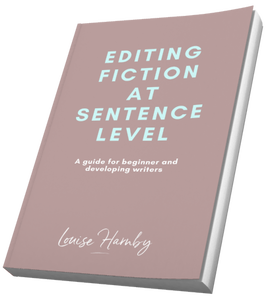
My own Editing Fiction at Sentence Level focuses on line craft that helps writers refine the flow, rhythm, mood, voice and style of their prose.
- community
- content
- craft books
- courses
- conscious language
Community
Take a look at the Alliance of Independent Authors (ALLi) and the Society of Authors. They’re two fine examples of organizations who are dedicated to supporting writers at different stages of their journey.
Membership includes access to free and affordable paid-for events and resources. But they offer something else that’s incredibly valuable too – a network of like-minded people.
Trying to make your mark in the publishing world can feel overwhelming, so being able to get advice and inspiration from others on the same journey is priceless.
Content
There’s a ton of useful – and free – guidance about the craft of writing online, so it’s worth budget-sensitive writers spending time digging around in the search engines. However, those interested in sentence-level guidance can visit my resource library as a first port of call.
I also recommend The Creative Penn, a superb knowledge bank through which Joanna Penn guides aspiring authors on how to write, how to get their books published and how to make their work visible. I love Joanna’s genuine and approachable teaching style, and how she makes self-publishing accessible to everyone.
Craft books
Books are the most affordable way I know of accessing high-quality guidance. There are lots – too many to mention here – but I recommend fiction writers start with The Magic of Fiction by Beth Hill because it pays attention to structure and helps writers create a great first draft.
My own Editing Fiction at Sentence Level focuses on line craft that helps writers refine the flow, rhythm, mood, voice and style of their prose.
For non-fiction writers, Andy Maslen’s Write to Sell is an excellent tool for any content creator who wants to craft a compelling message, something that’s critical for authors when they’re promoting their books.
And Joanna Penn’s How to Write Non-Fiction takes authors step by step through the whole book-creation process – from mindset to marketing and everything else in between.
Courses
Love learning at your own pace? Online courses are an affordable and convenient way to study in a multimedia environment.
There are lots to choose from. For starters, take a look at Joanna Penn’s business-focused author courses, and for craft-based tuition for fiction, try Narrative Distance: A Toolbox for Writers and Editors and Preparing Your Book for Submission, two courses from my own training stable.
The National Writing Centre also offers online training that aims to build authors’ confidence. Some of their courses are even free. The NWC also partners with the University of East Anglia to provide more in-depth premium creative-writing courses that come with tutor support.
Conscious language
Anyone who’s aware of the events surrounding Kate Clanchy’s Some Kids I Taught and What They Taught Me will understand the importance of reviewing their work through the lens of representation.
I’m not for a minute suggesting that a work of fiction or non-fiction has to follow a set of prescribed ‘rules’ about what can or can’t be written, but rather that writing means applying the same mindfulness to the words we put on a page as those that come out of our mouths.
When we write, we’re building a relationship with our readers, even though we don’t know who most of them are. And so consciously considering whether our words are helping or harming is just good human practice – one that means our books function as we intend them to, whether that’s to teach or to entertain.
For authors who want a little more guidance on this, I have a free booklet on inclusive and respectful writing. It doesn’t prescribe, just helps writers make informed decisions.
And Joanna Penn’s How to Write Non-Fiction takes authors step by step through the whole book-creation process – from mindset to marketing and everything else in between.
Courses
Love learning at your own pace? Online courses are an affordable and convenient way to study in a multimedia environment.
There are lots to choose from. For starters, take a look at Joanna Penn’s business-focused author courses, and for craft-based tuition for fiction, try Narrative Distance: A Toolbox for Writers and Editors and Preparing Your Book for Submission, two courses from my own training stable.
The National Writing Centre also offers online training that aims to build authors’ confidence. Some of their courses are even free. The NWC also partners with the University of East Anglia to provide more in-depth premium creative-writing courses that come with tutor support.
Conscious language
Anyone who’s aware of the events surrounding Kate Clanchy’s Some Kids I Taught and What They Taught Me will understand the importance of reviewing their work through the lens of representation.
I’m not for a minute suggesting that a work of fiction or non-fiction has to follow a set of prescribed ‘rules’ about what can or can’t be written, but rather that writing means applying the same mindfulness to the words we put on a page as those that come out of our mouths.
When we write, we’re building a relationship with our readers, even though we don’t know who most of them are. And so consciously considering whether our words are helping or harming is just good human practice – one that means our books function as we intend them to, whether that’s to teach or to entertain.
For authors who want a little more guidance on this, I have a free booklet on inclusive and respectful writing. It doesn’t prescribe, just helps writers make informed decisions.
3. Manage your first draft appropriately
The first draft isn’t usually something that should be sent to an editor. More often, the first draft is where the author lays down the story just as it comes.
Once that’s done, put the book away – just let it sit for a while – then revisit it and decide what’s working and what isn’t, what needs refining, amplifying or deleting.
Perhaps follow Sophie Hannah and Jeffery Deaver’s lead and create detailed outlines that help keep you on track even at first-draft stage. You can read more about Hannah’s method in ‘Why and how I plan my novels’.
If you do decide to work with an editor, invest time in finding someone who’s a great fit for you: someone who gets you and is engaged with what you’re doing with your writing.
That person should also be offering the right level of editing (see 1. Understand the different types of editing).
And tell them if you’re nervous about being edited; it’s perfectly normal to feel that way. Just bear in mind that they’re on your side and are working for you, for your book and for your reader!
Once that’s done, put the book away – just let it sit for a while – then revisit it and decide what’s working and what isn’t, what needs refining, amplifying or deleting.
Perhaps follow Sophie Hannah and Jeffery Deaver’s lead and create detailed outlines that help keep you on track even at first-draft stage. You can read more about Hannah’s method in ‘Why and how I plan my novels’.
If you do decide to work with an editor, invest time in finding someone who’s a great fit for you: someone who gets you and is engaged with what you’re doing with your writing.
That person should also be offering the right level of editing (see 1. Understand the different types of editing).
And tell them if you’re nervous about being edited; it’s perfectly normal to feel that way. Just bear in mind that they’re on your side and are working for you, for your book and for your reader!
4. Understand the difference between style, convention and peevery
I'm sometimes asked: 'What’s your biggest writing pet peeve as an editor?' My answer is: There’s no room for pet peeves in professional editing – or at least there shouldn’t be.
Do I have preferences? I do – everyone does – but that’s all they are and they have no business in the work that editors do for their clients. Our job is to focus on a client’s goals, the world of their story, and the readers who’ll come along for the journey.
There are stylistic and grammatical conventions in writing, and a professional editor should understand those and be mindful of them, but editing requires a malleable mindset that respects voice and rhythm as much as anything else.
It’s about sense and sensibility, not prescriptivism and pedantry.
Listen right here to this collection of episodes from The Editing Podcast on language, grammar and style:
Do I have preferences? I do – everyone does – but that’s all they are and they have no business in the work that editors do for their clients. Our job is to focus on a client’s goals, the world of their story, and the readers who’ll come along for the journey.
There are stylistic and grammatical conventions in writing, and a professional editor should understand those and be mindful of them, but editing requires a malleable mindset that respects voice and rhythm as much as anything else.
It’s about sense and sensibility, not prescriptivism and pedantry.
Listen right here to this collection of episodes from The Editing Podcast on language, grammar and style:
5. Recognize the pros and cons of being your own publisher
The main advantage of being an indie author is that you get to control everything.
The main disadvantage is … you get to control everything!
You’re the publisher as well as the writer, which means you decide which books to write and publish, what the cover will look like, which levels of editorial help to commission, which channels to distribute your book through, what the price will be, what formats the book will be available in, and how your promotion strategy will play out.
That’s a lot of work – work that costs you time and money. Publishers will do some of it for you. Still, that will come at a cost because you’ll be taking a royalty that’s likely lower than the return from selling direct.
Being your own publisher isn’t everyone’s wheelhouse, but for those who want to be in control, there’s never been a better time to wear that hat because of all the technical solutions available to authors.
Any writer can use Amazon. It’s the biggest bookstore on the planet. But you might want to sell direct via your website, too, because that’s your very own shop window.
Platforms like Payhip and BookFunnel have made that possible, and it’s made it easy … not just for you but for your customers too.
And for authors who are not only writing but also teaching about writing, there are multiple platforms that support that too – LearnDash (Wordpress plugin), LearnWorlds and Teachable for example.
The main disadvantage is … you get to control everything!
You’re the publisher as well as the writer, which means you decide which books to write and publish, what the cover will look like, which levels of editorial help to commission, which channels to distribute your book through, what the price will be, what formats the book will be available in, and how your promotion strategy will play out.
That’s a lot of work – work that costs you time and money. Publishers will do some of it for you. Still, that will come at a cost because you’ll be taking a royalty that’s likely lower than the return from selling direct.
Being your own publisher isn’t everyone’s wheelhouse, but for those who want to be in control, there’s never been a better time to wear that hat because of all the technical solutions available to authors.
Any writer can use Amazon. It’s the biggest bookstore on the planet. But you might want to sell direct via your website, too, because that’s your very own shop window.
Platforms like Payhip and BookFunnel have made that possible, and it’s made it easy … not just for you but for your customers too.
And for authors who are not only writing but also teaching about writing, there are multiple platforms that support that too – LearnDash (Wordpress plugin), LearnWorlds and Teachable for example.
6. Take control of cramped and communal work spaces
Having a dedicated work space means you're not shifting two large monitors and a hard drive off the dinner table every evening. For those working from home, having a place where your business ‘lives’ helps you separate writing from family life.
I realize that everyone’s situation is different, but I hope at least one of the following tips will speak to anyone trying to carve out a dedicated work space.
I realize that everyone’s situation is different, but I hope at least one of the following tips will speak to anyone trying to carve out a dedicated work space.
- Agree boundaries in shared spaces: Decide which part is yours and which is theirs, and respect that.
- Create boundaries in multifunctional spaces: Some writers have to work in a bedroom, kitchen or living room. If there’s enough space, fence off a corner with a panelled room divider. These can be pricey so an alternative is to install a rail and fashion a curtain from an old duvet cover or sheet.
- Use mobile desks in cramped spaces: Mobile desks are readily available online and are priced competitively so that even writers on a smaller budget can house a monitor, keyboard, mouse and hard drive. Complement with a storage trolley for your books and stationery. Wheel the whole lot into another room when required!
Summing up
There’s a lot to think about when you decide to become your own publisher – not just what you write but also who supports you during that process, the ways you’ll invest in developing your craft and how to manage the space in which your books are written.
You’re not alone. There’s a ton of help available to help you … whatever your budget and whatever subject or genre you’re writing in. These 6 tips barely scratch the surface, but I hope they at least inspire you to take the next steps of your indie-author journey with confidence.
You’re not alone. There’s a ton of help available to help you … whatever your budget and whatever subject or genre you’re writing in. These 6 tips barely scratch the surface, but I hope they at least inspire you to take the next steps of your indie-author journey with confidence.
Louise Harnby is a line editor, copyeditor and proofreader who specializes in working with crime, mystery, suspense and thriller writers.
She is an Advanced Professional Member of the Chartered Institute of Editing and Proofreading (CIEP), a member of ACES, a Partner Member of The Alliance of Independent Authors (ALLi), and co-hosts The Editing Podcast.
She is an Advanced Professional Member of the Chartered Institute of Editing and Proofreading (CIEP), a member of ACES, a Partner Member of The Alliance of Independent Authors (ALLi), and co-hosts The Editing Podcast.
- Get in touch: Louise Harnby | Fiction Editor & Proofreader
- Connect: Twitter at @LouiseHarnby, Facebook and LinkedIn
- Learn: Books and courses
- Discover: Resources for authors and editors
Find out what narrative distance is and why fiction editors and authors need to pay attention to it.
What’s in this post ...
- What is narrative distance?
- Are narrative distance and psychic distance the same thing?
- How is narrative distance related to narrative style?
- Why writers and editors need to learn about narrative distance
- Using a visual framework to understand narrative distance
- Related resources for you to dig into
What is narrative distance?
Narrative means story. It’s the part of a novel that isn’t dialogue.
A narrator is the person who tells the story. They can be a character in the book or an entity that stands outside it.
There can be multiple narrators in a book, too. That allows the author to present events from multiple perspectives.
‘Narrative distance’ describes the space between a novel’s narrator and the reader.
A narrator is the person who tells the story. They can be a character in the book or an entity that stands outside it.
There can be multiple narrators in a book, too. That allows the author to present events from multiple perspectives.
‘Narrative distance’ describes the space between a novel’s narrator and the reader.
- If we, as readers, feel deeply connected to the narrator and their experience of the fictional world they inhabit, narrative distance is tiny.
- If we feel dislocated from them, more like we’re looking out on the story’s landscape objectively, the narrative distance is wide.
Are narrative distance and psychic distance the same thing?
Yes, narrative distance and psychic distance are the same thing. Some writers and editors use one term, some the other. They’re interchangeable. Use whichever you feel comfortable with.
You might find one or other useful depending on what issues you’re dealing with when you’re writing or editing. I like the word ‘narrative’ because it reminds me what part of the prose I’m dealing with.
Then again, I sometimes use the word ‘psychic’ because it reminds me that although I’m dealing with fiction, and therefore something that’s not real, the narrator within that creative realm still has their own lived experience and a raft of emotions that come with that.
You might find one or other useful depending on what issues you’re dealing with when you’re writing or editing. I like the word ‘narrative’ because it reminds me what part of the prose I’m dealing with.
Then again, I sometimes use the word ‘psychic’ because it reminds me that although I’m dealing with fiction, and therefore something that’s not real, the narrator within that creative realm still has their own lived experience and a raft of emotions that come with that.
How is narrative distance related to narrative style?

Narrative style refers to the way in which the narrator offers their perspective. Common narrative styles include:
Each of those narrative styles come with a certain degree of distance between the narrator and the reader.
For example, first-person narrations always feel a little more intimate because the pronoun ‘I’ is used. Second-person narrations can feel equally intimate, but in a voyeuristic way.
Third-person narrations – and the pronouns that come with them – are what we’re used to using for those not being directly addressed, so in prose they naturally put space between readers and narrators using the third person.
When we move beyond a framework of narrative style and start to think specifically in terms of narrative distance, we’re able to analyse the effectiveness of prose in a more nuanced and flexible way.
- First-person limited
- Third-person limited
- Third-person objective
- Third-person omniscient
Each of those narrative styles come with a certain degree of distance between the narrator and the reader.
For example, first-person narrations always feel a little more intimate because the pronoun ‘I’ is used. Second-person narrations can feel equally intimate, but in a voyeuristic way.
Third-person narrations – and the pronouns that come with them – are what we’re used to using for those not being directly addressed, so in prose they naturally put space between readers and narrators using the third person.
When we move beyond a framework of narrative style and start to think specifically in terms of narrative distance, we’re able to analyse the effectiveness of prose in a more nuanced and flexible way.
Why writers and editors need to learn about narrative distance
Take a book off your shelf and read a couple of pages. Even though the entire section might be written in a single narrative style – for example, third-person limited, it’s likely that the narrative distance still changes.
Perhaps you’ve never noticed before, and if that’s the case, the author and their editor have done a great job because the movement is seamless.
If that movement is jarring and too obvious, it could be an indication that narrative distance isn’t being controlled sufficiently. Editors and writers who can recognize narrative distance and evaluate its effectiveness are better equipped to solve the problem, and justify their solutions.
Perhaps you’ve never noticed before, and if that’s the case, the author and their editor have done a great job because the movement is seamless.
If that movement is jarring and too obvious, it could be an indication that narrative distance isn’t being controlled sufficiently. Editors and writers who can recognize narrative distance and evaluate its effectiveness are better equipped to solve the problem, and justify their solutions.
Using a visual framework to understand narrative distance
Are you confused by narrative distance? Don’t worry – you’re not alone! It’s a complex topic. Even experienced line editors and authors can struggle to get their heads around it.
My solution was to structure my own learning as a visual framework. I presented that framework at the Chartered Institute of Editing and Proofreading’s annual conference in September 2021 and then for the Society of Authors in October 2021.
The framework I shared at those two events garnered fabulous reviews and convinced me to record a webinar that everyone could access.
Narrative Distance: A Toolbox for Writers and Editors is available now to anyone who wants to lift the curtain on narrative distance and use it to craft prose that offers a better reader experience.
Use the button below to find out what’s included in the course.
My solution was to structure my own learning as a visual framework. I presented that framework at the Chartered Institute of Editing and Proofreading’s annual conference in September 2021 and then for the Society of Authors in October 2021.
The framework I shared at those two events garnered fabulous reviews and convinced me to record a webinar that everyone could access.
Narrative Distance: A Toolbox for Writers and Editors is available now to anyone who wants to lift the curtain on narrative distance and use it to craft prose that offers a better reader experience.
Use the button below to find out what’s included in the course.
|
If you’re a CIEP member, don’t forget that you can save 20% on all my courses. Log in to Promoted courses · Louise Harnby’s online courses. Then enter the coupon code at my checkout.
|
|
Related resources for you to dig into
- Blog post: 7 reasons why I’m not the right editor for you
- Blog post: How to avoid repeating ‘I’ in first-person writing
- Blog post: How to show the emotions of non-viewpoint characters
- Blog post: What’s the difference between a viewpoint character and a protagonist?
- Book: Editing Fiction at Sentence Level
- Book: Making Sense of Point of View
- Course: How to Write the Perfect Fiction Editorial Report
- Course: Switching to Fiction
Louise Harnby is a line editor, copyeditor and proofreader who specializes in working with crime, mystery, suspense and thriller writers.
She is an Advanced Professional Member of the Chartered Institute of Editing and Proofreading (CIEP), a member of ACES, a Partner Member of The Alliance of Independent Authors (ALLi), and co-hosts The Editing Podcast.
She is an Advanced Professional Member of the Chartered Institute of Editing and Proofreading (CIEP), a member of ACES, a Partner Member of The Alliance of Independent Authors (ALLi), and co-hosts The Editing Podcast.
- Get in touch: Louise Harnby | Fiction Editor & Proofreader
- Connect: Twitter at @LouiseHarnby, Facebook and LinkedIn
- Learn: Books and courses
- Discover: Resources for authors and editors
Subversive copy editor Carol Saller offers yet more top tips on blogging for editors, proofreaders and writers! Join Carol, Louise and Denise on The Editing Podcast to find out more.
Listen to find out more about:
- In #1: Carol's blogging journey: The Subversive Copy Editor blog; Lingua Franca (for the Chronicle of Higher Education); Editor's Corner (for The Chicago Manual of Style); Fiction+ (for The Chicago Manual of Style)
- In #1: Blogging goals
- In #1: Coming up with ideas: two tips
- In #1: Blog promotion strategies
- In #2: Repurposing blog content
- In #2: Analytics, and how to avoid the rabbit hole
- In #3: Monetizing your blog
- In #3: Understanding the sales funnel
- In #3: Managing reader engagement
- In #3: Blogging trajectory: Deciding who to write for and when to stop
Related resources
- About Carol Saller
- Blogging for Business Growth (course)
- 'Blogging for writers' (Jane Friedman)
- But Can I Start a Sentence with “But”? (University of Chicago Press Editorial Staff)
- Content Chemistry (Andy Crestodina)
- 'Getting the Most from LinkedIn' (YouTube tutorial)
- 'Google Analytics Tutorial 2021 – Learn Google Analytics 4 (GA4) & Universal Analytics Step-By-Step' (YouTube tutorial)
- How to Build an Editorial Blog (book)
- 'How to promote your blog' (Blogging Wizard)
Music credit
‘Vivacity’ Kevin MacLeod (incompetech.com). Licensed under Creative Commons: By Attribution 3.0 License. http://creativecommons.org/licenses/by/3.0/
Louise Harnby is a line editor, copyeditor and proofreader who specializes in working with crime, mystery, suspense and thriller writers.
She is an Advanced Professional Member of the Chartered Institute of Editing and Proofreading (CIEP), a member of ACES, a Partner Member of The Alliance of Independent Authors (ALLi), and co-hosts The Editing Podcast.
She is an Advanced Professional Member of the Chartered Institute of Editing and Proofreading (CIEP), a member of ACES, a Partner Member of The Alliance of Independent Authors (ALLi), and co-hosts The Editing Podcast.
- Get in touch: Louise Harnby | Fiction Editor & Proofreader
- Connect: Twitter at @LouiseHarnby, Facebook and LinkedIn
- Learn: Books and courses
- Discover: Resources for authors and editors
Subversive copy editor Carol Saller offers more top tips on blogging for editors, proofreaders and writers! Join Carol, Louise and Denise on The Editing Podcast to find out more.
Listen to #2 to find out more about
- In #1: Carol's blogging journey: The Subversive Copy Editor blog; Lingua Franca (for the Chronicle of Higher Education); Editor's Corner (for The Chicago Manual of Style); Fiction+ (for The Chicago Manual of Style)
- In #1: Blogging goals
- In #1: Coming up with ideas: two tips
- In #1: Blog promotion strategies
- In #2: Repurposing blog content
- In #2: Analytics, and how to avoid the rabbit hole
- In #3: Monetizing your blog
- In #3: Understanding the sales funnel
- In #3: Managing reader engagement
- In #3: Blogging trajectory: Deciding who to write for and when to stop
Related resources
- About Carol Saller
- Blogging for Business Growth (course)
- 'Blogging for writers' (Jane Friedman)
- But Can I Start a Sentence with “But”? (University of Chicago Press Editorial Staff)
- Content Chemistry (Andy Crestodina)
- 'Getting the Most from LinkedIn' (YouTube tutorial)
- 'Google Analytics Tutorial 2021 – Learn Google Analytics 4 (GA4) & Universal Analytics Step-By-Step' (YouTube tutorial)
- How to Build an Editorial Blog (book)
- 'How to promote your blog' (Blogging Wizard)
Music credit
‘Vivacity’ Kevin MacLeod (incompetech.com). Licensed under Creative Commons: By Attribution 3.0 License. http://creativecommons.org/licenses/by/3.0/
Louise Harnby is a line editor, copyeditor and proofreader who specializes in working with crime, mystery, suspense and thriller writers.
She is an Advanced Professional Member of the Chartered Institute of Editing and Proofreading (CIEP), a member of ACES, a Partner Member of The Alliance of Independent Authors (ALLi), and co-hosts The Editing Podcast.
She is an Advanced Professional Member of the Chartered Institute of Editing and Proofreading (CIEP), a member of ACES, a Partner Member of The Alliance of Independent Authors (ALLi), and co-hosts The Editing Podcast.
- Get in touch: Louise Harnby | Fiction Editor & Proofreader
- Connect: Twitter at @LouiseHarnby, Facebook and LinkedIn
- Learn: Books and courses
- Discover: Resources for authors and editors
Subversive copy editor Carol Saller offers some top tips on blogging for editors, proofreaders and writers! Join Carol, Louise and Denise on The Editing Podcast to find out more.
Listen to #1 to find out more about
- Carol's blogging journey:
– The Subversive Copy Editor blog
– Lingua Franca (for the Chronicle of Higher Education)
– Editor's Corner (for The Chicago Manual of Style)
– Fiction+ (for The Chicago Manual of Style) - Blogging goals
- Coming up with ideas: two tips
- Blog promotion strategies
Related resources
- About Carol Saller
- Blogging for Business Growth (course)
- 'Blogging for writers' (Jane Friedman)
- But Can I Start a Sentence with “But”? (University of Chicago Press Editorial Staff)
- Content Chemistry (Andy Crestodina)
- 'Getting the Most from LinkedIn' (YouTube tutorial)
- 'Google Analytics Tutorial 2021 – Learn Google Analytics 4 (GA4) & Universal Analytics Step-By-Step' (YouTube tutorial)
- How to Build an Editorial Blog (book)
- 'How to promote your blog' (Blogging Wizard)
Music credit
‘Vivacity’ Kevin MacLeod (incompetech.com). Licensed under Creative Commons: By Attribution 3.0 License. http://creativecommons.org/licenses/by/3.0/
Louise Harnby is a line editor, copyeditor and proofreader who specializes in working with crime, mystery, suspense and thriller writers.
She is an Advanced Professional Member of the Chartered Institute of Editing and Proofreading (CIEP), a member of ACES, a Partner Member of The Alliance of Independent Authors (ALLi), and co-hosts The Editing Podcast.
She is an Advanced Professional Member of the Chartered Institute of Editing and Proofreading (CIEP), a member of ACES, a Partner Member of The Alliance of Independent Authors (ALLi), and co-hosts The Editing Podcast.
- Get in touch: Louise Harnby | Fiction Editor & Proofreader
- Connect: Twitter at @LouiseHarnby, Facebook and LinkedIn
- Learn: Books and courses
- Discover: Resources for authors and editors
Words are the professional editor’s business, yet the ones we use in the course of discussing how we apply our craft are all too often prescriptive.
This post looks at problematic language, the messages it might unintentionally convey, and how we can talk about the editorial conundrums we come across without judgement.
This post looks at problematic language, the messages it might unintentionally convey, and how we can talk about the editorial conundrums we come across without judgement.
Embedding the language of preference in editorial discussion
Most editors, however experienced, encounter conundrums in their work that lead to their seeking advice from colleagues. Too often, the language of prescription is used to frame questions:
The problem with notions such as ‘right’, ‘correct’ and ‘rule’ is that they’re loaded. The implication is that there’s one way – a best way – to write and to edit.
In reality, there are multiple ways to punctuate a sentence, each of which could alter its flow and rhythm in nuanced ways.
There are multiple Englishes, too, each with grammatical and syntactical structures that vary from region to region within nations as well as from country to country.
And there are multiple style guides that express particular preferences.
All of which means there is no ‘correct’ way to punctuate a sentence, no ‘right’ grammar, and no ‘rule’ on hyphenation. What there are instead are conventions and choices that that can be implemented or ignored.
Instead, we could ask:
The artistry of editing lies in helping the client craft prose in which the meaning is clear and interpreted as intended by readers. Embedding that principle – rather than the language of rights and rules – in the way we talk about our work means we’re more likely to think descriptively rather than prescriptively.
- ‘What’s the correct way to punctuate this sentence?’
- ‘Is the grammar in this sentence right?’
- ‘What’s APA’s rule for hyphenating [...]?’
The problem with notions such as ‘right’, ‘correct’ and ‘rule’ is that they’re loaded. The implication is that there’s one way – a best way – to write and to edit.
In reality, there are multiple ways to punctuate a sentence, each of which could alter its flow and rhythm in nuanced ways.
There are multiple Englishes, too, each with grammatical and syntactical structures that vary from region to region within nations as well as from country to country.
And there are multiple style guides that express particular preferences.
All of which means there is no ‘correct’ way to punctuate a sentence, no ‘right’ grammar, and no ‘rule’ on hyphenation. What there are instead are conventions and choices that that can be implemented or ignored.
Instead, we could ask:
- ‘How can I punctuate this sentence to convey urgency? The author’s used commas but I’m wondering if spaced en dashes would be effective.’
- ‘Is the grammar in this sentence distracting or is the sense clear? The narrator is from [...] but I’m not.’
- ‘What’s APA’s preference for hyphenating [...]?’
The artistry of editing lies in helping the client craft prose in which the meaning is clear and interpreted as intended by readers. Embedding that principle – rather than the language of rights and rules – in the way we talk about our work means we’re more likely to think descriptively rather than prescriptively.
Whose standards and conventions are in play?

There are myriad standards and conventions in language, ones that determine the following for example:
When we come across writing that doesn’t conform to these standards and conventions, some of us choose to refer instead to ‘non-standard’ language and ‘breaking from convention’ so as to avoid the judgement embodied in terms such as ‘right’, ‘best’, ‘correct’ and ‘rule’.
It’s been my preference because I felt it was more neutral and framed the issue around reader expectation rather than my own lived experience of language.
And that’s something I’ve been thinking about.
Why? Because these terms, too, need to be used with caution. We need to be aware that while standards and conventions help readers make sense of the written and spoken word, they are created and enforced by those with advantage, those who have the power to deem them as standard and conventional in the first place, and to assert their primacy.
That doesn’t make those standards and conventions better; it just means those who define them are in a position to do so. It also means that prose can be just as rich when those standards and conventions are ignored or flexed.
- How words are spelled in various Englishes
- How dialogue is punctuated
- Whether a term is hyphenated
- How apostrophes convey possession or omission
- Whether to place full points after contracted forms
- Whether the first paragraph in a section is indented or not
- The grammatical structure of a sentence
- How verbs are conjugated
When we come across writing that doesn’t conform to these standards and conventions, some of us choose to refer instead to ‘non-standard’ language and ‘breaking from convention’ so as to avoid the judgement embodied in terms such as ‘right’, ‘best’, ‘correct’ and ‘rule’.
It’s been my preference because I felt it was more neutral and framed the issue around reader expectation rather than my own lived experience of language.
And that’s something I’ve been thinking about.
Why? Because these terms, too, need to be used with caution. We need to be aware that while standards and conventions help readers make sense of the written and spoken word, they are created and enforced by those with advantage, those who have the power to deem them as standard and conventional in the first place, and to assert their primacy.
That doesn’t make those standards and conventions better; it just means those who define them are in a position to do so. It also means that prose can be just as rich when those standards and conventions are ignored or flexed.
What about style guides?
Individuals and organizations have preferences. For example, the Chartered Institute of Editing and Proofreading (CIEP), the University of Chicago Press and the American Psychological Association each have style guides that record their preferences for myriad stylistic decisions.
Mindful editing means remembering that these preferences aren’t ‘right’ or ‘better’. They’re certainly not rules. Even Oxford’s New Hart’s Rules isn’t a rulebook! Rather, these are useful guides that help editors and authors bring clarity and consistency to writing.
However, editors – particularly those working on creative texts – need to be ready to bend when character and narrative voice would be damaged by prescriptive application of a style guide.
As for those of us working on texts that deal with identity and representation, we need to be ready to question the advice in a published style guide; it might be behind the curve.
Mindful editing means remembering that these preferences aren’t ‘right’ or ‘better’. They’re certainly not rules. Even Oxford’s New Hart’s Rules isn’t a rulebook! Rather, these are useful guides that help editors and authors bring clarity and consistency to writing.
However, editors – particularly those working on creative texts – need to be ready to bend when character and narrative voice would be damaged by prescriptive application of a style guide.
As for those of us working on texts that deal with identity and representation, we need to be ready to question the advice in a published style guide; it might be behind the curve.
Transferring judgement to the client
If we use the language of ‘right/’wrong’, ‘correct’/’incorrect’ and even ‘standard’/’non-standard’ when we talk to other editors about our work, there’s a risk that this will leak into the way we convey solutions to our clients, even into the way we edit their work.
An author might not write in sentences that follow grammar, spelling and punctuation conventions, but that in no way means they’re a poor crafter of prose. Perhaps the way they lay down words is because they haven’t learned our conventions. Or perhaps they’ve actively chosen to ignore those conventions because that style of language doesn’t suit their character and narrative voices.
The mindful editor needs to recognize and respect both scenarios. Understanding which one is in play is critical because it will determine whether and which amendments are suggested, and why.
An author might not write in sentences that follow grammar, spelling and punctuation conventions, but that in no way means they’re a poor crafter of prose. Perhaps the way they lay down words is because they haven’t learned our conventions. Or perhaps they’ve actively chosen to ignore those conventions because that style of language doesn’t suit their character and narrative voices.
The mindful editor needs to recognize and respect both scenarios. Understanding which one is in play is critical because it will determine whether and which amendments are suggested, and why.
‘Wrong’, ‘non-standard’ or authentic voice?
Here’s an example that demonstrates how an author has chosen to craft a narrative that favours voice over ‘standard’ English now and then in order to reduce the distance between the narrator-protagonist and the reader.
These excerpts are from the opening chapter of Imran Mahmood’s You Don’t Know Me (pp 4–5; Penguin, 2017).
These excerpts are from the opening chapter of Imran Mahmood’s You Don’t Know Me (pp 4–5; Penguin, 2017).
|
I don’t mean it as joke ting, but like as a thing to shake you up. You never knew that I could speak like a professor is it? But I just wanted you to know that there’s more than just that one side to me that you lot saw when I was giving evidence.
[…] |
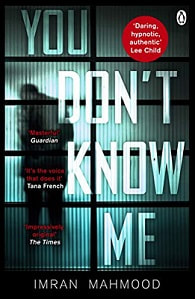
|
Like I’ll give you an example. You remember when I gave my evidence a couple of days back? Well that was one of them things we had opinions about. He wanted me to tell you what he called ‘plausible story’. ‘Give them what they need to hear,’ he goes to me. So I go to him, ‘Nah bruv, I want to give them what they don’ want to hear from me, the truth.’
[…]
He don’t know what I know. The problem for me was that although I know what I know, I don’t know what he knows. Do I let him speak to you in your language but telling only half the story, or do I do it myself and tell the full story with the risk that you won’t understand none of it?
[…]
He don’t know what I know. The problem for me was that although I know what I know, I don’t know what he knows. Do I let him speak to you in your language but telling only half the story, or do I do it myself and tell the full story with the risk that you won’t understand none of it?
Are the words I placed in bold ‘incorrect’ or ‘wrong’? That’s a judgemental approach that implies there’s a single perfect, right way to write and speak English. There isn’t.
Are the terms ‘non-standard’? To my ear, yes, some of them are, but that’s because I’m a 54-year-old middle-class white woman raised in Buckinghamshire, England, who was taught how to write and speak according to a standard dreamt up by … actually, I’m not sure who dreamt up the standard but it was probably someone who looked, spoke and was educated quite a lot like me and had the advantages I have.
Rather than thinking about these excerpts in terms of whether some of the words are non-standard or standard, instead we can evaluate them in terms of voice. Rich, evocative voice.
Our first-person narrator has been accused of murder and has elected to defend himself. As the blurb on the back cover says: ‘He now stands in the dock and wants to tell you the truth. He needs you to believe him. Will you?’
Actually, it’s his authentic voice that draws me – a 54-year-old middle-class white woman raised in Buckinghamshire, England – deep into his psyche so that I can see and hear him as if we are one. And that means I can root for him, invest in him, care about him, believe him.
Thinking about that narrative in terms of whether it’s ‘correct’ or ‘right’ would be butchery. To apply a digital red pen to it would be a crime.
And even those of us who might apply the term ‘non-standard’ to the emboldened words must acknowledge that such prescription is based purely on our own lived experience of English – how we write, how we speak, and what we were taught. That doesn’t make our way of speaking and writing better or worthier.
When story and characters drive language, readers will come along for the ride, regardless of their lived experience. When prescriptivism is behind the wheel, readers will disengage and find a different journey to take.
Framing errors in terms of author intention and reader expectation
An error is a mistake. We all make them when we’re writing – because we don’t know what the conventions are, because we’re focusing on meaning rather than mechanics, or because our fingers are typing so fast.
Regardless, the focus here is on intention, and for that reason there are times when it’s appropriate for the editor to use the term ‘error’.
When editors are tasked with finding errors, they’re looking for what wasn’t intended in that particular project. Take a look at these four examples:
We can say without judgement that there are four ‘errors’ in the above examples because in each case the author likely made a mistake – they meant to use a consistent style of speech marks in the first example, meant the pronouns to be consistent in the second, meant to use ‘they’re' in the third, and meant to use an alternative style for the nested quotation marks in the fourth.
When we’re querying potential errors, however, we can still use the language of intention and reader expectation in our comments, thereby avoiding a more critical tone:
Regardless, the focus here is on intention, and for that reason there are times when it’s appropriate for the editor to use the term ‘error’.
When editors are tasked with finding errors, they’re looking for what wasn’t intended in that particular project. Take a look at these four examples:
- “Are the autopsy results in yet?’ Milburn asked.
- Xe put xyr pen on the table and frowned. No way was he letting that one pass.
- She hears him clearly – banging on again about how their from out of town and don’t know their way around.
- ‘I wanted to call the police but Johnny ‘One Sock’ Swainston wasn’t having any of it.’
We can say without judgement that there are four ‘errors’ in the above examples because in each case the author likely made a mistake – they meant to use a consistent style of speech marks in the first example, meant the pronouns to be consistent in the second, meant to use ‘they’re' in the third, and meant to use an alternative style for the nested quotation marks in the fourth.
When we’re querying potential errors, however, we can still use the language of intention and reader expectation in our comments, thereby avoiding a more critical tone:
- Did you mean to write […] here or is this a typo?
- How about [...] instead? This would be less likely to distract the reader, who might be more used to seeing [...] and therefore misinterpret what you've written.
- The grammar in this section doesn’t align with your usual narrative voice, and reads more like something Character Y would say. Is this intentional? If not, how about trying [...]?
Summing up
As professional editors, we need to think about the language we use about language!
Instead, we can frame our discussions and queries around meaning, author intention and reader experience. That way, we’re putting the prose where it belongs – front and centre.
- Saying something’s ‘right’ might imply that all alternatives are wrong when they aren’t.
- Defining something as a ‘rule’ might imply that breaking it is non-conformist, eccentric, non-compliant, even disobedient.
- Referring to something as ‘standard’ normalizes the preferences of those who have the power to make that decision in the first place.
Instead, we can frame our discussions and queries around meaning, author intention and reader experience. That way, we’re putting the prose where it belongs – front and centre.
Louise Harnby is a line editor, copyeditor and proofreader who specializes in working with crime, mystery, suspense and thriller writers.
She is an Advanced Professional Member of the Chartered Institute of Editing and Proofreading (CIEP), a member of ACES, a Partner Member of The Alliance of Independent Authors (ALLi), and co-hosts The Editing Podcast.
She is an Advanced Professional Member of the Chartered Institute of Editing and Proofreading (CIEP), a member of ACES, a Partner Member of The Alliance of Independent Authors (ALLi), and co-hosts The Editing Podcast.
- Get in touch: Louise Harnby | Fiction Editor & Proofreader
- Connect: Twitter at @LouiseHarnby, Facebook and LinkedIn
- Learn: Books and courses
- Discover: Resources for authors and editors
Learn about romance editing with editor Sarah Calfee in this episode of The Editing Podcast!
Summary of Episode 76
- What's special about romance editing
- The size of the market
- Tropes, challenges and styles in romance editing
- HEAs: Happy ever afters
- Romancelandia
- Understanding the romance writing and editing via Pride and Prejudice
- How to get in touch with Sarah Calfee
- Get a free sample of Sarah's book, How To Pride and Prejudice
Music credit
‘Vivacity’ Kevin MacLeod (incompetech.com). Licensed under Creative Commons: By Attribution 3.0 License. http://creativecommons.org/licenses/by/3.0/
Louise Harnby is a line editor, copyeditor and proofreader who specializes in working with crime, mystery, suspense and thriller writers.
She is an Advanced Professional Member of the Chartered Institute of Editing and Proofreading (CIEP), a member of ACES, a Partner Member of The Alliance of Independent Authors (ALLi), and co-hosts The Editing Podcast.
She is an Advanced Professional Member of the Chartered Institute of Editing and Proofreading (CIEP), a member of ACES, a Partner Member of The Alliance of Independent Authors (ALLi), and co-hosts The Editing Podcast.
- Get in touch: Louise Harnby | Fiction Editor & Proofreader
- Connect: Twitter at @LouiseHarnby, Facebook and LinkedIn
- Learn: Books and courses
- Discover: Resources for authors and editors
Find out about 4 key things you need to know if you want to become a non-fiction editor. Louise Harnby interviews Denise Cowle!
Listen to find out more about
- The main types of non-fiction editing and the kinds of things a non-fic editor needs to look out for
- Working on complex materials
- The move to digital content and the role of the editor·
- Ethical issues the editor or proofreader needs to be aware of
- How to Mark Up PDF Page Proofs (course)
- How to become a fiction editor (podcast episode)
Music credit
‘Vivacity’ Kevin MacLeod (incompetech.com). Licensed under Creative Commons: By Attribution 3.0 License. http://creativecommons.org/licenses/by/3.0/
Louise Harnby is a line editor, copyeditor and proofreader who specializes in working with crime, mystery, suspense and thriller writers.
She is an Advanced Professional Member of the Chartered Institute of Editing and Proofreading (CIEP), a member of ACES, a Partner Member of The Alliance of Independent Authors (ALLi), and co-hosts The Editing Podcast.
She is an Advanced Professional Member of the Chartered Institute of Editing and Proofreading (CIEP), a member of ACES, a Partner Member of The Alliance of Independent Authors (ALLi), and co-hosts The Editing Podcast.
- Get in touch: Louise Harnby | Fiction Editor & Proofreader
- Connect: Twitter at @LouiseHarnby, Facebook and LinkedIn
- Learn: Books and courses
- Discover: Resources for authors and editors
Find out about 4 key things you need to know if you want to become a fiction editor. Denise Cowle puts Louise Harnby under the microscope!
Listen to find out more about
- The main types of fiction editing and the kinds of things a fiction editor needs to look out for
- What additional training you might need
- The market and client expectations
- The need for a flexible hand
- Becoming a fiction editor (free booklet)
- Switching to Fiction (course)
Music credit
‘Vivacity’ Kevin MacLeod (incompetech.com). Licensed under Creative Commons: By Attribution 3.0 License. http://creativecommons.org/licenses/by/3.0/
More fiction-skills resources
Check out these additional resources that will help you develop your fiction-editing business.
|
|
Louise Harnby is a line editor, copyeditor and proofreader who specializes in working with crime, mystery, suspense and thriller writers.
She is an Advanced Professional Member of the Chartered Institute of Editing and Proofreading (CIEP), a member of ACES, a Partner Member of The Alliance of Independent Authors (ALLi), and co-hosts The Editing Podcast.
She is an Advanced Professional Member of the Chartered Institute of Editing and Proofreading (CIEP), a member of ACES, a Partner Member of The Alliance of Independent Authors (ALLi), and co-hosts The Editing Podcast.
- Get in touch: Louise Harnby | Fiction Editor & Proofreader
- Connect: Twitter at @LouiseHarnby, Facebook and LinkedIn
- Learn: Books and courses
- Discover: Resources for authors and editors
Find out more about The Chicago Manual of Style for PerfectIt. Developer Daniel Heuman talks with Louise Harnby and Denise Cowle about the union of a 115-year-old style guide and advanced copyediting software technology, and how it will help you edit faster and better.
Listen to find out more about
- What The Chicago Manual of Style for PerfectIt is
- How much it costs
- How the union came about
- Full integration of CMOS into PerfectIt 5
- Why it's free to subscribers of both products
- What PerfectIt can and can't do
- Working with the CMOS team
- Favourite features that help editors learn
- Why CMOS is a style guide rather than a rule book
- How users can suggest additions
- Customizing the CMOS style sheet
- The Mac-user experience
- Accessing The Chicago Manual of Style for PerfectIt
Music credit
‘Vivacity’ Kevin MacLeod (incompetech.com). Licensed under Creative Commons: By Attribution 3.0 License. http://creativecommons.org/licenses/by/3.0/
More fiction-skills resources
|
Check out these additional resources that will help you develop your fiction-editing business.
|
|
Louise Harnby is a line editor, copyeditor and proofreader who specializes in working with crime, mystery, suspense and thriller writers.
She is an Advanced Professional Member of the Chartered Institute of Editing and Proofreading (CIEP), a member of ACES, a Partner Member of The Alliance of Independent Authors (ALLi), and co-hosts The Editing Podcast.
She is an Advanced Professional Member of the Chartered Institute of Editing and Proofreading (CIEP), a member of ACES, a Partner Member of The Alliance of Independent Authors (ALLi), and co-hosts The Editing Podcast.
- Get in touch: Louise Harnby | Fiction Editor & Proofreader
- Connect: Twitter at @LouiseHarnby, Facebook and LinkedIn
- Learn: Books and courses
- Discover: Resources for authors and editors
Do you use PerfectIt to find inconsistencies in a novel? Do you follow The Chicago Manual of Style? Now you can use both from a single platform! I might be in love. Here’s why.
What's in this post
- What is PerfectIt?
- What is The Chicago Manual of Style (CMOS)?
- What is The Chicago Manual of Style for PerfectIt?
- Beta testing on a novel
- Why the editor retains control
- How to customize The Chicago Manual of Style for PerfectIt
- Wow factor 1: CMOS learning at the editor’s fingertips
- Wow factor 2: Seamless access
- Wow factor 3: Shifting the burden of search
- What PerfectIt won't do
- How much does The Chicago Manual of Style for PerfectIt cost?
- How to unlock access to the CMOS style sheet
- My beta test: The verdict
- Where to get The Chicago Manual of Style for PerfectIt
What is PerfectIt?
PerfectIt is software developed by Intelligent Editing. It helps editors and authors check a Word document for:
I’ve been using PerfectIt since its first iteration and, for me, it’s a must-have. Not because the human brain isn’t able to handle the checks it carries out but because software can do it faster.
And that means I can spend more of my time (which is what my clients are paying for) helping authors craft a compelling story rather than hunting down important but small details.
In other words, PerfectIt does the heavy-lifting but lets me retain complete control of the changes being made.
- Consistency: eg spelling, capitalization, hyphenation, acronym definitions.
- Adherence to style preferences: eg how numbers are rendered, punctuation of lists, capitalization of titles, ize/ise suffixes.
I’ve been using PerfectIt since its first iteration and, for me, it’s a must-have. Not because the human brain isn’t able to handle the checks it carries out but because software can do it faster.
And that means I can spend more of my time (which is what my clients are paying for) helping authors craft a compelling story rather than hunting down important but small details.
In other words, PerfectIt does the heavy-lifting but lets me retain complete control of the changes being made.
What is The Chicago Manual of Style (CMOS)?
CMOS is a 115-year-old style guide published by The University of Chicago Press. For many editors, even those beyond US shores, it too is a must-have because of its mindful, sensible advice.
CMOS isn’t a rule book. It’s a manual of style preferences. And given that novel editing requires a flexible approach to grammar, spelling and punctuation – one that serves rhythm and voice first and foremost – many editors choose to customize its guidance, ignore some of it, or blend it with another style guide’s preferences.
CMOS’s strength lies in how comprehensive it is, and the fact that the online version is easy to search.
Even though fifty per cent of my clients write in British English, CMOS is still my go-to style guide because lots of its guidance can be universally applied. The rest I tweak to fit my authors’ needs.
CMOS isn’t a rule book. It’s a manual of style preferences. And given that novel editing requires a flexible approach to grammar, spelling and punctuation – one that serves rhythm and voice first and foremost – many editors choose to customize its guidance, ignore some of it, or blend it with another style guide’s preferences.
CMOS’s strength lies in how comprehensive it is, and the fact that the online version is easy to search.
Even though fifty per cent of my clients write in British English, CMOS is still my go-to style guide because lots of its guidance can be universally applied. The rest I tweak to fit my authors’ needs.
What is The Chicago Manual of Style for PerfectIt?
Until recently, these two editing staples were in my editing studio but sitting at different digital tables. But what if CMOS could be integrated into PerfectIt? Afterall, PerfectIt has lots of built-in style sheets – why not CMOS too?
It was a beautiful dream. Now it’s a beautiful reality.
The Chicago Manual of Style for PerfectIt is a brand-new product that comes free with PerfectIt 5, and I’ve been privileged to play with it. As I said, I might be in love.
It was a beautiful dream. Now it’s a beautiful reality.
The Chicago Manual of Style for PerfectIt is a brand-new product that comes free with PerfectIt 5, and I’ve been privileged to play with it. As I said, I might be in love.
Beta testing on a novel

I ran The Chicago Manual of Style for PerfectIt on a 65,000-word test document – a copy of a thriller written in British English.
Here’s what else you also need to know about my setup:
Here’s what else you also need to know about my setup:
- The CMOS style sheet sits within PerfectIt 5
- I have an existing subscription to CMOS Online and PerfectIt
- I work on a PC and my OS is Windows 10, so I run the Windows version of PerfectIt
- I use Microsoft 365, which means I’m always working in the latest edition of Microsoft Word
- I’m based in the UK but work for clients all over the world and in a variety of Englishes and styles.
Why the editor retains control
I chose to test a document written in British English style in order to illustrate the control editors and writers have over any changes PerfectIt suggests.
Just because we’re checking against the built-in CMOS style sheet, which has its own set of defined preferences, doesn’t mean we have to adhere to all of them.
For example, PerfectIt flagged up ‘amongst’. At the top of the Spelling Variations window you can see why: In American English, “among” is usually preferred to “amongst.”
Actually, that preference is common in British English too. But the instances flagged up here are dialogue, and the character who’s speaking would be more likely to use ‘amongst’. And so I elected to ignore the suggestion and click on the Next button.
Using The Chicago Manual of Style for PerfectIt therefore doesn’t force us to make inappropriate changes to a client’s work. The editor retains stylistic control.
Just because we’re checking against the built-in CMOS style sheet, which has its own set of defined preferences, doesn’t mean we have to adhere to all of them.
For example, PerfectIt flagged up ‘amongst’. At the top of the Spelling Variations window you can see why: In American English, “among” is usually preferred to “amongst.”
Actually, that preference is common in British English too. But the instances flagged up here are dialogue, and the character who’s speaking would be more likely to use ‘amongst’. And so I elected to ignore the suggestion and click on the Next button.
Using The Chicago Manual of Style for PerfectIt therefore doesn’t force us to make inappropriate changes to a client’s work. The editor retains stylistic control.
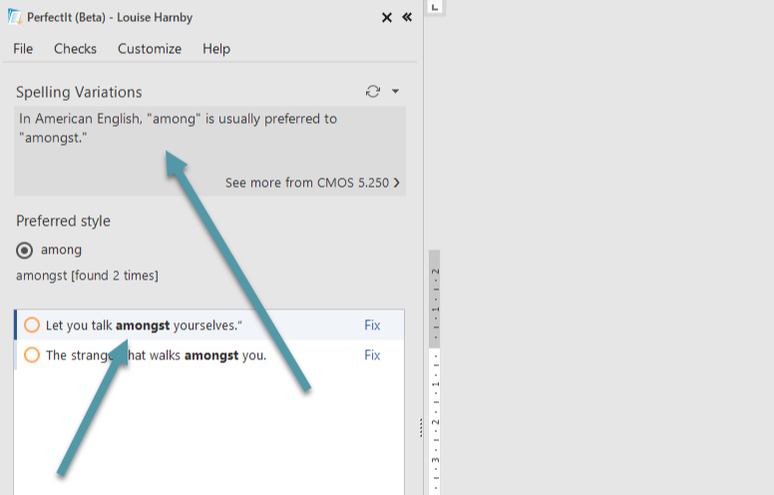
How to customize The Chicago Manual of Style for PerfectIt
I love CMOS’s good-sense guidance, and find much of it helpful for all of the crime fiction, thrillers and mysteries that pass over my desk.
However, half of those books are written in British English style, which means I want to access all the functionality of The Chicago Manual of Style for PerfectIt but tweaked for my own needs.
If spelling is all I’m worried about, a simple workaround is just to turn off PerfectIt’s Spelling Variations check. However, there are other customizations I usually like to do with novels in British English style in addition to spelling.
For me, the ability to customize PerfectIt has always been one of its biggest selling points. That flexibility is fantastic for any editor who regularly uses CMOS’s guidance but just as regularly needs to adapt key aspects of it.
We can’t amend built-in style sheets. What PerfectIt does instead is allow us to create a copy and amend that. Which is why I now have this little gem in the dropdown menu of available style sheets: Chicago Manual of Style LHUK.
However, half of those books are written in British English style, which means I want to access all the functionality of The Chicago Manual of Style for PerfectIt but tweaked for my own needs.
If spelling is all I’m worried about, a simple workaround is just to turn off PerfectIt’s Spelling Variations check. However, there are other customizations I usually like to do with novels in British English style in addition to spelling.
For me, the ability to customize PerfectIt has always been one of its biggest selling points. That flexibility is fantastic for any editor who regularly uses CMOS’s guidance but just as regularly needs to adapt key aspects of it.
We can’t amend built-in style sheets. What PerfectIt does instead is allow us to create a copy and amend that. Which is why I now have this little gem in the dropdown menu of available style sheets: Chicago Manual of Style LHUK.
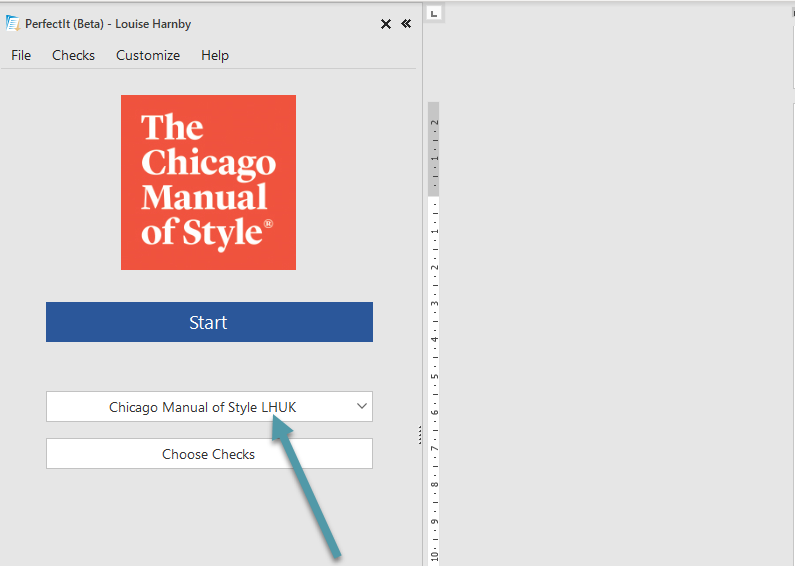
This is still CMOS, but CMOS for me and some of my clients! I’ve edited the copied style sheet so that now it has a different set of preferences:
- Yze and yse endings: preference set to 'Prefer 's'.
- Personal title format: preference set to Mrs, Mx etc.
- Hyphens next to spaces: preference set to convert to en dash.
- Percent symbol: preference set to open (per cent).
- Space around dashes: preference set to en dash with spaces.
I retained the following:
- Quotes with punctuation: preference left at 'final before quotation mark' (because in British English fiction dialogue, that’s the convention followed).
- Ize and ise endings: preference left at -ize (because -ize suffixes aren’t American English style. They’ve been used in British English for centuries and are favoured by many British publishers).
Wow factor 1: CMOS learning at the editor’s fingertips
With The Chicago Manual of Style for PerfectIt, editors can access the best features of both from one platform, which means we can learn CMOS’s style preferences in tandem with our consistency checking.
Yes, we’re running PerfectIt 5. And, yes, we’re able to set it to work to CMOS’s recommendations. That in itself is a gem.
But the wow factor is the advice that comes with it – that mindful guidance I mentioned above.
In the screenshot below, you can see what The Chicago Manual of Style for PerfectIt has flagged up: ‘long-time’ versus the preferred ‘longtime’. Now look at the comment above. This isn’t prescriptivism in play. Instead, we’re asked to ‘check carefully’ because of what Chicago ‘usually prefers’.
That’s a subtle but important reminder that regardless of whether we’re following CMOS or some other style guide, we’re dealing with preferences, not rules. This concept is foundational to professional editorial practice, and I’m pleased to see it shining through here.
Yes, we’re running PerfectIt 5. And, yes, we’re able to set it to work to CMOS’s recommendations. That in itself is a gem.
But the wow factor is the advice that comes with it – that mindful guidance I mentioned above.
In the screenshot below, you can see what The Chicago Manual of Style for PerfectIt has flagged up: ‘long-time’ versus the preferred ‘longtime’. Now look at the comment above. This isn’t prescriptivism in play. Instead, we’re asked to ‘check carefully’ because of what Chicago ‘usually prefers’.
That’s a subtle but important reminder that regardless of whether we’re following CMOS or some other style guide, we’re dealing with preferences, not rules. This concept is foundational to professional editorial practice, and I’m pleased to see it shining through here.
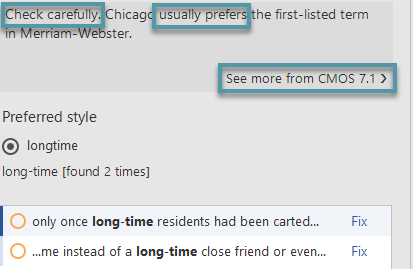
There’s more too. Perhaps we need additional information. Sure, we now know why this issue has been flagged up, but what if we want to verify that, just to be sure?
Perhaps we have to open our print or online dictionary after all. Not so. By clicking on ‘See more from CMOS 7.1 >’, we open another pane.
Within that pane are links not only to more detailed information from CMOS but also to the website of the external source cited, in this case Merriam Webster.com, which allows us to verify and learn if we want to.
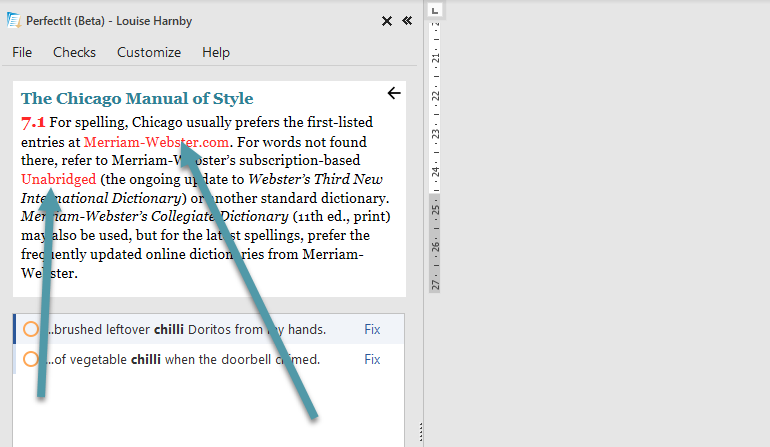
Or perhaps we want to explore the issue in more detail via our CMOS Online subscription. It’s right there in a clickable link.
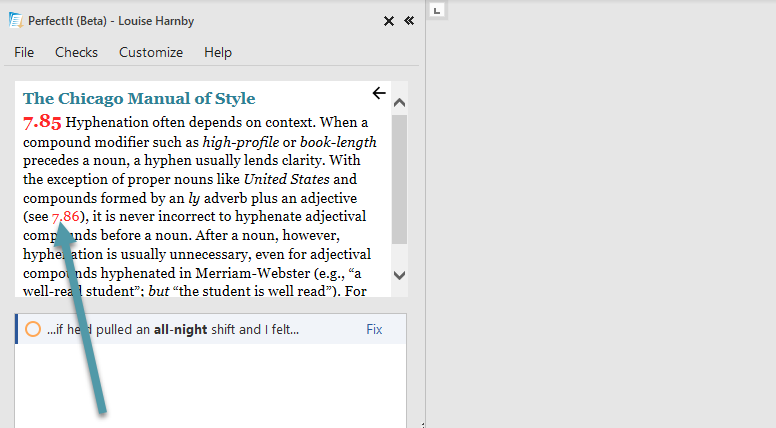
It’s seconds saved, but those seconds add up – fewer keystrokes and zero searching for where the solution to our problem lies. The Chicago Manual of Style for PerfectIt has done the heavy-lifting for us.
Wow factor 2: Seamless access

Editors often want quick access to information that enables us to develop our learning. Impatience and software aren’t always favourite cousins, and clicking through to external resources while a program’s in the middle of doing its thing is usually a no-no.
Would clicking through to CMOS Online or Merriam Webster.com in the middle of a PerfectIt run be too much? Would the software slow down, stall or even crash? Would that instant access to learning be more trouble that it was worth?
I’m delighted to report that the clickthroughs were seamless.
The nub of it is this. CMOS hasn’t been shoehorned in PerfectIt 5. It, and the external links built into it, are fully integrated. So when we want to access external content via those links, we can do so and be assured that the software will remain stable.
That’s a big plus for busy editors who want software that works without clunk
Would clicking through to CMOS Online or Merriam Webster.com in the middle of a PerfectIt run be too much? Would the software slow down, stall or even crash? Would that instant access to learning be more trouble that it was worth?
I’m delighted to report that the clickthroughs were seamless.
The nub of it is this. CMOS hasn’t been shoehorned in PerfectIt 5. It, and the external links built into it, are fully integrated. So when we want to access external content via those links, we can do so and be assured that the software will remain stable.
That’s a big plus for busy editors who want software that works without clunk
Wow factor 3: Shifting the burden of search
CMOS is comprehensive. Any editor who owns the print version knows just how comprehensive. The online version made finding solutions to problems easier. Integrating some of the core elements of style within PerfectIt 5 has taken things a stage further.
It comes down to who or what bears the burden of search. Ordinarily, the editor does. We spot a style-consistency issue, open up our reference source, check the preference and make a decision.
It comes down to who or what bears the burden of search. Ordinarily, the editor does. We spot a style-consistency issue, open up our reference source, check the preference and make a decision.
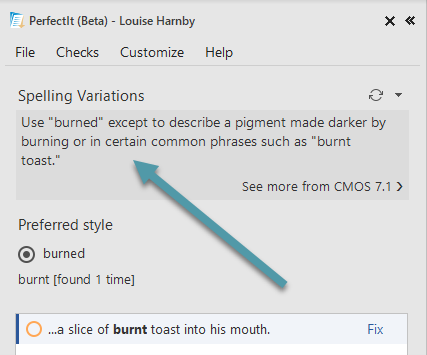
With this product, the burden shifts. Now The Chicago Manual of Style for PerfectIt is bearing some of the load. It’s spotting potential problems, suggesting the fix, explaining the reasoning behind that suggestion, and taking us to the exact place in one of the world’s premier style guides where deeper learning resides.
That’s a time-saver and a stress-reducer. No editor wants to spend time on searching for anything. Pro editors love to learn but none of us love struggling to find answers. After all, we’re paid to edit, not to search.
And so for those of us working to fixed project fees, time saved means a better hourly rate and a more profitable business.
What PerfectIt 5 won't do
I don’t expect my roofer to comment on the condition of my hair or how well my car’s running. Similarly, we mustn’t expect PerfectIt 5 to check our book files for problems it’s not designed to handle.
CMOS is huge, and there’s a ton of information in it that isn’t related to the kind of checks PerfectIt runs.
PerfectIt is a consistency checker, so if you want guidance on how to cite a reference according to CMOS or any other style guide, you’re still going to have to look it up.
Same thing if you’re wondering whether to place a comma between two independent clauses separated by coordinating conjunctions. CMOS has advice on this, but fiction editors will need to consider context and sentence rhythm too.
CMOS is huge, and there’s a ton of information in it that isn’t related to the kind of checks PerfectIt runs.
PerfectIt is a consistency checker, so if you want guidance on how to cite a reference according to CMOS or any other style guide, you’re still going to have to look it up.
Same thing if you’re wondering whether to place a comma between two independent clauses separated by coordinating conjunctions. CMOS has advice on this, but fiction editors will need to consider context and sentence rhythm too.
How much does it cost?

If you have a subscription to PerfectIt 4 and to CMOS Online, you’ll pay nothing. That’s right. Zero! You’ll automatically be upgraded to PerfectIt 5, which includes the CMOS style guide. Are you falling in love now?
You will have to grab the latest update from the Intelligent Editing website, but that’s always been the case.
So who needs to pay? If you have a subscription to one product but not the other, you’ll need to rectify that if you want to use The Chicago Manual of Style for PerfectIt.
You will have to grab the latest update from the Intelligent Editing website, but that’s always been the case.
So who needs to pay? If you have a subscription to one product but not the other, you’ll need to rectify that if you want to use The Chicago Manual of Style for PerfectIt.
How to unlock access to the CMOS style sheet
Once you’ve downloaded PerfectIt 5, you’ll see that CMOS is available in the dropdown list of styles. However, there’s one more step you’ll need to take before you can use it.
First, link your PerfectIt account to an active CMOS Online subscription. That will give you a new license key that unlocks The Chicago Manual of Style for PerfectIt.
First, link your PerfectIt account to an active CMOS Online subscription. That will give you a new license key that unlocks The Chicago Manual of Style for PerfectIt.
My beta test: The verdict

I love it. So should you buy it? If you already subscribe to PerfectIt and CMOS Online, you don’t need to spend a penny! All you need to do is link both accounts and unlock the features.
If you’re already using CMOS regularly, want to build your knowledge about the guide’s preferences, and check for consistency in line with CMOS within a seamless interface, yes, I recommend you invest in PerfectIt.
PerfectIt and CMOS are both trusted resources. This digital partnership will help all of us edit more confidently and mindfully.
If you’re already using CMOS regularly, want to build your knowledge about the guide’s preferences, and check for consistency in line with CMOS within a seamless interface, yes, I recommend you invest in PerfectIt.
PerfectIt and CMOS are both trusted resources. This digital partnership will help all of us edit more confidently and mindfully.
Where to get The Chicago Manual of Style for PerfectIt
Here's what to do:
And if you’ve bought one of my courses, there’s a discount code waiting for you on the course page.
Then let me know if you fall in love too!
- If all you need to do is link your existing subscriptions to PerfectIt and CMOS, sign in to your PerfectIt account and follow the instructions.
- If you want to buy PerfectIt for the first time, head over to the Intelligent Editing website.
And if you’ve bought one of my courses, there’s a discount code waiting for you on the course page.
Then let me know if you fall in love too!
Resources
Louise Harnby is a line editor, copyeditor and proofreader who specializes in working with crime, mystery, suspense and thriller writers.
She is an Advanced Professional Member of the Chartered Institute of Editing and Proofreading (CIEP), a member of ACES, a Partner Member of The Alliance of Independent Authors (ALLi), and co-hosts The Editing Podcast.
She is an Advanced Professional Member of the Chartered Institute of Editing and Proofreading (CIEP), a member of ACES, a Partner Member of The Alliance of Independent Authors (ALLi), and co-hosts The Editing Podcast.
- Get in touch: Louise Harnby | Fiction Editor & Proofreader
- Connect: Twitter at @LouiseHarnby, Facebook and LinkedIn
- Learn: Books and courses
- Discover: Resources for authors and editors
Find out what editorial style is, why it’s important, and how editors work to create, evaluate and enforce style.
Listen to find out more about
- What is style?
- The differences between rules, preferences and conventions
- Flexibility in fiction and non-fiction
- What is a style guide?
- Why style guides aren't rule books
- When editors need to respect tone, register, voice and brand identity
- What is a style sheet?
Music credit
‘Vivacity’ Kevin MacLeod (incompetech.com). Licensed under Creative Commons: By Attribution 3.0 License. http://creativecommons.org/licenses/by/3.0/
More editorial-skills resources
|
Check out these additional resources that will help you develop your fiction-editing business.
|
|
Louise Harnby is a line editor, copyeditor and proofreader who specializes in working with crime, mystery, suspense and thriller writers.
She is an Advanced Professional Member of the Chartered Institute of Editing and Proofreading (CIEP), a member of ACES, a Partner Member of The Alliance of Independent Authors (ALLi), and co-hosts The Editing Podcast.
She is an Advanced Professional Member of the Chartered Institute of Editing and Proofreading (CIEP), a member of ACES, a Partner Member of The Alliance of Independent Authors (ALLi), and co-hosts The Editing Podcast.
- Get in touch: Louise Harnby | Fiction Editor & Proofreader
- Connect: Twitter at @LouiseHarnby, Facebook and LinkedIn
- Learn: Books and courses
- Discover: Resources for authors and editors
Learn about why editing and proofreading training is necessary if you want to run a professional editorial practice. Louise Harnby and Denise Cowle talk skills!
Listen to find out more about
- The client's perspective
- Doing the job to industry-recognized standards
- The marketing benefits for the editor and proofreader
- How training forges a healthy business mindset
Music credit
‘Vivacity’ Kevin MacLeod (incompetech.com). Licensed under Creative Commons: By Attribution 3.0 License. http://creativecommons.org/licenses/by/3.0/
More business-skills resources
|
Check out these additional resources that will help you develop your fiction-editing business.
|
|
Louise Harnby is a line editor, copyeditor and proofreader who specializes in working with crime, mystery, suspense and thriller writers.
She is an Advanced Professional Member of the Chartered Institute of Editing and Proofreading (CIEP), a member of ACES, a Partner Member of The Alliance of Independent Authors (ALLi), and co-hosts The Editing Podcast.
She is an Advanced Professional Member of the Chartered Institute of Editing and Proofreading (CIEP), a member of ACES, a Partner Member of The Alliance of Independent Authors (ALLi), and co-hosts The Editing Podcast.
- Get in touch: Louise Harnby | Fiction Editor & Proofreader
- Connect: Twitter at @LouiseHarnby, Facebook and LinkedIn
- Learn: Books and courses
- Discover: Resources for authors and editors
6 months of editorial business marketing: Progress made and lessons learned (by Harriet Power)
16/7/2021
Editor Harriet Power discusses how moving from in-house to freelance editing meant upping her marketing game. Here's what she achieved in 6 months.
In this post
- What kickstarted the marketing focus
- Marketing activity #1: Website
- Marketing activity #2: Blogging
- Marketing activity #3: Creating a Reedsy profile
- Marketing activity #4: Social media
- Marketing activity #5: CIEP meetings
- Marketing activity #6: Emailing former contacts
- Marketing activity #7: Cold emails
- Marketing activity #8: Write Useful Books Slack group
- 6 months later: Has the marketing paid off?
- The plan for the next 6 months
- Lessons learned as a newbie marketer
What kickstarted the marketing focus
I’m not new to freelancing or editing – I spent 8 years working in-house for publishers like OUP and Pearson before going freelance 4 years ago.
However, I am new to marketing, because I spent the first 3 years of my freelance career coasting along on repeat work from a handful of former in-house contacts. That work dropped off in the summer of 2020 thanks to the pandemic.
I was happily distracted for a while by the arrival of our new lockdown puppy, but towards the end of the year I was still limping along on 2 or 3 days’ work a week. That prompted me to get serious for the first time about marketing my business.
At the start of this year I read Louise’s book Marketing Your Editing and Proofreading Business, which I thought was brilliant. Of course I’m hardly going to say otherwise here, but it’s still true; I skimmed through it again this week and although bits of it feel a little dated now (it was published in 2014), it’s packed full of useful advice and ideas.
The case studies and examples are really helpful, and I love the way it moves from overarching principles (‘put yourself in the customer’s shoes’) through to specific activities (‘cold email publishers’). I’d happily recommend it.
Six months ago my immediate goal was simply to get more work. My longer-term goal is to get better-paid work, and also to carve out a niche for myself in prescriptive nonfiction, which is a fairly new area for me.
After reading Louise’s book I ended up with a 5-page list of ideas. Here’s what I’ve achieved so far.
However, I am new to marketing, because I spent the first 3 years of my freelance career coasting along on repeat work from a handful of former in-house contacts. That work dropped off in the summer of 2020 thanks to the pandemic.
I was happily distracted for a while by the arrival of our new lockdown puppy, but towards the end of the year I was still limping along on 2 or 3 days’ work a week. That prompted me to get serious for the first time about marketing my business.
At the start of this year I read Louise’s book Marketing Your Editing and Proofreading Business, which I thought was brilliant. Of course I’m hardly going to say otherwise here, but it’s still true; I skimmed through it again this week and although bits of it feel a little dated now (it was published in 2014), it’s packed full of useful advice and ideas.
The case studies and examples are really helpful, and I love the way it moves from overarching principles (‘put yourself in the customer’s shoes’) through to specific activities (‘cold email publishers’). I’d happily recommend it.
Six months ago my immediate goal was simply to get more work. My longer-term goal is to get better-paid work, and also to carve out a niche for myself in prescriptive nonfiction, which is a fairly new area for me.
After reading Louise’s book I ended up with a 5-page list of ideas. Here’s what I’ve achieved so far.

Marketing activity #1: Website
I did a full revamp of my website at the end of 2019, but after reading Louise’s book I went back and completely redid the Services for authors page in an attempt to make it more useful/persuasive.
There's probably still too much text, but I’m pleased with the ‘editor’s creed’, a summary of the principles that guide my work (in marketing-speak these are my brand values).
I doubt these principles are unique to me, but I think stating them on my website helps fill out who I am as an editor. And at least one author has commented on how they liked my editing philosophy.
There's probably still too much text, but I’m pleased with the ‘editor’s creed’, a summary of the principles that guide my work (in marketing-speak these are my brand values).
I doubt these principles are unique to me, but I think stating them on my website helps fill out who I am as an editor. And at least one author has commented on how they liked my editing philosophy.
Marketing activity #2: Blogging
So far, I’m managing about one blog post a month. Anything more would be too much because blogging is a LOT of work, a point that Louise provides a nice big warning about in her book.
I’ve concentrated on developing two series, both with a target audience of nonfiction writers:
Books that work
Each post focuses on a well-received prescriptive nonfiction book and analyses why it’s done so well. I also invite the author to contribute their thoughts. My aim with this series is twofold:
The first in the series is available here: Books that work #1: Obviously Awesome by April Dunford.
Q&A on the editing process
Each post features an author whom I’ve worked with, but I’m hoping the series will be of interest to writers more generally. You can find the first post here: Q&A on the editing process with Dietmar Sternad.
I’ve concentrated on developing two series, both with a target audience of nonfiction writers:
Books that work
Each post focuses on a well-received prescriptive nonfiction book and analyses why it’s done so well. I also invite the author to contribute their thoughts. My aim with this series is twofold:
- To gradually expand my network of interesting people.
- To hold myself accountable in regard to continuing professional development (CPD)
The first in the series is available here: Books that work #1: Obviously Awesome by April Dunford.
Q&A on the editing process
Each post features an author whom I’ve worked with, but I’m hoping the series will be of interest to writers more generally. You can find the first post here: Q&A on the editing process with Dietmar Sternad.
Marketing activity #3: Creating a Reedsy profile
I was quite leery of Reedsy before I joined, but I’ve come around to it and think it’ll be a useful backstop whenever work quietens down. It’s certainly been a good way to get more work with nonfiction indie authors, particularly while I'm waiting for my website to generate leads.
So far I’ve completed two edits, including one for an author who’s just set up his own publishing company. He's commissioned me to work on two more books.
So far I’ve completed two edits, including one for an author who’s just set up his own publishing company. He's commissioned me to work on two more books.
Marketing activity #4: Social media
I’ve started using social media. I'm here on Twitter; say hello!
I’m also on LinkedIn. I have to admit I struggle with it – it’s very motivational, and a lot of posts (even the more personal ones) are either trying to teach a lesson or sell something. But I’m going to persevere for a bit longer, mainly because I know it’s an excellent place to connect with prescriptive nonfiction (i.e. business and self-help) writers.
I’m also on LinkedIn. I have to admit I struggle with it – it’s very motivational, and a lot of posts (even the more personal ones) are either trying to teach a lesson or sell something. But I’m going to persevere for a bit longer, mainly because I know it’s an excellent place to connect with prescriptive nonfiction (i.e. business and self-help) writers.

Marketing activity #5: CIEP meetings
I’ve also taken part in a few online CIEP meetings. As a complete introvert, I’m not someone who naturally enjoys Zoom meetings with strangers, and I need to make the effort to keep going with these.
However, I do appreciate getting to know fellow editors better because it’s lovely to meet others with the same professional focus as me. Plus, from a marketing perspective, once I’ve earned their trust, they might one day even consider referring work to me.
However, I do appreciate getting to know fellow editors better because it’s lovely to meet others with the same professional focus as me. Plus, from a marketing perspective, once I’ve earned their trust, they might one day even consider referring work to me.
Marketing activity #6: Emailing former contacts
I’ve emailed old in-house contacts (or contacts of contacts). I appreciate that this is a no-go if you’ve never worked in-house, but if you have then it definitely pays off.
Just one email along the lines of ‘Hey, I used to work at OUP for a different team – hopefully they can put in a good word for me. Can I help you at all?’ has led to a considerable amount of work this year.
Just one email along the lines of ‘Hey, I used to work at OUP for a different team – hopefully they can put in a good word for me. Can I help you at all?’ has led to a considerable amount of work this year.
Marketing activity #7: Cold emails
I expected the return on my round of cold emailing to be lower. However, I had nothing to lose so I gave it a try. And just a few months after I’d sent an email to a publisher, a new project landed on my desk.
Marketing activity #8: Write Useful Books Slack group
Write Useful Books is a brilliant craft book by Rob Fitzpatrick on how to write prescriptive nonfiction. The book comes with optional access to a Slack group.
I’ve offered free short beta reads for group members. To date, two writers have taken up my offer, and one of those beta reads has led to paid work.
Plus, it’s interesting to hang out with a bunch of nonfiction writers and see what questions they have about self-publishing.
I’ve offered free short beta reads for group members. To date, two writers have taken up my offer, and one of those beta reads has led to paid work.
Plus, it’s interesting to hang out with a bunch of nonfiction writers and see what questions they have about self-publishing.
6 months later: Has the marketing paid off?
I have to keep reminding myself that some of my marketing activities probably won’t bear fruit for months, maybe longer. I haven’t had a single person contact me through my website, for example.
But I’m now fully booked for the next 3 months, and starting to turn away work – a novel experience for me. And while some of that work is probably down to publishers getting over their initial pandemic jitters, I think the marketing has made a difference.
Where’s this work coming from? A lot is from the two publishers who gave me most of my work pre-Covid, although this workstream currently feels more secure because there are now three teams at OUP who might pass jobs my way, rather than one.
Most of the rest has is coming from Reedsy authors. I’ve also had some work from a new publisher who found me through the CIEP Directory of Editorial Services.
But I’m now fully booked for the next 3 months, and starting to turn away work – a novel experience for me. And while some of that work is probably down to publishers getting over their initial pandemic jitters, I think the marketing has made a difference.
Where’s this work coming from? A lot is from the two publishers who gave me most of my work pre-Covid, although this workstream currently feels more secure because there are now three teams at OUP who might pass jobs my way, rather than one.
Most of the rest has is coming from Reedsy authors. I’ve also had some work from a new publisher who found me through the CIEP Directory of Editorial Services.
The plan for the next 6 months
Here’s what I’d like to achieve over the next 6 months, time permitting:
- Engage more on Twitter and LinkedIn; connect with more writers, rather than just editors.
- Keep blogging, and do more guest blogging.
- Learn more about self-publishing and create content to help indie authors with their publishing journey.
- Set up a monthly mailing list. The main hurdle here is convincing myself that anyone would actually want to read it.
- Add a portfolio/testimonials page to my website. I’ve definitely got better at asking authors for testimonials since reading Louise’s book, and am slowly building up a nice bank of praise.
- Do some market research with nonfiction writers to find out how they go about finding an editor, what they look for in an editor, and what they most want help with.
- Design and create a PDF that I can send out to potential clients. It will include information on the different types of editing and the blog series I’m developing.
- Join an accountability group.
- Make more of an effort to join online meetups.
- Do another round of cold emailing to nonfiction publishers.

Lessons learned as a newbie marketer
Working through the time-sink
Marketing sometimes feels like a never-ending time-sink and it requires a lot of perseverance. There’s always more to do, and that makes it hard to switch off from it.
When it feels overwhelming (and that’s often the case now that I’m busier), it helps to follow Louise and Denise’s advice to think in ones: one blog post at a time, one LinkedIn post at a time, or even one tweet at a time.
I also try to remind myself that my business isn’t going to collapse just because I didn’t go on Twitter for a week.
On the upside, being proactive about strengthening my business is satisfying. And in the long run, I hope it will lead me to a point where I can charge enough to be able to work a little less.
CPD
I’m also enjoying the creative side of marketing. It’s fun coming up with ideas for content, and I’m enjoying the writing.
I’ve found that marketing goes hand in hand with CPD. It’s forced me to do more professional development so that I have something useful to say, and has helped me get over feelings of imposter syndrome.
Specializing
Specializing definitely helps. This is an idea that Louise promotes and I completely agree with it. Focusing my marketing efforts primarily on prescriptive nonfiction indie authors has given me direction and made the marketing more manageable.
Putting yourself in the customer’s shoes.
This is another lesson I learned from Louise’s book. I worked hard on this when tweaking my website, and it’s been a useful guiding principle in deciding what to tweet or post about.
The principle links well to the concept of specializing because you can only put yourself in the customer’s shoes when you’ve identified who that customer is.
Value-based pricing
Another concept from Louise’s book that struck a chord is thinking of how I can add value to my basic service of performing an edit – either in terms of how I market myself or what I can offer to the client.
This approach has helped shift my mindset such that I hope that in the future I’ll garner the confidence to charge more.
Say hi to interesting people
My own humble piece of advice would be to say hi to interesting people that you stumble across, even if this makes you feel a bit uncomfortable, or because it takes time to sit down and write an email, or because it’s just something you’d never normally do. (All of these things apply to me.) You never know where those connections might lead you.
I was very happy to stumble across Rob Fitzpatrick and join his Slack group, for example. Another interesting person I’ve become acquainted with recently is Francis Miller, who’s helping publishers and authors create nonfiction that’s easier to learn from. It’s also been lovely to gradually get to know some fellow editors.
For better or worse, I very much identify at heart with that saying ‘Don’t talk unless you can improve the silence’. This means I struggle with adding to the general noise of social media when much of the time it feels like talking for the sake of talking.
To some extent, it helps to think of the online version of me as a different persona. I try to post things that I believe will be useful or interesting. And, again, the CPD element of this work has helped to mitigate the sense of imposter syndrome.
Marketing sometimes feels like a never-ending time-sink and it requires a lot of perseverance. There’s always more to do, and that makes it hard to switch off from it.
When it feels overwhelming (and that’s often the case now that I’m busier), it helps to follow Louise and Denise’s advice to think in ones: one blog post at a time, one LinkedIn post at a time, or even one tweet at a time.
I also try to remind myself that my business isn’t going to collapse just because I didn’t go on Twitter for a week.
On the upside, being proactive about strengthening my business is satisfying. And in the long run, I hope it will lead me to a point where I can charge enough to be able to work a little less.
CPD
I’m also enjoying the creative side of marketing. It’s fun coming up with ideas for content, and I’m enjoying the writing.
I’ve found that marketing goes hand in hand with CPD. It’s forced me to do more professional development so that I have something useful to say, and has helped me get over feelings of imposter syndrome.
Specializing
Specializing definitely helps. This is an idea that Louise promotes and I completely agree with it. Focusing my marketing efforts primarily on prescriptive nonfiction indie authors has given me direction and made the marketing more manageable.
Putting yourself in the customer’s shoes.
This is another lesson I learned from Louise’s book. I worked hard on this when tweaking my website, and it’s been a useful guiding principle in deciding what to tweet or post about.
The principle links well to the concept of specializing because you can only put yourself in the customer’s shoes when you’ve identified who that customer is.
Value-based pricing
Another concept from Louise’s book that struck a chord is thinking of how I can add value to my basic service of performing an edit – either in terms of how I market myself or what I can offer to the client.
This approach has helped shift my mindset such that I hope that in the future I’ll garner the confidence to charge more.
Say hi to interesting people
My own humble piece of advice would be to say hi to interesting people that you stumble across, even if this makes you feel a bit uncomfortable, or because it takes time to sit down and write an email, or because it’s just something you’d never normally do. (All of these things apply to me.) You never know where those connections might lead you.
I was very happy to stumble across Rob Fitzpatrick and join his Slack group, for example. Another interesting person I’ve become acquainted with recently is Francis Miller, who’s helping publishers and authors create nonfiction that’s easier to learn from. It’s also been lovely to gradually get to know some fellow editors.
For better or worse, I very much identify at heart with that saying ‘Don’t talk unless you can improve the silence’. This means I struggle with adding to the general noise of social media when much of the time it feels like talking for the sake of talking.
To some extent, it helps to think of the online version of me as a different persona. I try to post things that I believe will be useful or interesting. And, again, the CPD element of this work has helped to mitigate the sense of imposter syndrome.

Summing up
If you want more interesting work, or better-paid work, or just more work, it makes sense to take marketing seriously.
Don’t worry about being late to the party – it took me over 3 years, after all. Instead, read Louise’s book. Think long term and keep chipping away at it. And say hello if you’d like to join me on the journey!
Don’t worry about being late to the party – it took me over 3 years, after all. Instead, read Louise’s book. Think long term and keep chipping away at it. And say hello if you’d like to join me on the journey!

|
ABOUT HARRIET
Harriet Power edits nonfiction books and educational materials for publishers and indie authors. She spent 8 years working in-house for educational publishers before going freelance in 2017. On the side, she performs in a folk music duo and enjoys walks with the lockdown puppy. |
Find out how to choose a name for your editing or proofreading business with Louise Harnby and Denise Cowle.
Listen to find out more about
- Brainstorming a list of possible business names
- Considering your target clients
- Identifying your core brand values
- Using a business name to tell the client what's on offer
- Checking the name is available
- Does the name reflect your brand identity?
- How findable and SEO-friendly is the name?
- Will the name stand the test of time?
Music credit
‘Vivacity’ Kevin MacLeod (incompetech.com). Licensed under Creative Commons: By Attribution 3.0 License. http://creativecommons.org/licenses/by/3.0/
More business-tips resources
|
Check out these additional resources that will help you make good decisions for your editorial business.
|
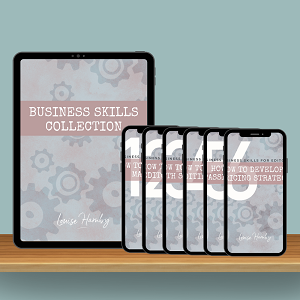
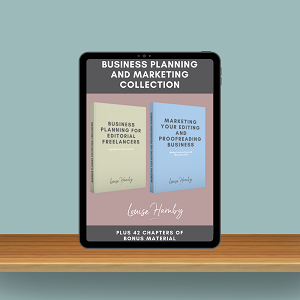
|
Louise Harnby is a line editor, copyeditor and proofreader who specializes in working with crime, mystery, suspense and thriller writers.
She is an Advanced Professional Member of the Chartered Institute of Editing and Proofreading (CIEP), a member of ACES, a Partner Member of The Alliance of Independent Authors (ALLi), and co-hosts The Editing Podcast.
She is an Advanced Professional Member of the Chartered Institute of Editing and Proofreading (CIEP), a member of ACES, a Partner Member of The Alliance of Independent Authors (ALLi), and co-hosts The Editing Podcast.
- Get in touch: Louise Harnby | Fiction Editor & Proofreader
- Connect: Twitter at @LouiseHarnby, Facebook and LinkedIn
- Learn: Books and courses
- Discover: Resources for authors and editors
Even if you don't specialize in your editorial practice, it's still worth using the language of specialism in your marketing. That's what Louise Harnby and Denise Cowle are chatting about in this episode of The Editing Podcast.
Listen to find out more about ...
- The different ways in which we might specialize
- Helping clients understand how we can help them
- What does the client want to know?
- Why saying we can edit 'everything' is a weak message
- Why the language of specialization is interesting
Music credit
‘Vivacity’ Kevin MacLeod (incompetech.com). Licensed under Creative Commons: By Attribution 3.0 License. http://creativecommons.org/licenses/by/3.0/
More business-growth tools
|
Discover more ways to get noticed by your ideal clients with this toolbox of resources:
|
|
Louise Harnby is a line editor, copyeditor and proofreader who specializes in working with crime, mystery, suspense and thriller writers.
She is an Advanced Professional Member of the Chartered Institute of Editing and Proofreading (CIEP), a member of ACES, a Partner Member of The Alliance of Independent Authors (ALLi), and co-hosts The Editing Podcast.
She is an Advanced Professional Member of the Chartered Institute of Editing and Proofreading (CIEP), a member of ACES, a Partner Member of The Alliance of Independent Authors (ALLi), and co-hosts The Editing Podcast.
- Get in touch: Louise Harnby | Fiction Editor & Proofreader
- Connect: Twitter at @LouiseHarnby, Facebook and LinkedIn
- Learn: Books and courses
- Discover: Resources for authors and editors
Louise Harnby and Denise Cowle talk about two more zombie rules that have no place in a professional editor's toolbox.
Listen to find out more about ...
- What a zombie rule is
- The power of a double negative in rich narrative and dialogue
- Why singular 'they' is a grammatically correct gender-neutral pronoun
Mentioned in the show
- Welcome, singular “they”: Lee, C. (2019, October 31). Welcome, singular “they”. APA Style. http://apastyle.apa.org/blog/singular-they
Music credit
‘Vivacity’ Kevin MacLeod (incompetech.com). Licensed under Creative Commons: By Attribution 3.0 License. http://creativecommons.org/licenses/by/3.0/
More grammar and line-craft resources
|
Learn about how to use grammar and punctuation to amplify prose rather than butchering it with a rule book.
|
|
Louise Harnby is a line editor, copyeditor and proofreader who specializes in working with crime, mystery, suspense and thriller writers.
She is an Advanced Professional Member of the Chartered Institute of Editing and Proofreading (CIEP), a member of ACES, a Partner Member of The Alliance of Independent Authors (ALLi), and co-hosts The Editing Podcast.
She is an Advanced Professional Member of the Chartered Institute of Editing and Proofreading (CIEP), a member of ACES, a Partner Member of The Alliance of Independent Authors (ALLi), and co-hosts The Editing Podcast.
- Get in touch: Louise Harnby | Fiction Editor & Proofreader
- Connect: Twitter at @LouiseHarnby, Facebook and LinkedIn
- Learn: Books and courses
- Discover: Resources for authors and editors
Louise Harnby and Denise Cowle share 3 more tips about how to beat the overwhelm that can come with making your editing and proofreading business visible.
Listen to find out more about ...
- Why everyone has something to shout about, even if they think they don't
- Why some editors appear to do more marketing that is humanly possible, and why that shouldn't deter you
- The tricks those busy editorial marketers have up their sleeve and how you can mimic them
- Managing marketing by thinking in ones
Music Credit
'Vivacity’ Kevin MacLeod (incompetech.com). Licensed under Creative Commons: By Attribution 3.0 License. http://creativecommons.org/licenses/by/3.0/
More help with marketing and being visible
|
Marketing can be learned! Here are some of my most popular teaching tools, all created specifically for editors and proofreaders working in a global freelance market.
|
|
Louise Harnby is a line editor, copyeditor and proofreader who specializes in working with crime, mystery, suspense and thriller writers.
She is an Advanced Professional Member of the Chartered Institute of Editing and Proofreading (CIEP), a member of ACES, a Partner Member of The Alliance of Independent Authors (ALLi), and co-hosts The Editing Podcast.
She is an Advanced Professional Member of the Chartered Institute of Editing and Proofreading (CIEP), a member of ACES, a Partner Member of The Alliance of Independent Authors (ALLi), and co-hosts The Editing Podcast.
- Get in touch: Louise Harnby | Fiction Editor & Proofreader
- Connect: Twitter at @LouiseHarnby, Facebook and LinkedIn
- Learn: Books and courses
- Discover: Resources for authors and editors
Here are three clutter checks you can carry out on your novel. Reviewing, and editing where appropriate, will help keep your crime fiction, thriller or mystery writing tight and engaging.
In this post ...
In this post, I look at the following ways of decluttering prose in commercial fiction:
- Clutter check #1: Reviewing filter words
- Clutter check #2: Reviewing speech tags
- Clutter check #3: Reviewing action beats
Clutter check #1: Review your filter words
Filter words are verbs that focus the reader’s gaze inwards on the senses a character is using to experience action with.
Too many filter words that explain this sensory behaviour in action can make prose feel told rather shown, and increase narrative distance.
Examples include ‘noticed’, ‘seemed’, ‘spotted’, ‘saw’, ‘realized’, ‘felt’, ‘thought’, ‘wondered’, ‘believed’, ‘knew’ and ‘decided’.
Removing them focuses the reader’s gaze outwards on what is being experienced.
Sometimes an author wants an inward focus, but it’s often the case that the reader will assume that an odour is being smelled, a view is being seen, a thought is being thought, and knowledge is being known.
Review your narrative and consider whether the removal of a filter word would make the prose shorter and more immersive.
Here are some examples:
Too many filter words that explain this sensory behaviour in action can make prose feel told rather shown, and increase narrative distance.
Examples include ‘noticed’, ‘seemed’, ‘spotted’, ‘saw’, ‘realized’, ‘felt’, ‘thought’, ‘wondered’, ‘believed’, ‘knew’ and ‘decided’.
Removing them focuses the reader’s gaze outwards on what is being experienced.
Sometimes an author wants an inward focus, but it’s often the case that the reader will assume that an odour is being smelled, a view is being seen, a thought is being thought, and knowledge is being known.
Review your narrative and consider whether the removal of a filter word would make the prose shorter and more immersive.
Here are some examples:
|
WITH FILTER
|
FILTER REMOVED
|
|
Danni knew there was a door in the back of the hut that led into the woods. She could make her escape there.
[Reader’s gaze focuses inwards on Danni’s doing the action of knowing.] |
There was a door in the back of the hut that led into the woods. She could make her escape there.
[Reader assumes it’s Danni doing the knowing since she’s the viewpoint character, and focuses outwards on the solution – the door.] |
|
The backdoor – it leads to the woods, Danni thought.
[Reader’s gaze focuses inwards on Danni’s doing the action of thinking.] |
The backdoor – it leads to the woods.
[Reader assumes the thought belongs to Danni, and focuses on the substance of the thought.] The backdoor – it led to the woods. [This alternative uses free indirect style; it frames the thought in the novel’s base tense and narrative style – third-person past.] |
|
He flung open the door and saw the gunman standing over by the window, rifle trained on the street below.
[Reader’s gaze focuses inwards on the man’s doing the action of seeing.] |
He flung open the door.
The gunman stood over by the window, rifle trained on the street below. [Reader assumes it’s the man doing the seeing since he’s the viewpoint character, and focuses outwards on the gunman.] |
Clutter check #2: Review speech tags
Great speech tags help the reader keep track of who’s speaking without drawing attention away from the dialogue.
Review your dialogue tags and consider the following:
If there are only two characters in a scene, it might be obvious who’s speaking, which gives the author space to introduce reminder nudges only now and then.
Review your dialogue tags and consider the following:
- Is the tag necessary?
- Is the tag taking centre stage?
- Is the tag illogical?
If there are only two characters in a scene, it might be obvious who’s speaking, which gives the author space to introduce reminder nudges only now and then.
|
ALL THE TAGS!
|
REDUCED TAGGING
|
|
‘There’s a door at the back of the hut,’ Danni said.
‘You’re sure it isn’t locked?’ I said. ‘No,’ she said. ‘Trish never locks it. Not since the fire.’ ‘And that’ll get us into the woods?’ I said. ‘Yup. There’s a track. It’s overgrown but I know the way. Used it all the time when I was young and foolish,’ she said. ‘What do you mean was?’ I said. ‘You’re too funny,’ she said, and pulled a face. |
‘There’s a door at the back of the hut,’ Danni said.
‘You’re sure it isn’t locked?’ ‘No. Trish never locks it. Not since the fire.’ ‘And that’ll get us into the woods?’ ‘Yup. There’s a track. It’s overgrown but I know the way. Used it all the time when I was young and foolish.’ ‘What do you mean was?’ I said. Danny pulled a face. ‘You’re too funny.’ |
‘Said’ is often best because it’s used so frequently in novels that it’s almost invisible. ‘Asked’ is also inoffensive when used to tag questions in dialogue. Others like ‘whispered’, ‘yelled’, ‘hissed’, ‘spat’ and ‘barked’ can be useful when used sparingly to convey volume and mood.
Showy speech tags scream their presence from the page, and shift the reader’s attention away from the dialogue and onto the tag. They often tell what the dialogue’s already shown, and indicate a lack of trust in the reader to get the speech. Examples include ‘exclaimed’, ‘opined’, ‘commanded’
Showy speech tags scream their presence from the page, and shift the reader’s attention away from the dialogue and onto the tag. They often tell what the dialogue’s already shown, and indicate a lack of trust in the reader to get the speech. Examples include ‘exclaimed’, ‘opined’, ‘commanded’
|
TAG TAKES CENTRE STAGE
|
DIALOGUE TAKES CENTRE STAGE
|
|
‘Watch out!’ Danni warned.
|
‘Watch out!’ Danni said.
|
|
‘Yup. There’s a track. It’s overgrown but I know the way. Used it all the time when I was young and foolish.’
‘What do you mean was?’ I joked. |
‘Yup. There’s a track. It’s overgrown but I know the way. Used it all the time when I was young and foolish.’
‘What do you mean was? |
Facial expressions used as tags need special care. Examples include ‘laughed’, ‘smiled’, ‘grimaced’ and ‘sneered’. These are best recast as action beats or replaced with simpler speech tags.
|
EXPRESSION TAG
|
ACTION BEAT
|
|
‘No,’ Danni grimaced. ‘Trish never locks it. Not since the fire.’
|
‘No.’ Danni grimaced. ‘Trish never locks it. Not since the fire.’
|
|
EXPRESSION TAG
|
SPEECH TAG
|
|
‘Yup. There’s a track. It’s overgrown but I know the way. Used it all the time when I was young and foolish.’
‘What do you mean was?’ I laughed. |
‘Yup. There’s a track. It’s overgrown but I know the way. Used it all the time when I was young and foolish.’
‘What do you mean was?’ I said. |
Removing redundant tags will reduce your word count. Recasting showy and illogical tags won’t, but your prose will still be more immersive.
Clutter check #3: Review action beats
Action beats are short descriptions that come before, between or just after dialogue. They ground speech in the characters’ environment and can be effective alternatives to speech tags.
They key to effective use is ensuring they amplify dialogue rather than interrupt it.
Think about movies. On the screen, all the actors movements and gestures are visible. Replicating this detail in a novel can be invasive and pull the reader away from what’s being unveiled through the speech.
While action beats are superb backdoors into the emotional space of non-viewpoint characters, the dialogue should be where the main action is taking place. If it’s not, what might be required is a reworking of the dialogue, not the introduction of more action beats.
Instead of mimicking the screen experience, use action beats to show what the dialogue doesn’t convey. That needn’t mean including them with every turn. Great dialogue doesn’t need to be anchored every time a character opens their mouth. A purposeful nudge now and then will be enough.
Watch out in particular for prose that’s overloaded with mundane action beats – legs stretching, fingers raking through hair, raised eyebrows, arms folding, fingers steepling.
Review your action beats:
Getting rid of the dull and redundant ones will reduce your word count. And what’s left on the page will be more engaging.
They key to effective use is ensuring they amplify dialogue rather than interrupt it.
Think about movies. On the screen, all the actors movements and gestures are visible. Replicating this detail in a novel can be invasive and pull the reader away from what’s being unveiled through the speech.
While action beats are superb backdoors into the emotional space of non-viewpoint characters, the dialogue should be where the main action is taking place. If it’s not, what might be required is a reworking of the dialogue, not the introduction of more action beats.
Instead of mimicking the screen experience, use action beats to show what the dialogue doesn’t convey. That needn’t mean including them with every turn. Great dialogue doesn’t need to be anchored every time a character opens their mouth. A purposeful nudge now and then will be enough.
Watch out in particular for prose that’s overloaded with mundane action beats – legs stretching, fingers raking through hair, raised eyebrows, arms folding, fingers steepling.
Review your action beats:
- Do they tell the reader something the dialogue doesn’t or are they mundane details that a reader could imagine?
- Are they infrequent nudges or are they littering the dialogue at every turn of speech?
- Could the mood conveyed by the action beat be conveyed better by improving the dialogue?
Getting rid of the dull and redundant ones will reduce your word count. And what’s left on the page will be more engaging.
|
ACTION BEATS THAT INTERRUPT DIALOGUE
|
ACTION BEATS THAT AMPLIFY DIALOGUE
|
|
Danni pointed at the back of the cellar. ‘Over there. The door. It leads to the woods.’
‘You’re sure it isn’t locked?’ Max rubbed his forehead. ‘Maybe we need a Plan B.’ ‘No.’ Her brow furrowed. ‘Trish never locks it. Not since the fire.’ Max tilted his head. ‘The fire? What happened?’ ‘It was years ago.’ She waved his question away and jabbed a finger towards the door again. ‘Out back there’s a track. It’s overgrown but I know the way. Used it all the time when I was young and foolish.’ ‘What do you mean was?’ he said, and smirked. She pulled a face. ‘You’re too funny.’ |
Danni pointed at the back of the cellar. ‘Over there. The door. It leads to the woods.’
‘You’re sure it isn’t locked?’ Max said. ‘I dunno, maybe we need a Plan B.’ ‘No. Trish never locks it. Not since the fire.’ ‘The fire? What—’ ‘It was years ago. Whatever. Focus. Out back there’s a track. It’s overgrown but I know the way. Used it all the time when I was young and foolish.’ ‘What do you mean was?’ She pulled a face. ‘You’re too funny.’ |
Summing up
There’s nothing wrong with the filter words, speech tags and actions beats. They’re useful tools when they help a reader make sense of the story.
However, if they’re mundane or interruptive clutter that can be assumed, leave them out so we can focus on the words that really matter.
However, if they’re mundane or interruptive clutter that can be assumed, leave them out so we can focus on the words that really matter.
Related reading
- 3 reasons to use free indirect speech in your crime fiction
- Author writing resources
- Becoming a Fiction Editor (free booklet for editors)
- Dialogue tags and how to use them in fiction writing
- Editing Fiction at Sentence Level (book for editors and authors)
- Filter words in fiction
- Making Sense of ‘Show, Don’t Tell’ (book for editors and authors)
- Switching to Fiction (course for editors)
- Tips on lean writing
- What are action beats and how can you use them in fiction writing?
Louise Harnby is a line editor, copyeditor and proofreader who specializes in working with crime, mystery, suspense and thriller writers.
She is an Advanced Professional Member of the Chartered Institute of Editing and Proofreading (CIEP), a member of ACES, a Partner Member of The Alliance of Independent Authors (ALLi), and co-hosts The Editing Podcast.
She is an Advanced Professional Member of the Chartered Institute of Editing and Proofreading (CIEP), a member of ACES, a Partner Member of The Alliance of Independent Authors (ALLi), and co-hosts The Editing Podcast.
- Get in touch: Louise Harnby | Fiction Editor & Proofreader
- Connect: Twitter at @LouiseHarnby, Facebook and LinkedIn
- Learn: Books and courses
- Discover: Resources for authors and editors

PDF MARKUP

AUTHOR RESOURCES
EDITOR RESOURCES
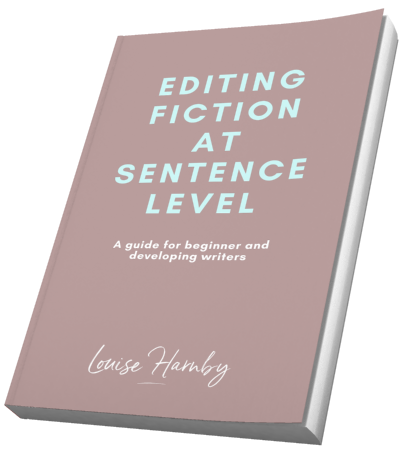
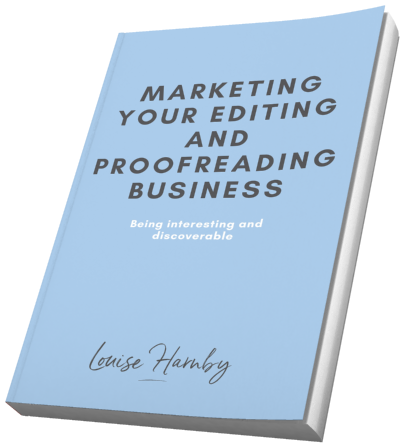
TESTIMONIALS
Dare Rogers
'Louise uses her expertise to hone a story until it's razor sharp, while still allowing the author’s voice to remain dominant.'
Jeff Carson
'I wholeheartedly recommend her services ... Just don’t hire her when I need her.'
J B Turner
'Sincere thanks for a beautiful and elegant piece of work. First class.'
Ayshe Gemedzhy
'What makes her stand out and shine is her ability to immerse herself in your story.'
Salt Publishing
'A million thanks – your mark-up is perfect, as always.'
CATEGORIES
All
Around The World
Audio Books
Author Chat
Author Interviews
Author Platform
Author Resources
Blogging
Book Marketing
Books
Branding
Business Tips
Choosing An Editor
Client Talk
Conscious Language
Core Editorial Skills
Crime Writing
Design And Layout
Dialogue
Editing
Editorial Tips
Editorial Tools
Editors On The Blog
Erotica
Fiction
Fiction Editing
Freelancing
Free Stuff
Getting Noticed
Getting Work
Grammar Links
Guest Writers
Indexing
Indie Authors
Lean Writing
Line Craft
Link Of The Week
Macro Chat
Marketing Tips
Money Talk
Mood And Rhythm
More Macros And Add Ins
Networking
Online Courses
PDF Markup
Podcasting
POV
Proofreading
Proofreading Marks
Publishing
Punctuation
Q&A With Louise
Resources
Roundups
Self Editing
Self Publishing Authors
Sentence Editing
Showing And Telling
Software
Stamps
Starting Out
Story Craft
The Editing Podcast
Training
Types Of Editing
Using Word
Website Tips
Work Choices
Working Onscreen
Working Smart
Writer Resources
Writing
Writing Tips
Writing Tools
ARCHIVES
April 2024
March 2024
October 2023
August 2023
July 2023
June 2023
May 2023
April 2023
March 2023
January 2023
December 2022
November 2022
October 2022
September 2022
August 2022
July 2022
June 2022
May 2022
April 2022
March 2022
February 2022
January 2022
December 2021
November 2021
October 2021
September 2021
August 2021
July 2021
June 2021
May 2021
April 2021
March 2021
February 2021
January 2021
December 2020
November 2020
October 2020
September 2020
August 2020
July 2020
June 2020
May 2020
April 2020
March 2020
February 2020
January 2020
December 2019
November 2019
October 2019
September 2019
August 2019
July 2019
June 2019
May 2019
April 2019
March 2019
February 2019
January 2019
December 2018
November 2018
October 2018
September 2018
August 2018
July 2018
June 2018
May 2018
April 2018
March 2018
February 2018
January 2018
December 2017
November 2017
October 2017
September 2017
August 2017
July 2017
June 2017
May 2017
April 2017
March 2017
February 2017
January 2017
December 2016
November 2016
October 2016
September 2016
June 2016
May 2016
April 2016
March 2016
February 2016
January 2016
December 2015
November 2015
October 2015
September 2015
July 2015
June 2015
May 2015
March 2015
February 2015
January 2015
November 2014
October 2014
September 2014
August 2014
July 2014
June 2014
March 2014
January 2014
November 2013
October 2013
September 2013
August 2013
June 2013
February 2013
January 2013
November 2012
October 2012
September 2012
August 2012
July 2012
June 2012
May 2012
April 2012
March 2012
February 2012
January 2012
December 2011
 RSS Feed
 |

|

|

|

|
|
|
|

© 2011–2024 Louise Harnby